BaaS vs Building Custom Blockchain: Which Approach Wins for Your Business?
 Mar, 5 2026
When companies first hear about blockchain, they often think: build it ourselves or use a service. It sounds simple. But the choice between Blockchain as a Service (BaaS) and building a custom blockchain isn’t about tech specs alone-it’s about your business goals, your budget, and how much control you really need.
Let’s cut through the noise. If you’re trying to track shipments, verify documents, or automate payments without reinventing the wheel, BaaS might be your best bet. But if you’re handling sensitive health data, managing high-frequency financial trades, or need to meet strict compliance rules like HIPAA or GDPR? You might be better off building from scratch. The truth? Most companies don’t need to build their own blockchain. And most that do, regret it.
What Is Blockchain as a Service (BaaS)?
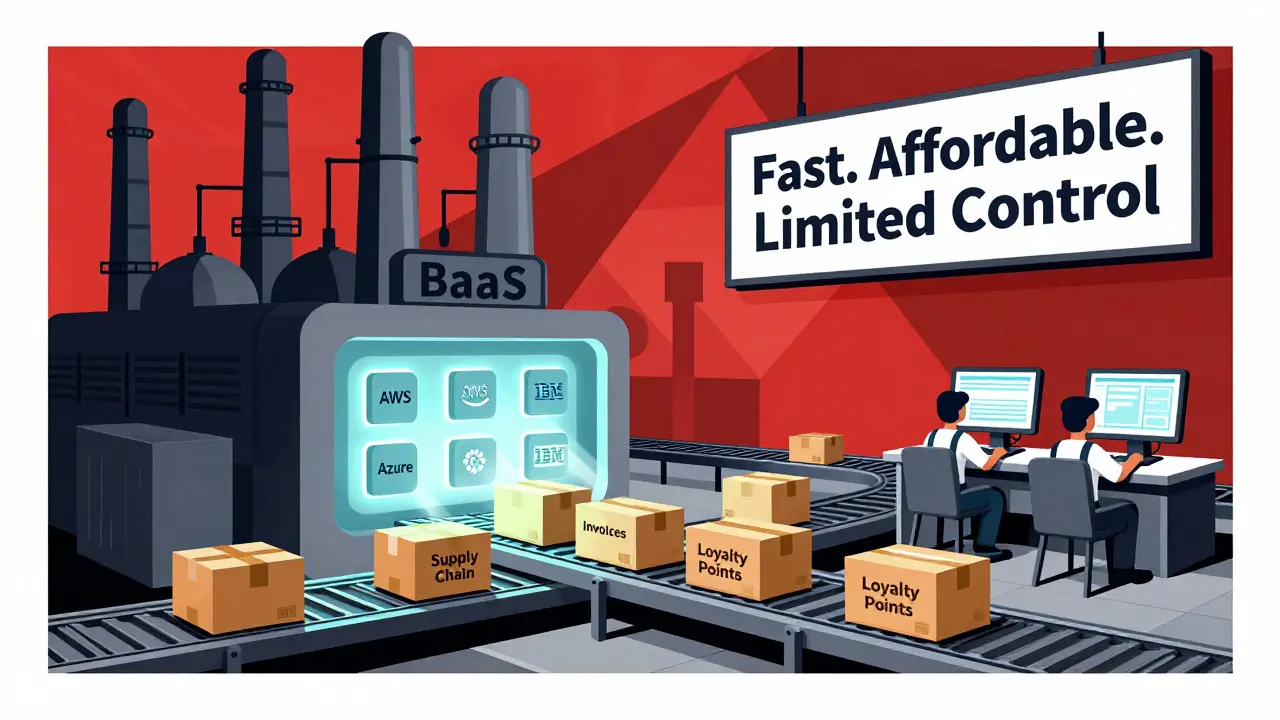
BaaS is like renting a fully built blockchain. Instead of hiring cryptographers, setting up servers, and debugging consensus protocols, you sign up with a cloud provider-like AWS, Microsoft Azure, or IBM-and get a ready-to-use blockchain network. Think of it as getting a pre-configured car instead of building one from engine parts.
These platforms handle everything: node management, network security, updates, and scaling. You focus on writing smart contracts and connecting your apps. AWS Managed Blockchain lets you spin up a Hyperledger Fabric network in minutes. Azure Blockchain Service auto-scales to handle 10,000 concurrent users. IBM’s platform includes pre-built templates for supply chain, trade finance, and identity management.
And the numbers back it up. According to Gartner’s 2024 report, 68% of enterprises looking at blockchain started with BaaS. Why? Because it cuts costs. Debut Infotech’s 2024 analysis found BaaS reduces initial investment by 65-80%. You pay as you go: as low as $0.50 per hour for a basic node, up to $15,000/month for enterprise-grade setups. No need to hire a team of blockchain engineers. No upfront hardware costs. No months of development.
When Custom Blockchain Makes Sense
Building your own blockchain isn’t for everyone. It’s expensive, slow, and risky. But for some industries, it’s the only option.
Take healthcare. A consortium of hospitals in the U.S. needed to share patient records across state lines while staying compliant with HIPAA. Standard BaaS platforms couldn’t handle the encryption requirements or audit trails they needed. So they built a custom blockchain. The result? A system that automatically logs every access, encrypts data at the field level, and blocks unauthorized queries-all while meeting federal compliance rules. It cost $380,000 to build. But it saved them $1.2 million a year in compliance fines and legal fees.
Finance is another area where custom matters. High-frequency trading firms need microsecond-level control over transaction order and execution. BaaS platforms use generic consensus algorithms like Proof-of-Authority. But one trading firm we studied replaced theirs with a custom algorithm that reduced latency by 40%. They achieved 15,000 transactions per second-far beyond what Azure or AWS could offer out of the box.
Custom blockchains let you design everything: how data is stored, how nodes communicate, how consensus is reached, even how upgrades happen. You can embed regulatory logic directly into the code. You can create private sub-chains for different departments. You can integrate with legacy systems in ways no off-the-shelf platform allows.
But here’s the catch: it takes time. PixelPlex’s 2024 analysis showed custom blockchains take 6-9 months to build. You need experts in cryptography, distributed systems, and smart contract security. And if you mess up? You’re on your own.
Cost Comparison: Upfront Investment vs Long-Term Spend
Let’s talk money. BaaS wins on upfront cost. Rapid Innovation’s 2025 data says custom blockchain development averages $150,000 to $500,000 just to get started. That includes salaries, infrastructure, testing, and legal reviews. BaaS? You’re looking at $0 to $10,000 in the first month.
But cost isn’t just about the initial price tag. Look at long-term expenses.
- BaaS: Monthly fees average $8,500 for medium-sized deployments. You pay for uptime, support, and scaling. But if your needs change-say, you need a new consensus algorithm or custom encryption-you’re stuck. You can’t modify the core. You’re locked in.
- Custom: After launch, your costs shift to maintenance. You need full-time developers to monitor nodes, patch vulnerabilities, and upgrade protocols. One European bank reported $450,000 in extra costs after their BaaS provider refused to update their document verification system to meet new GDPR rules. They had to rebuild everything from scratch.
BitGo’s 2023 case study found BaaS cuts time-to-market by 70%. But TreasuryXL’s 2025 report shows that 61% of companies using BaaS regretted it later because they couldn’t adapt. Custom solutions cost more upfront, but they don’t trap you.

Performance and Scalability: Speed vs Flexibility
How fast can your blockchain go?
On BaaS, AWS Managed Blockchain supports up to 5,000 transactions per second (TPS) on Hyperledger Fabric. Azure can scale to 10,000 concurrent users. That’s more than enough for supply chain tracking, invoice processing, or loyalty programs.
But custom blockchains? They can go much faster. PixelPlex’s 2024 analysis showed that tailored networks can achieve 30-40% better performance for niche use cases. One financial services firm built a custom blockchain with a proprietary consensus algorithm that hit 15,000 TPS. Why? Because they removed unnecessary layers and optimized for their exact workflow.
Scalability works differently too. BaaS platforms auto-scale. Need more nodes? Click a button. But if your app needs to handle 100,000 users next month, you’re still limited by the provider’s architecture. Custom blockchains let you scale horizontally-add more nodes, change the network topology, even split the chain into shards. You’re not bound by someone else’s design.
But here’s the trade-off: custom networks are harder to manage. 78% of teams building their own blockchain report difficulties with node synchronization and consensus failures during early deployment. BaaS handles that for you.
Security: Who’s Responsible?
This is where it gets serious.
BaaS providers like Kaleido and Azure use FIPS 140-2 encryption and undergo annual SOC 2 Type II audits. Microsoft claims their BaaS platform gets 37% more security audits than typical custom setups. That sounds reassuring.
But CertiK’s 2023 blockchain security report found that 78% of custom blockchain failures were due to poor cryptographic implementation. That means most teams don’t know how to do it right. If you’re not a security expert, building your own blockchain is like handing your car keys to a teenager who just got their license.
On the flip side, custom blockchains built by experienced teams have 22% fewer critical vulnerabilities than BaaS platforms, according to the same report. Why? Because they’re designed for one purpose. No generic features. No shared infrastructure. No shared vulnerabilities.
The real issue? Accountability. With BaaS, if something breaks, you call support. With custom, you fix it yourself. And if you’re audited by regulators? You need documentation. And most custom projects fail audits because they lack proper logs, access controls, or change records.
Who Should Use BaaS?
BaaS is perfect if:
- You’re in retail, logistics, or media-industries with low regulatory barriers.
- You need to move fast. You’re testing a new idea and don’t want to wait six months.
- You don’t have a blockchain team. Or you can’t afford one.
- Your use case doesn’t need deep customization-like tracking product origin or automating contract payments.
85% of retail companies using blockchain for supply chain tracking chose BaaS in 2024, according to Cisin. Why? Because they didn’t need to change how the blockchain worked. They just needed to connect their ERP system.
Who Should Build Custom?
Build your own if:
- You’re in healthcare, finance, or government-sectors with strict data rules.
- You need to control every layer: encryption, consensus, access control, audit trails.
- You’re building a system that will run for 10+ years and can’t be replaced.
- You have a team with blockchain expertise-or you’re willing to invest in training.
92% of healthcare blockchain projects in BitGo’s 2024 study were custom. Why? Because BaaS couldn’t handle HIPAA’s requirements for data isolation and audit logging. The same goes for financial institutions using blockchain for settlement systems. They need total control.
The Hybrid Future: BaaS with Custom Layers
The market is changing. In March 2025, Microsoft launched Azure Blockchain Service 3.0 with customizable consensus layers. AWS introduced its Hybrid Blockchain Framework, letting users tweak core components while still using managed infrastructure.
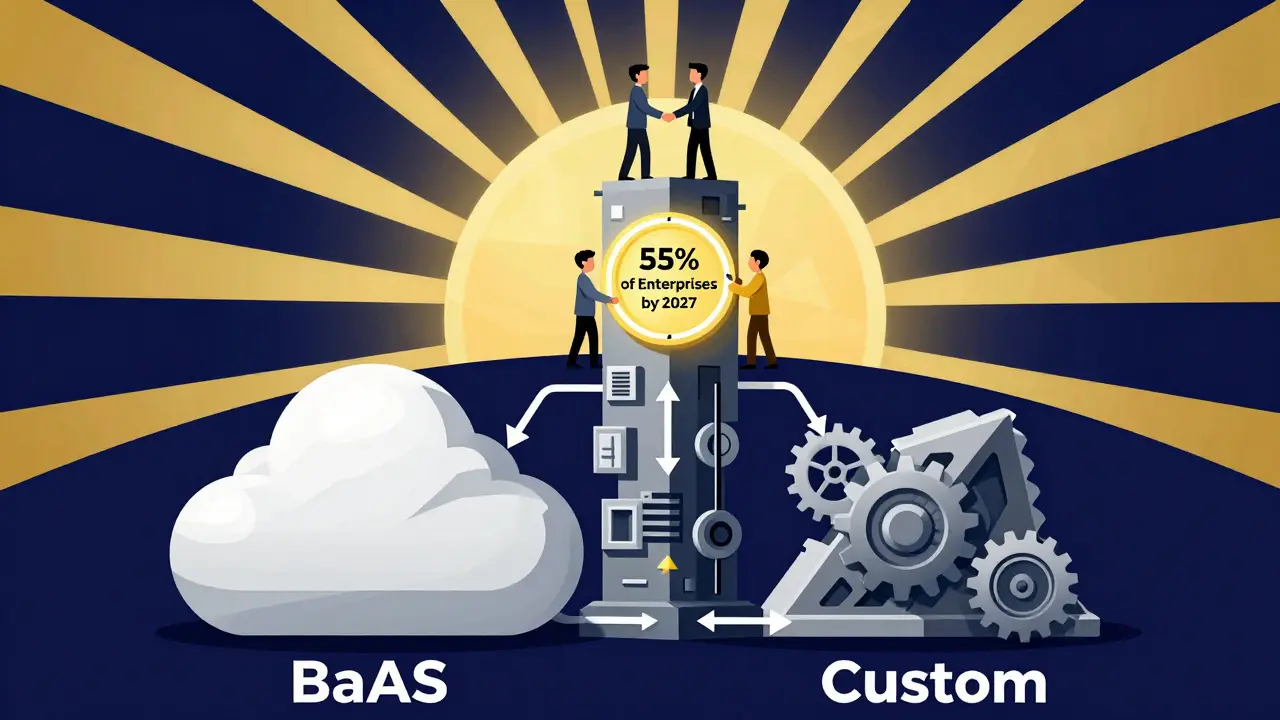
This is the new middle ground. You get the speed and support of BaaS, but with room to customize. Gartner predicts 55% of enterprise blockchains will use hybrid models by 2027-up from just 18% in 2024.
It’s not perfect. You still rely on the provider’s core. But it’s a smart compromise. For most companies, this is the future.
Final Decision Checklist
Still unsure? Ask yourself these five questions:
- Do I need to meet strict regulatory standards? If yes → custom.
- Do I need to modify the consensus algorithm or encryption? If yes → custom.
- Do I have a team with blockchain expertise? If no → BaaS.
- Am I building something that will last 5+ years? If yes → consider custom.
- Can I afford to wait 6-9 months to launch? If no → BaaS.
If you answered yes to #1 or #2, and no to #3, you’re in a tough spot. That’s when hybrid models shine.
Is BaaS secure enough for enterprise use?
Yes, for most use cases. Leading BaaS providers like AWS, Azure, and IBM undergo regular security audits, use enterprise-grade encryption, and offer SLA-backed uptime. However, if your industry requires data sovereignty or custom compliance protocols (like HIPAA or GDPR), BaaS may not offer enough control. In those cases, custom blockchains give you full ownership of security design.
Can I switch from BaaS to a custom blockchain later?
Technically, yes-but it’s expensive and risky. BaaS platforms often lock you in through proprietary APIs, data formats, and integration layers. Migrating means rebuilding smart contracts, revalidating data, and retraining teams. TreasuryXL’s 2025 report found that 58% of enterprises faced major delays and costs when trying to leave their BaaS provider. Plan your exit strategy before you start.
How long does it take to build a custom blockchain?
Typically 6 to 9 months for a production-ready system. This includes designing the architecture, writing smart contracts, testing consensus, auditing security, and training staff. BaaS can go live in 1-3 months. If speed is critical, BaaS is the clear winner-unless your use case demands deep customization.
What’s the biggest mistake companies make with BaaS?
Assuming it’s a one-size-fits-all solution. Many companies start with BaaS because it’s easy, then hit a wall when they need to change how the blockchain works-like adding a new consensus mechanism or modifying data storage. BaaS platforms don’t allow deep customization. If you don’t plan for this early, you’ll end up paying more to rebuild than you saved by using BaaS.
Are there any industries where BaaS doesn’t work?
Yes. Healthcare, finance, and government sectors often require data isolation, custom audit trails, and regulatory-specific encryption that BaaS platforms can’t provide. For example, HIPAA-compliant patient data handling demands field-level encryption and granular access logs that are impossible on generic BaaS systems. In these cases, custom blockchain development is the only viable path.
At the end of the day, blockchain isn’t about the tech. It’s about solving a real business problem. BaaS is the fast lane. Custom is the backroad with no speed limit. Choose based on where you’re going-not just how fast you want to get there.
nalini jeyapalan
March 6, 2026 AT 17:07Christina Young
March 6, 2026 AT 21:19Drago Fila
March 8, 2026 AT 17:59Steven Lefebvre
March 10, 2026 AT 15:32James Burke
March 12, 2026 AT 01:08Bryanna Barnett
March 13, 2026 AT 21:44Josh Moorcroft-Jones
March 14, 2026 AT 07:25Rachel Rowland
March 16, 2026 AT 07:08Bonnie Jenkins-Hodges
March 17, 2026 AT 20:00Cerissa Kimball
March 18, 2026 AT 04:38Basil Bacor
March 18, 2026 AT 19:26Emily Pegg
March 20, 2026 AT 15:34Ethan Grace
March 20, 2026 AT 21:37Jamie Hoyle
March 21, 2026 AT 18:23Jeffrey Dean
March 21, 2026 AT 20:53Brian T
March 22, 2026 AT 17:37Nash Tree Service
March 23, 2026 AT 23:48Jane Darrah
March 25, 2026 AT 07:57jack carr
March 27, 2026 AT 05:20Eva Gupta
March 28, 2026 AT 13:41