BHEX (BlueHelix Exchange) Crypto Exchange Review: Why It’s Dead and What Happened
 Feb, 2 2026
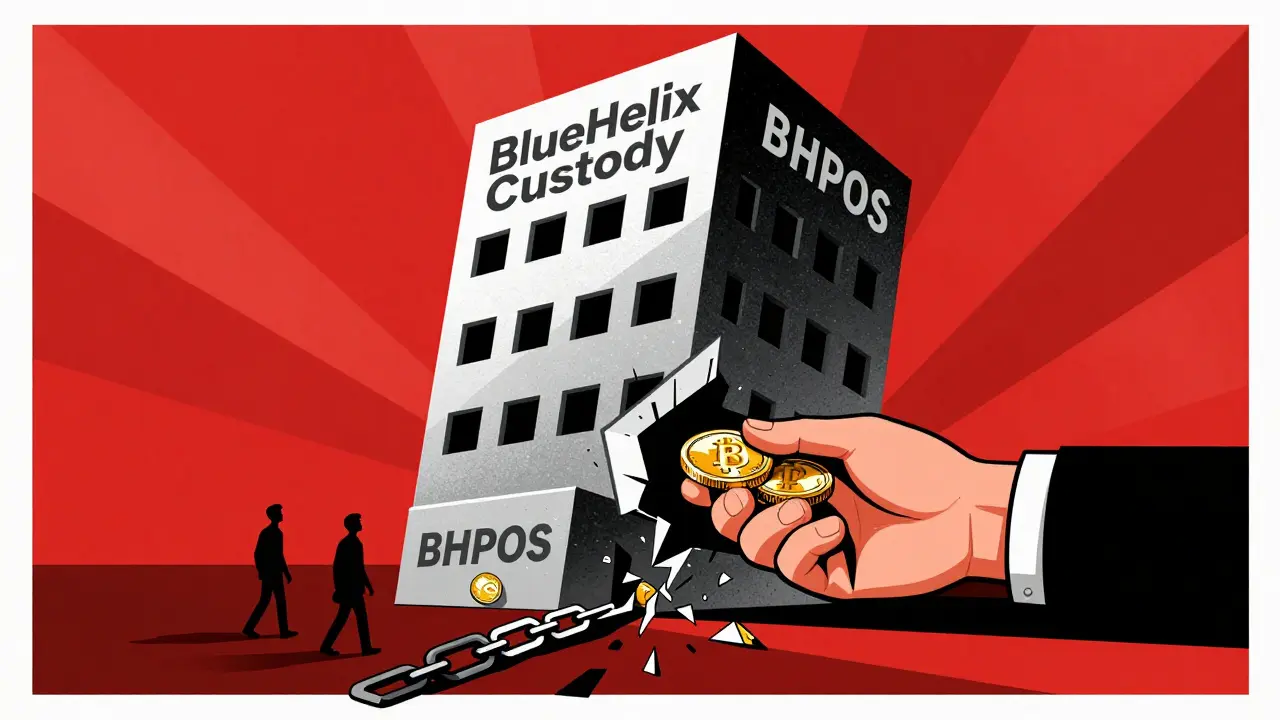
When BHEX (BlueHelix Exchange) launched in December 2018, it looked like the next big thing in crypto trading. Backed by Huobi, OKEx, and 56 institutional investors, it promised something no other exchange had: a system where users didn’t have to trust the platform with their money. Its BlueHelix custody and clearing technology claimed to eliminate exchange fraud by separating trading from asset control. The idea was simple - let the blockchain handle custody, not a company. For a moment, it seemed like the future had arrived.
What BHEX Actually Offered
BHEX didn’t just offer spot trading. It had futures, options, margin trading, OTC desks, and even a decentralized cross-chain protocol called HDEX. You could trade 25 cryptocurrency pairs, stake BHT tokens, and use mobile apps to trade on the go. It wasn’t the biggest exchange, but it had ambition. Its architecture was built around the idea that centralized exchanges were broken because they held your keys. BHEX said it solved that with its patented BlueHelix Chain - a system where transaction data was recorded on public blockchains, wallets were split between hot and cold storage, and multi-signature approvals were required for any movement of funds. Even better, they claimed users didn’t need to trust BHEX itself. Assets were managed by a community-based clearing mechanism called BHPOS - a proof-of-stake model where stakeholders validated transactions.
On paper, this was revolutionary. Most exchanges at the time were still using the old model: you deposit, they hold your coins, you trade, they settle. If they got hacked, you lost everything. BHEX said it changed that. And with investors like Huobi and OKEx - two giants in the space - backing it, people believed it.
The HDEX Promise and the Decentralized Dream
In July 2021, BHEX launched HDEX, billed as the world’s first decentralized exchange that could connect any blockchain. You could deposit Bitcoin, swap it for Ethereum, then send it to Solana - all without leaving the platform. No bridges. No wrapped tokens. No third-party intermediaries. The claim was that HDEX used a proprietary decentralized private key generation system to make this possible. It was supposed to be the crown jewel of their ecosystem - the bridge between centralized trading and true DeFi.
But here’s the problem: no one used it. Even at its peak, HDEX had barely any liquidity. The trading pairs were thin. The fees were high. And most importantly, users didn’t trust it. Why? Because if you couldn’t move your money off the platform easily, or if trades took minutes instead of seconds, you wouldn’t use it. And if the interface was clunky and the documentation confusing, you’d leave. That’s exactly what happened.
The Numbers Don’t Lie
On March 16, 2020, BHEX recorded $1.51 billion in 24-hour trading volume. That put it in the top 20 exchanges globally. A year later, volume dropped to $400 million. By the end of 2021, it was down to $707,798. Today? Zero. Not $100,000. Not $10,000. Zero. Market trackers like CoinGecko and CoinMarketCap no longer list BHEX as active. The order books are empty. The liquidity has vanished. The website still loads, but the trading engine is offline. The mobile apps don’t connect. The customer support emails bounce.
There’s no official shutdown notice. No press release. No explanation. Just silence. That’s the worst kind of failure in crypto. It’s not a hack. It’s not a regulatory raid. It’s abandonment.

Why Did BHEX Fail?
It wasn’t the tech. The BlueHelix custody system was technically sound. The patents were real. The institutional backing was solid. So why did it collapse?
First, they overpromised and underdelivered. They talked about decentralization but kept the trading interface centralized. They claimed users didn’t need to trust them - but users still had to deposit funds into BHEX wallets to trade. That’s not decentralization. That’s marketing.
Second, they ignored user experience. The platform was slow. The UI was outdated. Customer support was nonexistent after 2020. If you had a problem with a withdrawal, you were stuck. No chat. No tickets. No replies. In crypto, trust is built on speed and reliability. BHEX gave neither.
Third, they didn’t adapt. While other exchanges added new coins, lowered fees, and improved mobile apps, BHEX stayed static. They didn’t launch new features. They didn’t run promotions. They didn’t respond to market shifts. When Bitcoin surged in 2021, BHEX didn’t ride the wave - it sat still.
And finally, the community turned on them. Early adopters who believed in the BlueHelix vision started leaving. When they did, liquidity dried up. And when liquidity disappears, traders leave. It’s a death spiral. BHEX never broke out of it.
What Happened to the Team?
James Ju, the former CTO of Huobi and founder of BHEX, vanished from public view after 2021. No interviews. No LinkedIn updates. No tweets. The same goes for most of the core team. The institutional investors - Huobi, OKEx, Node Capital - never publicly commented on the failure. No one took responsibility. No one offered refunds. No one even acknowledged the platform was dead.
That’s the quietest kind of collapse. No scandal. No lawsuit. Just disappearance.

Is BHEX Safe to Use Today?
No. Not even close.
If you try to log in now, you might get a blank screen or a loading spinner. If you manage to access your account, you won’t be able to withdraw. Your funds are likely stuck - if they’re even still there. There’s no proof of reserves. No audits. No transparency. The platform is a ghost.
Some crypto directories still list BHEX, but they all flag it as “inactive” or “untracked.” That’s not a recommendation. That’s a warning.
What You Should Do Instead
If you’re looking for a reliable crypto exchange, don’t waste time on BHEX. Instead, consider platforms that are active, audited, and transparent. Look for exchanges that publish regular proof-of-reserves reports. Check their trading volume on CoinGecko. Read user reviews on Trustpilot. Make sure customer support responds within hours, not weeks.
There are dozens of solid alternatives: Binance, Kraken, Coinbase, KuCoin, and Bybit all offer better liquidity, faster withdrawals, and real customer service. None of them promise magic blockchain tech - but they deliver what matters: reliability.
The Bigger Lesson
BHEX wasn’t just a failed exchange. It was a lesson in how crypto projects can die quietly. You don’t need a hack to lose everything. You don’t need a scandal. You just need to lose trust. And once trust is gone, no amount of patents or institutional backing can bring it back.
The crypto space is full of startups with flashy whitepapers and big names on their investor list. But none of that matters if you can’t move your money. If a platform feels slow, silent, or sketchy - walk away. No amount of technical jargon can replace simple, honest execution.
BHEX had the vision. It had the money. It had the team. But it didn’t have the users. And in crypto, users are everything.
Michael Sullivan
February 2, 2026 AT 09:26Mrs. Miller
February 2, 2026 AT 17:58sabeer ibrahim
February 3, 2026 AT 10:00Mendy H
February 4, 2026 AT 00:15Molly Andrejko
February 5, 2026 AT 09:31Jacque Istok
February 7, 2026 AT 03:37Alisha Arora
February 8, 2026 AT 22:11David Bain
February 10, 2026 AT 13:00Danica Cheney
February 11, 2026 AT 23:36Brittany Coleman
February 12, 2026 AT 16:08laura mundy
February 14, 2026 AT 07:27Deeksha Sharma
February 15, 2026 AT 14:57Nathaniel Okubule
February 15, 2026 AT 19:13Reda Adaou
February 16, 2026 AT 04:28