Crypto Banking Restrictions Rescinded in US: 2025 Changes
 Mar, 20 2026
On April 24, 2025, the Federal Reserve officially pulled the plug on two major rules that had blocked banks from offering crypto services. It wasn’t a slow fade. It was a full reset. For years, banks had to jump through hoops just to let customers buy or hold Bitcoin. Now? Those hoops are gone. The change didn’t come out of nowhere. It was the final piece of a coordinated move by all three federal banking regulators - the Federal Reserve, the Office of the Comptroller of the Currency (OCC), and the Federal Deposit Insurance Corporation (FDIC). Together, they erased the last of the Biden-era restrictions that made crypto feel like a forbidden activity for traditional banks.
What exactly changed?
Before 2025, if a bank wanted to offer crypto custody, hold stablecoins, or even run a node on a blockchain network, it had to ask permission. Not just once. Over and over. The Federal Reserve’s SR 22-6 and SR 23-8 letters forced banks to notify regulators ahead of time and get formal approval before doing anything crypto-related. It was like needing a special permit to open a savings account. The OCC had its own version: Interpretive Letter 1179, issued in 2021, told national banks they needed supervisory non-objection before touching crypto. The FDIC wasn’t far behind, requiring prior notice under FIL-16-2022. All of that is gone. On March 7, 2025, the OCC dropped Interpretive Letter 1179 and replaced it with Interpretive Letter 1183. It said clearly: national banks and federal savings associations can custody crypto, hold stablecoin reserves, and participate in independent node networks - no approval needed. The FDIC followed on March 28, saying supervised institutions can do crypto-related work as long as they manage risk properly. Then, on April 24, the Federal Reserve confirmed it was no longer requiring advance notice or non-objection for state member banks and bank holding companies.Why does this matter?
This isn’t just paperwork cleanup. It’s a door opening. For years, banks avoided crypto because the rules were too messy, slow, and risky. Legal teams spent months just trying to figure out if a single crypto service was allowed. Many gave up. Now, the message is clear: crypto is a banking activity, not a special case. If a bank can manage risk, follow anti-money laundering rules, and protect customers, it can offer crypto services - just like it offers wire transfers or mortgage loans. The biggest winners? Customers. Imagine walking into your local bank and being able to buy Ethereum, store Bitcoin in a secure wallet, or use a stablecoin to send money overseas - all within your existing account. No need to juggle a separate crypto exchange. No more trusting a third-party app with your keys. That’s now possible. And it’s not just about convenience. It’s about trust. People trust banks. If banks start offering crypto, millions more will feel safe trying it.
What’s still off-limits?
Don’t get the wrong idea. This isn’t a free-for-all. The regulators didn’t throw out safety rules. They just stopped requiring special permission. Banks still have to follow existing rules: capital requirements, consumer protection, AML/KYC, and sound risk management. But now, they can do it without jumping through bureaucratic hoops. What’s still unclear? A few big things. Can banks hold Bitcoin or Ethereum directly on their balance sheets? The new rules don’t say. What about lending crypto? Or offering crypto-backed loans? Those are still gray areas. The agencies admitted they’re still working on guidance for those. The Federal Reserve, OCC, and FDIC all said they’ll keep working with the President’s Working Group on Digital Asset Markets to figure out what’s next. So while the biggest roadblocks are gone, the map isn’t fully drawn yet.Who’s behind this shift?
The change didn’t happen because regulators suddenly liked crypto. It happened because they learned. Over the last four years, bank staff got smarter. Compliance teams built better systems. Risk models improved. The failures of 2022 - FTX, Celsius, Terra - forced everyone to take crypto seriously. Regulators saw that banks could handle it, if given the right framework. The OCC said it outright: "The supervisory non-objection process is no longer necessary." They didn’t say crypto is safe. They said banks are ready. Legal firms like Latham & Watkins and Jones Day called it a "permissive stance." That’s the key word: permissive. Not enthusiastic. Not encouraging. Just letting banks do what they’re already capable of. And that’s exactly what’s needed. The market doesn’t need regulators cheering. It needs them to get out of the way.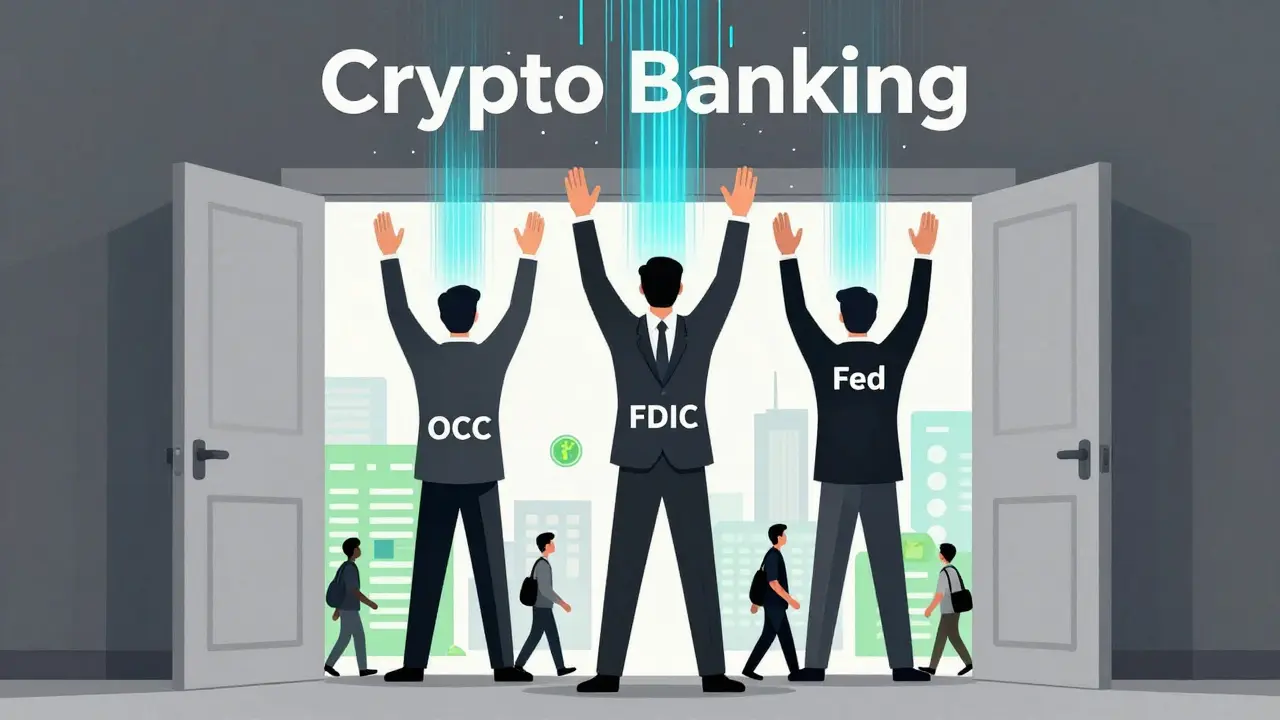
What’s next?
Expect a flood of new crypto services from big banks. JPMorgan, Bank of America, Wells Fargo - they’ve all been watching. Some have already dipped toes in. Now, they’ll dive in. You’ll see crypto trading integrated into mobile apps. Crypto savings accounts. Stablecoin payments. Even crypto ATMs inside bank branches. The competition isn’t just with Coinbase or Kraken anymore. It’s with your local bank. But here’s the real shift: crypto is becoming infrastructure. Not a side hustle. Not a gamble. A normal part of finance. That’s what 2025’s changes mean. The regulators didn’t legalize crypto. They recognized it’s already here. And they’re finally letting banks meet their customers where they are.What this means for you
If you’re a customer: start asking your bank if they offer crypto services. If they don’t yet, they will soon. The pressure is on. If you’re a bank employee: your compliance team is already retraining. Crypto isn’t a threat anymore - it’s a product line. If you’re in fintech: the game changed. You’re no longer competing against banks. You’re partnering with them. The crypto world spent years waiting for banks to catch up. Now, they’re sprinting. And the finish line is closer than ever.Did the Federal Reserve fully legalize crypto banking in 2025?
No, the Federal Reserve didn’t "legalize" crypto banking - it was never illegal. What changed in 2025 was the removal of restrictive notification and approval requirements. Banks can now offer crypto services without needing prior regulatory permission, as long as they follow existing safety, soundness, and consumer protection rules. The regulators shifted from a "ask first" model to a "do responsibly" model.
Can banks now hold Bitcoin or Ethereum on their balance sheets?
The 2025 changes don’t explicitly say yes or no. The new guidance from the OCC, FDIC, and Federal Reserve focuses on custody, stablecoin reserves, and node participation. Holding non-stablecoin crypto-assets like Bitcoin or Ethereum directly on a bank’s balance sheet remains legally unclear. Regulators have signaled they’re still working on guidance for this, so banks are proceeding cautiously.
What’s the difference between the OCC, FDIC, and Federal Reserve’s roles in crypto banking?
The OCC supervises national banks and federal savings associations - so its rules apply to big banks like Chase and Wells Fargo. The FDIC covers state-chartered banks that are insured, which includes many regional banks. The Federal Reserve oversees state member banks and bank holding companies. All three agencies coordinated their 2025 changes to remove overlapping restrictions, so now banks under any of these regulators can offer crypto services under the same basic rules.
Are crypto custody services now safe and regulated?
Yes, but with a caveat. The OCC’s Interpretive Letter 1183 explicitly confirmed that national banks can custody crypto assets, including holding private keys for customers. This means banks can now offer secure, insured custody - something most crypto exchanges can’t do. But safety still depends on the bank’s internal controls. The regulators don’t guarantee security - they just allow banks to build it.
Will this lead to crypto becoming mainstream in U.S. banking?
Almost certainly. With regulatory clarity, banks will roll out crypto services as fast as they can. Expect to see crypto trading in mobile apps, crypto-backed savings accounts, and stablecoin payments by late 2026. The biggest barrier - regulatory fear - is gone. Now, it’s about execution. Banks have the infrastructure, the customers, and the trust. All they needed was permission to move.
What about state-chartered banks? Are they affected too?
Yes. Before 2025, state banks were blocked from crypto because federal rules didn’t apply to them. But once the OCC rescinded Interpretive Letter 1179 - which had defined what national banks could do - state banks gained the ability to follow the same rules. Since state banks can’t do anything national banks can’t, the OCC’s new guidance effectively unlocked crypto services for them too. The FDIC’s change reinforced this by removing prior approval for all supervised institutions.
Lucy de Gruchy
March 20, 2026 AT 07:32Carol Lueneburg
March 20, 2026 AT 22:57Brenda White
March 21, 2026 AT 18:18Tobias Wriedt
March 21, 2026 AT 22:15Ernestine La Baronne Orange
March 23, 2026 AT 14:33Manali Sovani
March 24, 2026 AT 10:11S F
March 26, 2026 AT 03:34sai nikhil
March 27, 2026 AT 08:00Sahithi Reddy
March 28, 2026 AT 12:06George Hutchings
March 29, 2026 AT 12:57Henrique Lyma
March 30, 2026 AT 10:08Steph Andrews
April 1, 2026 AT 06:14Prakash Patel
April 1, 2026 AT 19:48Zachary N
April 3, 2026 AT 10:53Elizabeth Kurtz
April 5, 2026 AT 09:08john peter
April 6, 2026 AT 18:30Marc Morgan
April 7, 2026 AT 02:25