DLT vs Blockchain: What's the Difference
 Dec, 22 2025
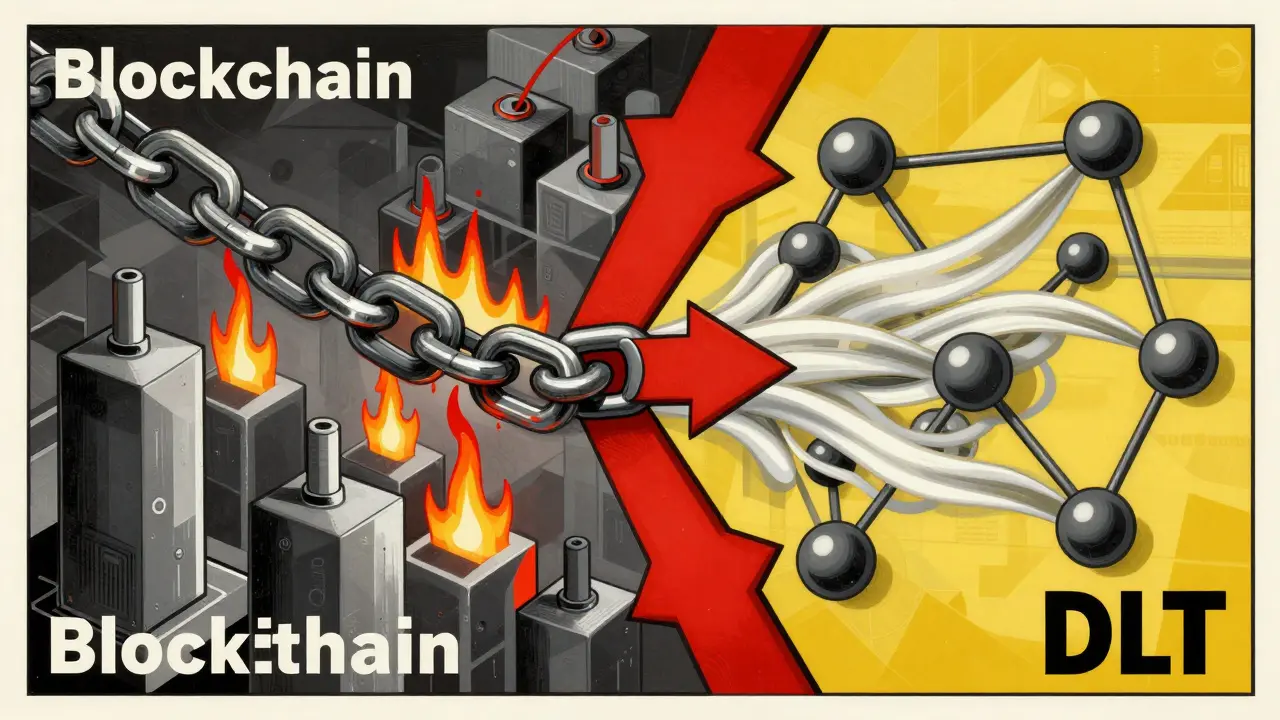
When people talk about blockchain, they often mean Distributed Ledger Technology (DLT). But here’s the truth: blockchain is just one kind of DLT. Not all DLTs are blockchains. And that difference matters-especially if you're building something real, not just talking about crypto.
What Exactly Is DLT?
Think of DLT as a shared digital ledger. It’s like a Google Sheet that everyone on a team can edit at the same time-but no one can secretly change what’s already there. Every participant holds a copy. Every update is verified by the group. No bank, no government, no single company controls it. This isn’t new. BitTorrent used similar ideas back in 2001 to share files without a central server. Today, DLT is used in supply chains, banking, and even voting systems. The key point? It doesn’t have to use blocks. It doesn’t have to be chained. It just needs to be distributed and tamper-resistant. Real-world examples? R3’s Corda, Hyperledger Fabric, and IOTA’s Tangle. These are all DLTs. None of them use blocks. Yet they’re trusted by banks, logistics firms, and governments.What Makes Blockchain Different?
Blockchain is a specific way to build a DLT. It forces data into blocks. Each block holds a batch of transactions. Then it links to the next block using a cryptographic hash-like a digital fingerprint of the previous block. Change one transaction? You break the chain. That’s why it’s called “immutable.” Bitcoin was the first blockchain. It needed to work without trust. So it added Proof-of-Work: miners compete to solve hard math puzzles. It’s slow. It uses massive energy. But it works even if you don’t know who’s on the other side. That’s the core of blockchain: trustless environments. You don’t need to know or trust the other party. The system enforces honesty through code and math. Compare that to a bank. You trust the bank because it’s a known institution. With blockchain, you trust the algorithm. That’s powerful-but not always necessary.Key Differences at a Glance
| Feature | DLT (General) | Blockchain (Specific) |
|---|---|---|
| Data Structure | Can be graph-based, DAG, or other forms | Strictly sequential blocks in a chain |
| Consensus Mechanism | Can use PBFT, Raft, or no consensus at all | Typically uses PoW, PoS, or variants |
| Energy Use | Low to moderate (PBFT uses 99% less energy than PoW) | High (Bitcoin: ~1,544 kWh per transaction) |
| Transaction Speed | Up to 10,000+ TPS (e.g., Hedera Hashgraph) | 7-30 TPS (Bitcoin/Ethereum pre-merge) |
| Token Required? | No-enterprise DLTs often run without tokens | Yes-gas fees, mining rewards, staking |
| Trust Model | Permissioned: participants are known and vetted | Permissionless: anyone can join anonymously |
| Common Use Cases | Banking settlements, supply chain, CBDCs | Cryptocurrencies, NFTs, public DeFi apps |
Why Does This Matter for Businesses?
If you’re a bank, you don’t need Bitcoin-style decentralization. You need speed, privacy, and compliance. That’s why 68% of banking pilots use non-blockchain DLTs like Hyperledger Fabric or R3 Corda, according to Deloitte’s 2023 survey. Corda, for example, lets two parties transact privately. Only they see the details. No public ledger. No mining. No gas fees. Just secure, fast settlement. BBVA used it for trade finance and cut document processing time by 80%. Meanwhile, public blockchains like Ethereum are great for open apps-DeFi, NFTs, DAOs. But they’re too slow and expensive for daily banking. JPMorgan’s Quorum team found that 15-second finality times broke their high-frequency trading systems. The European Central Bank chose non-blockchain DLT for its digital euro pilot. Why? Because it needs to handle millions of transactions per second. Blockchain can’t scale that way-not yet.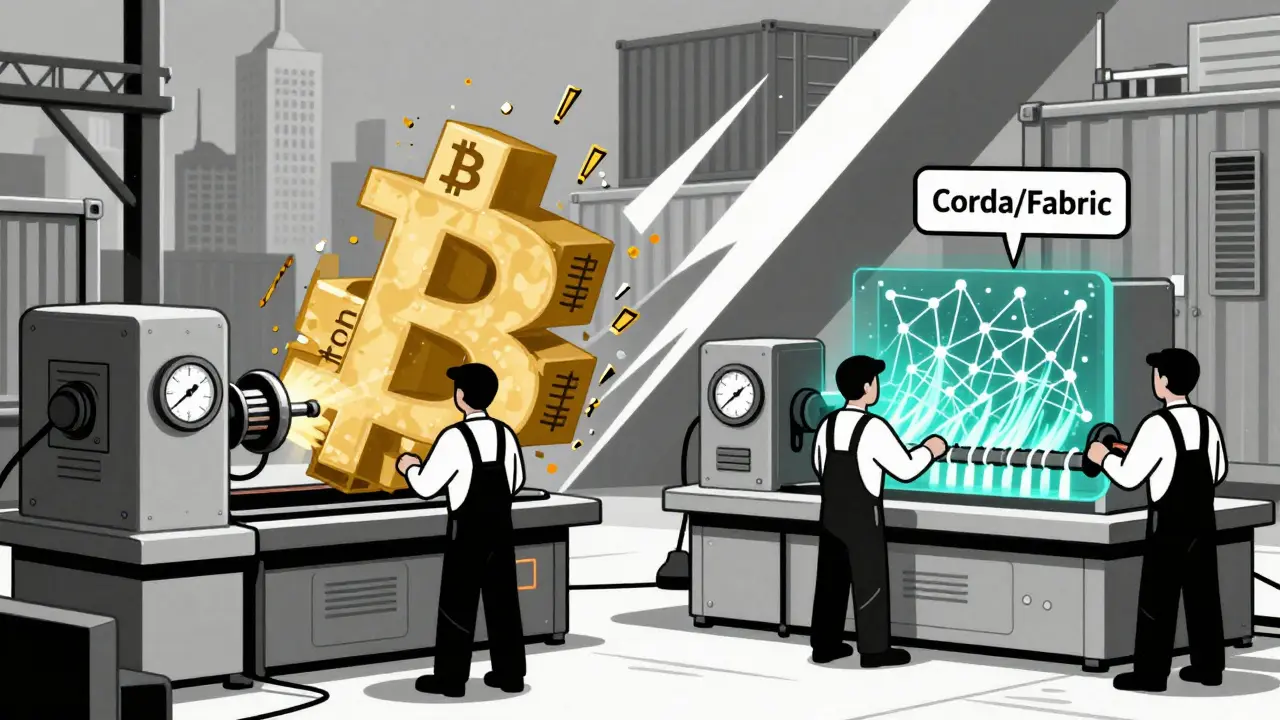
Performance and Scalability: The Real Bottleneck
Let’s talk numbers. - Bitcoin: 7 transactions per second (TPS)- Ethereum (pre-Merge): 30 TPS
- Hyperledger Fabric: 4,500 TPS
- Hedera Hashgraph: 10,000+ TPS
If you’re running a national payment system, 30 TPS is a disaster. That’s less than a Visa transaction. But for peer-to-peer crypto trading? It’s fine. Energy use is another dealbreaker. Bitcoin’s annual electricity use rivals that of Argentina. PBFT-based DLTs use less than 1% of that energy. That’s not just eco-friendly-it’s economically smarter for enterprises. The Ethereum Merge in 2022 cut its energy use by 99.95%. That was huge. But even now, Ethereum can’t match the speed of permissioned DLTs. And it still needs ETH for gas.
Trust: Who Are You Dealing With?
This is the hidden divider. Blockchain assumes strangers are dishonest until proven otherwise. That’s why it’s so secure. But it’s also why it’s slow and expensive. DLT assumes participants are known and vetted. Think banks, shipping companies, government agencies. They’re not anonymous. They’re regulated. They have legal contracts. So you don’t need Proof-of-Work. You just need a reliable, fast way to sync records. Maersk’s TradeLens used Hyperledger Fabric to track shipping containers. 98 companies were on the network. No crypto. No tokens. Just real-time data sharing. That’s the power of trusted DLT.What’s the Future?
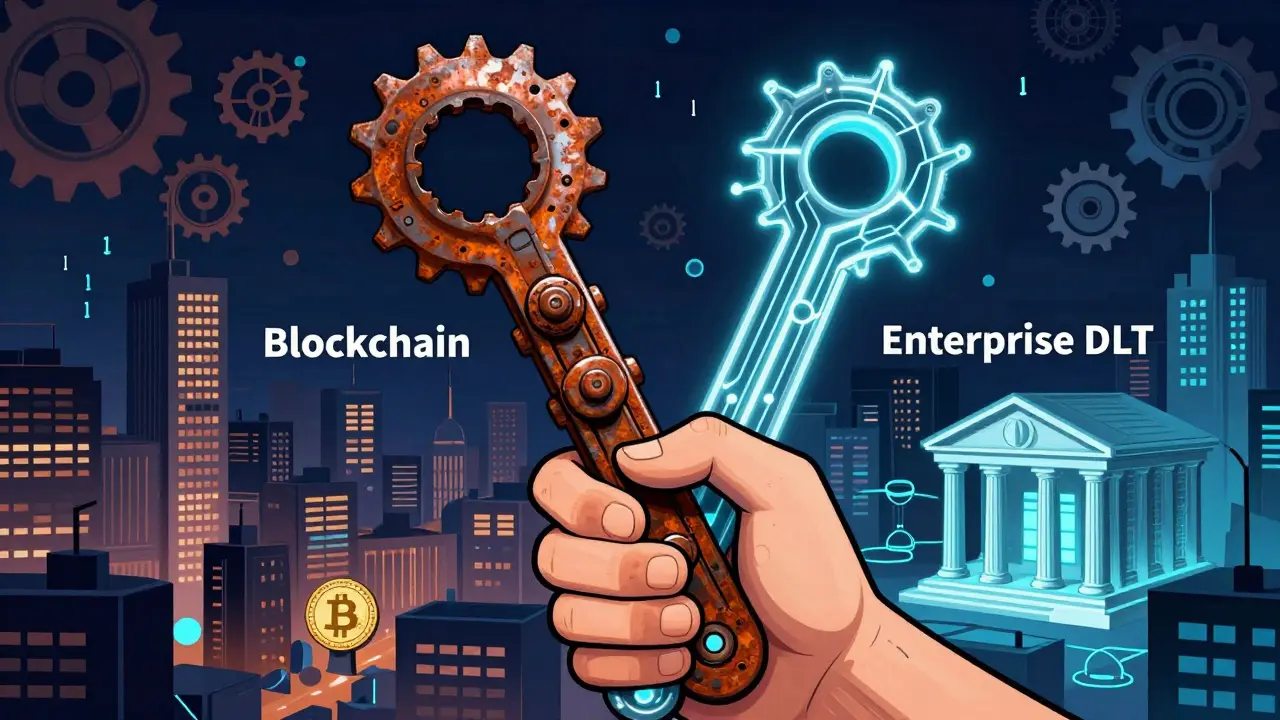
The lines are blurring. R3’s Corda 5 now supports blockchain-like chaining for audit trails. Ethereum is moving toward sharding and layer-2 solutions to scale. Some new systems combine DAGs with smart contracts. Gartner says DLT has reached the “Plateau of Productivity.” That means it’s no longer hype-it’s in use. 25% of global enterprises are already using some form of DLT. But blockchain? It’s still the face of the tech. That’s fine for crypto. But for enterprise? The future is hybrid. Use the right tool for the job. If you need open access, censorship resistance, and global trust? Blockchain.If you need speed, privacy, compliance, and low cost? DLT without blocks.
Getting Started: What Should You Learn?
Want to build something? Start here:- For blockchain: Learn Solidity, Ethereum, MetaMask, Truffle. Join Ethereum’s Discord. Build a simple token or NFT.
- For enterprise DLT: Study Hyperledger Fabric or R3 Corda. Set up a local network. Try writing a chaincode (smart contract) in Go or Java.
Common Misconceptions
- “Blockchain is the only DLT.” False. DLT is the umbrella. Blockchain is one branch.
- “DLT isn’t secure.” False. Hyperledger Fabric is used by the U.S. military and major banks.
- “All DLTs are private.” False. Some DLTs are public. But most enterprise ones are permissioned.
- “You need crypto to use DLT.” False. Corda, Fabric, and many others run without tokens.
Final Thought
Don’t let marketing confuse you. Blockchain isn’t the future of everything. It’s the future of open, trustless systems. DLT is the future of efficient, regulated, high-speed record-keeping. The best companies aren’t choosing one over the other. They’re picking the right tool. And that’s the real lesson.Is blockchain the same as DLT?
No. Blockchain is a type of DLT, but not all DLTs are blockchains. DLT is the broader category-like “vehicle.” Blockchain is a specific kind-like “sedan.” You can have other types of DLT, like Hashgraph or Tangle, that don’t use blocks or chains.
Can DLT work without cryptocurrency?
Yes. Many enterprise DLT systems like Hyperledger Fabric and R3 Corda don’t use tokens or crypto at all. They rely on permissioned access and traditional authentication. Crypto is only needed if you’re building a public, trustless system like Bitcoin or Ethereum.
Why do banks prefer DLT over blockchain?
Banks need speed, privacy, and regulatory compliance. Blockchain’s public nature and slow transaction speeds (7-30 TPS) don’t fit. DLTs like Corda and Fabric can process thousands of transactions per second, keep data private between parties, and meet financial regulations-all without crypto.
Which is more energy-efficient: DLT or blockchain?
DLT systems using Practical Byzantine Fault Tolerance (PBFT) are far more energy-efficient than Proof-of-Work blockchains. Bitcoin uses about 1,544 kWh per transaction. PBFT-based DLTs use less than 1% of that. Even Ethereum after its Merge is still slower and less efficient than enterprise DLTs for high-volume use.
What’s the biggest mistake people make when comparing DLT and blockchain?
They treat them as interchangeable. People say “blockchain” when they mean “any distributed ledger.” That leads to bad decisions-like trying to use Bitcoin-style tech for a bank’s internal settlement system. The right tool depends on your trust model, speed needs, and whether you need public access or privacy.
Are there any real-world examples of DLT without blockchain?
Yes. The European Central Bank’s digital euro project uses a non-blockchain DLT. Maersk’s TradeLens uses Hyperledger Fabric. IBM’s Food Trust uses it too. These aren’t crypto projects-they’re supply chain and financial systems built for efficiency, not decentralization.
Will blockchain disappear as DLT becomes more popular?
No. Blockchain will keep its place in public, permissionless systems-like cryptocurrencies, NFTs, and DeFi. But in enterprise settings, non-blockchain DLTs are taking over because they’re faster, cheaper, and more compliant. The future isn’t one replacing the other-it’s using each where it fits best.
Vyas Koduvayur
December 22, 2025 AT 18:59Look, everyone keeps saying blockchain and DLT like they're synonyms, but that's like calling a Tesla a car and then acting surprised when a Prius doesn't have a gas engine. DLT is the architecture, blockchain is one implementation-sometimes the right one, often not. I've seen banks waste millions trying to force PoW into private ledgers because someone at a conference said 'blockchain is the future.' The future is Corda, Fabric, Hashgraph-systems that don't require your accountant to mine crypto just to reconcile a trade. If your use case doesn't need permissionless anonymity, stop pretending you're building the next Bitcoin.
Lloyd Yang
December 24, 2025 AT 00:23Man, I love how this post breaks it down like a masterclass. Seriously, the table comparing TPS and energy use? Chef’s kiss. I used to be one of those people who thought 'blockchain' meant 'magic internet money'-until I worked on a supply chain project using Hyperledger. No tokens. No gas fees. Just a secure, real-time ledger between 14 vendors. It cut our invoice disputes by 70%. The real win? The CFO didn’t need to understand cryptography-just that the system didn’t crash during peak season. DLT isn’t sexy, but it’s the unsung hero of enterprise tech. Keep preaching this gospel.
Jake Mepham
December 24, 2025 AT 09:04Let me tell you something-DLT is the quiet giant no one talks about because it doesn’t have a meme coin. While everyone’s screaming about Ethereum’s next fork, banks are quietly settling billions in seconds with PBFT. I’ve been in the trenches with Corda. It’s not flashy, but it’s like a Swiss watch: precise, reliable, and doesn’t need a battery swap every 10 minutes. The real tragedy? Developers flock to Solidity tutorials while enterprise DLT docs are buried under 3 layers of corporate jargon. If you want to build something that actually moves the needle? Learn Go, not JavaScript. The money’s in the back office, not the blockchain zoo.
Sheila Ayu
December 25, 2025 AT 10:03Dan Dellechiaie
December 27, 2025 AT 02:29Bro, you’re preaching to the choir. I’ve been in Nigeria’s fintech space for 8 years. We built a DLT for micro-loan settlements-no crypto, no mining, just a permissioned network between 12 cooperatives. 2000 transactions per second. Zero energy waste. And guess what? The regulators loved it because they could audit every transaction without needing a PhD in cryptography. The real villain here isn’t blockchain-it’s the crypto bros who turned a tool into a cult. If you’re building for real people, not moonboys, DLT without the token tax is the only sane choice.
Rachel McDonald
December 28, 2025 AT 16:32I just… I can’t. I read this whole thing and I’m crying. Not because I’m sad-because I’m SO RELIEVED someone finally said it out loud. I’ve been trying to explain this to my uncle for 3 years. He keeps saying ‘blockchain will fix everything’ and then tries to use Bitcoin to pay for his groceries. I tried to show him Corda. He asked if it was a new type of NFT. I didn’t speak to him for a week. Thank you. I feel seen. 💔
Vijay n
December 29, 2025 AT 04:57Alison Fenske
December 30, 2025 AT 01:15I used to think blockchain was the future. Then I worked on a healthcare data project using a private DLT. We moved patient records between 7 hospitals in real time. No one had to sign a new NDA. No one had to wait 3 weeks for IT to ‘set up access.’ It just… worked. And it didn’t cost a dime in gas fees. I’m not anti-blockchain-I just hate when people use the wrong tool for the job. Like using a flamethrower to light a candle. You don’t need to burn the whole house down to see in the dark.
Collin Crawford
December 30, 2025 AT 02:23While the author's distinction between DLT and blockchain is technically accurate, it is insufficiently rigorous in its treatment of consensus mechanisms. The assertion that PBFT-based systems are inherently superior is a fallacy rooted in a misunderstanding of Byzantine fault tolerance as a binary condition. In reality, the trade-offs between liveness, safety, and decentralization are non-linear, and the assumption that enterprise environments are 'trusted' is a dangerous oversimplification-especially in cross-border contexts where regulatory jurisdictions conflict. Furthermore, the dismissal of token economics ignores the emergent properties of incentive alignment in open systems. To reduce DLT to a mere performance metric is to ignore its sociotechnical architecture.
Jayakanth Kesan
December 31, 2025 AT 18:13Love this breakdown. I’m just a guy who builds websites, but I’ve been watching this whole thing unfold since 2017. I remember when everyone was putting ‘blockchain’ in their LinkedIn bio just to get interviews. Now? The smart ones are learning Fabric. The rest are still trying to sell NFTs of their cat. Honestly? The future belongs to the people who don’t care about hype. Just build something that works. No tokens. No memes. Just code that saves someone 10 hours a week. That’s the real win.
Megan O'Brien
January 1, 2026 AT 05:46Earlene Dollie
January 1, 2026 AT 13:07It’s not about blocks or chains or consensus-it’s about control. Who holds the keys? Who owns the truth? Blockchain says: the algorithm. DLT says: the boardroom. And honestly? I don’t trust either. The real revolution isn’t in the tech-it’s in the people who stop believing that any system, digital or not, can be truly neutral. We’re just swapping one god for another. The blockchain god with his mining rigs… and the DLT god with his compliance officers. Either way, we’re still kneeling.
Dusty Rogers
January 1, 2026 AT 20:23Biggest thing people miss? Blockchain was built for chaos. DLT was built for order. If you’re running a bank, you don’t want chaos-you want predictability. If you’re running a decentralized app, you need chaos to survive censorship. They’re not rivals. They’re different languages for different worlds. I built a blockchain app for artists. Then I built a DLT for a hospital. One needed anonymity. The other needed audit trails. Same tech. Different souls. Stop forcing one into the other’s skin.