How Interest Rate Models Work in DeFi Lending Protocols
 Dec, 11 2025
DeFi Interest Rate Calculator
How Utilization Affects Your Borrowing Rate
See how borrowing rates change based on the ratio of borrowed funds to total available funds in the lending pool.
Borrowing Rate
EstimatedWhen you lend or borrow crypto in DeFi, there’s no bank manager deciding your interest rate. No board meeting. No hidden fees. Instead, a smart contract runs the show - and it’s all based on one simple number: utilization.
What Is Utilization, and Why Does It Matter?
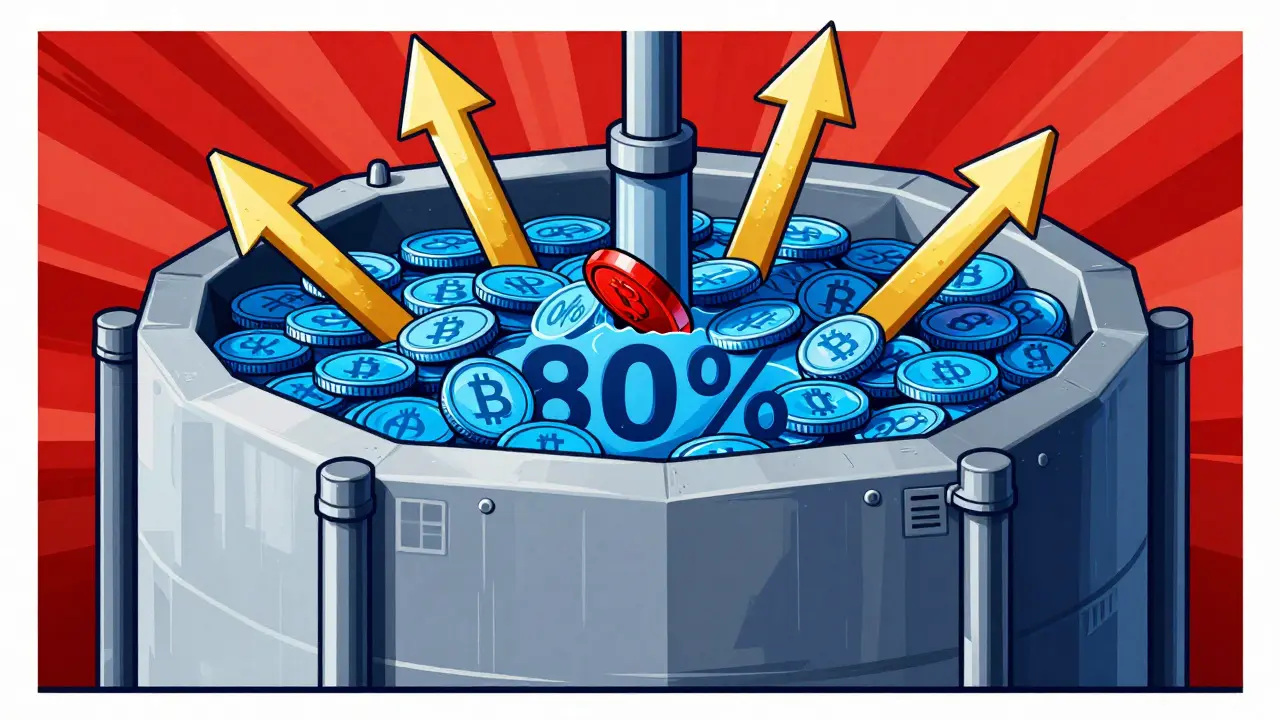
Utilization is the ratio of how much of the available crypto has been borrowed versus how much is sitting idle in the pool. If $100 million is deposited and $80 million is lent out, utilization is 80%. Simple. But that one number controls everything - how much lenders earn, how much borrowers pay, and whether the system stays stable.
Imagine a water tank. If the tank is nearly empty, water flows in cheaply. If it’s almost full, you need to pay more to take more out. That’s exactly how DeFi lending works. The higher the utilization, the higher the borrowing cost. And when it hits 90% or above, rates spike fast - not to punish borrowers, but to lure more lenders in. Without that spike, no one would add more funds. The system would freeze.
The Kinked Model: Why Most DeFi Protocols Use It
Most major DeFi platforms - Aave, Compound, and even MakerDAO - use what’s called a kinked interest rate model. It’s not a straight line. It’s two lines joined at a bend, or a "kink."
Below 80% utilization, borrowing rates rise slowly. A 10% jump in utilization might only bump the rate from 3% to 4%. But once you cross that 80% mark, the slope gets steep. Another 10% increase can push the rate from 5% to 15% or higher. That’s intentional. It’s a pressure valve.
This design keeps the system healthy. It encourages lenders to add funds when utilization is high. It pushes borrowers to repay loans before rates explode. And it prevents the system from hitting 100% utilization - which would mean no one can withdraw their money. That’s a liquidity crisis waiting to happen.
Aave’s model targets 80-95% utilization as the "sweet spot." That’s where the platform is most efficient: enough borrowing to keep lenders earning, but not so much that the system becomes fragile. Compound uses a similar structure, though its kink point is slightly lower at 70-80%.
How Rates Compare Across Major Platforms
Not all DeFi lending platforms are built the same. Here’s how the big three stack up as of late 2025:
| Platform | Supply APY (USDC) | Borrow APR (USDC) | Max LTV | Rate Type |
|---|---|---|---|---|
| Aave | 7.47% | 8.94% | 80% | Kinked (80% kink) |
| Compound | 8.30% | 4.10% | 75% | Kinked (70% kink) |
| MakerDAO | 11.5% (DSR) | 12.5% | 66-75% | Fixed + Dynamic |
Notice something odd? Compound gives you a higher return on your deposit than Aave, but charges less to borrow. Why? Because Compound’s model is designed to attract more lenders, not borrowers. It’s betting that lenders will flood in with stablecoins, keeping utilization low and borrowing rates cheap. Aave, on the other hand, wants to keep utilization high - so it charges more to borrow, but still pays competitive yields to keep lenders happy.
MakerDAO is the outlier. Its DAI savings rate (DSR) is nearly 12%, which is unusually high. That’s because DAI is a stablecoin backed by volatile crypto collateral. MakerDAO needs to pay more to attract lenders who are willing to lock up their crypto to mint DAI. And because it’s more conservative, it caps loan-to-value ratios lower - meaning you can’t borrow as much against your ETH or WBTC.
Why Rates Spike - And When to Worry
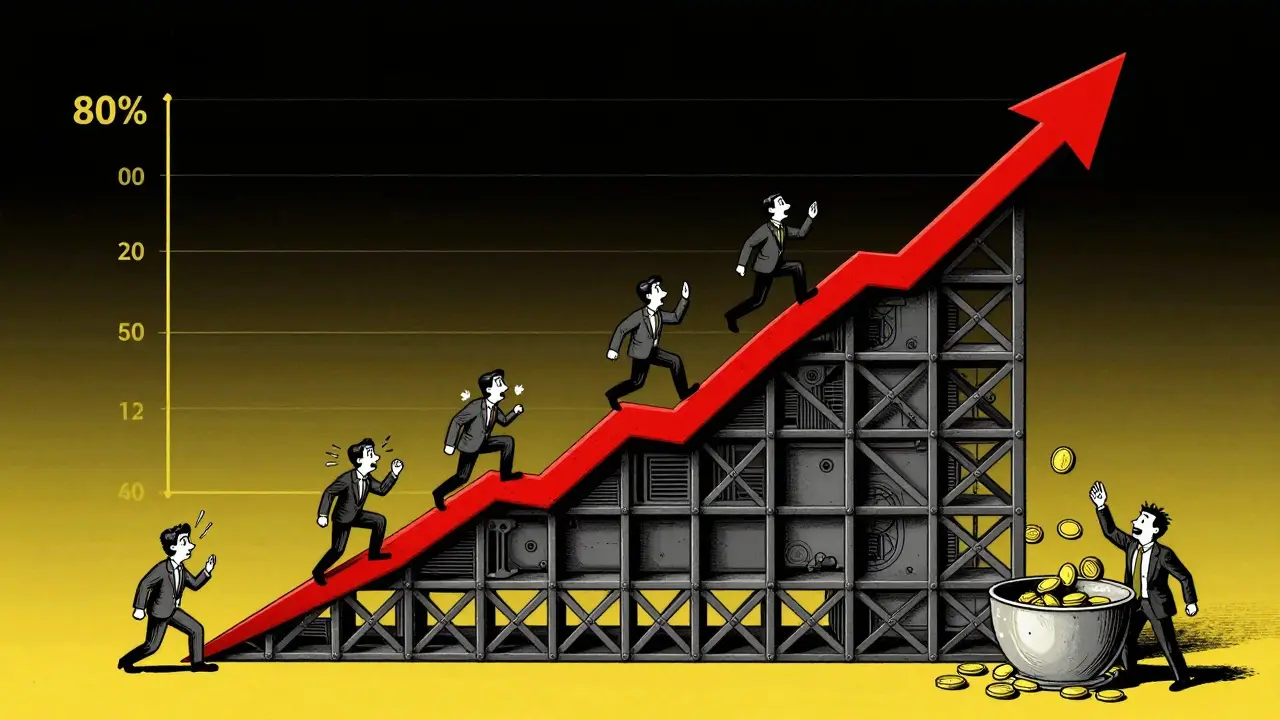
During market crashes, like the one in March 2020 or the Terra collapse in 2022, utilization can skyrocket. Panic selling leads to mass liquidations. Borrowers rush to repay loans. Lenders pull funds. Rates can jump from 8% to 50% in hours.
That’s not a bug. It’s a feature. The spike forces borrowers to act - either repay or get liquidated. It also pulls in new lenders who see an opportunity to earn 50% APY. But for regular users, it’s terrifying. One minute you’re safe with a health factor of 1.5, the next you’re liquidated because your collateral dropped 20% and your borrowing rate doubled.
Experienced users track utilization in real time using tools like DeFiLlama or Aave’s own dashboard. If utilization hits 85% on a token you’re borrowing, they start preparing to repay - even if the market looks stable. It’s not about fear. It’s about control.
Stable vs. Variable Rates: Which Should You Choose?
Aave lets you pick between stable and variable rates. Stable rates lock in your borrowing cost for a set period - usually 24 to 72 hours. Variable rates change every block, based on real-time utilization.
Stable rates are good if you’re planning a long-term position and want to avoid surprises. But they’re not always cheaper. Sometimes, when utilization is low, variable rates drop below 2%. Locking in a stable rate at 5% would be a mistake.
Variable rates are better for short-term trades or if you’re confident you can react quickly. But they’re risky. If you’re leveraged and rates spike, your debt grows fast. Some users have lost 30-50% of their positions during sudden rate surges.
Most beginners stick with stable rates. Advanced users use variable rates to chase arbitrage - borrowing low on one platform and lending high on another.
What’s Changing in 2025 and Beyond
DeFi isn’t standing still. Aave V4, launching in Q2 2025, introduces rate smoothing - a way to reduce the sudden jumps around the kink point. Instead of a sharp spike, the rate rises more gradually. That’s meant to reduce liquidations and make the system feel less chaotic.
Compound’s V3 update, rolled out in September 2025, now adjusts the kink point dynamically. If a token’s price has been volatile, the system shifts the kink lower - say from 80% to 70% - to protect against sudden drops. It’s like giving the model a sense of market awareness.
And it’s not just DeFi. JP Morgan started testing utilization-based pricing on its JPM Coin platform in early 2025. Traditional finance is watching - and learning.
By 2026, some experts predict AI will start predicting utilization spikes before they happen. Imagine a model that says: "ETH price is falling, gas fees are rising, and 70% of users are withdrawing USDC - rates will spike in 3 hours." That’s the next frontier.
Who Should Use DeFi Lending?
DeFi lending isn’t for everyone. If you want predictable, low-risk returns, stick to bank savings or government bonds. But if you understand risk, can monitor your positions, and are okay with volatility, DeFi offers something traditional finance can’t: full control, full transparency, and yields that often beat inflation.
Beginners should start small. Deposit $100 in USDC on Aave, watch how the APY changes over a week. Learn how utilization moves. Then try borrowing against your ETH - but never borrow more than 50% of your collateral’s value.
Advanced users can exploit rate gaps. If Aave’s DAI borrow rate is 5% and Compound’s is 3.5%, you can borrow on Compound, lend on Aave, and pocket the 1.5% spread. But you need to factor in gas fees, slippage, and liquidation risk. One bad move, and you lose more than you earn.
The key is patience. DeFi isn’t a get-rich-quick scheme. It’s a high-efficiency financial system - and like any system, it rewards those who understand how it works.
Common Mistakes and How to Avoid Them
- Ignoring utilization - Never assume a rate will stay the same. Check the utilization chart before borrowing.
- Over-leveraging - Borrowing 80% of your collateral might seem safe. But if the market drops 15%, you’re liquidated. Keep a buffer.
- Chasing high APY blindly - A 20% APY on a new token? It’s probably a rug pull or a dying protocol. Stick to major assets: ETH, WBTC, USDC, DAI.
- Forgetting gas fees - Moving funds between platforms to chase rates can cost $50-$200 per transaction. Only do it if the spread is at least 3%.
- Not setting alerts - Use DeFiSaver or Zapper to set notifications for when your health factor drops below 1.2.
How are DeFi interest rates different from bank rates?
Bank rates are set by central banks and financial institutions based on policy, inflation, and risk assessments. DeFi rates are set automatically by smart contracts based on real-time supply and demand - no human decisions involved. If more people want to borrow than lend, rates rise. If there’s a surplus of deposits, rates fall. It’s a pure market mechanism.
Why do some DeFi platforms pay higher interest than others?
It’s all about demand and strategy. Platforms with lower utilization (like Compound) pay higher yields to attract more lenders. Platforms with high utilization (like Aave) may pay slightly less because they’re already saturated. MakerDAO pays high rates because DAI is backed by volatile crypto - lenders need extra incentive to lock up their assets. Also, newer or smaller platforms sometimes offer higher yields to gain market share.
Can I lose money using DeFi lending?
Yes - but not because the protocol steals your money. You can lose money if your collateral drops in value and you get liquidated. You can also lose if you borrow at a low rate and then the rate spikes, making your debt grow faster than your collateral. Smart contracts don’t make mistakes - but users do. Always keep a safety buffer and monitor your positions.
What’s the safest asset to lend in DeFi?
USDC and DAI are the safest because they’re stablecoins pegged to the US dollar. ETH and WBTC are also commonly used, but their value fluctuates - so if you’re lending them, you’re exposed to price risk. Always prefer assets with deep liquidity and proven track records. Avoid new or obscure tokens - even if they offer 30% APY.
Do DeFi interest rate models work in bear markets?
Yes - and that’s when they matter most. In bear markets, utilization drops as people pull funds. Rates fall, making borrowing cheaper. That’s exactly what you want: lower rates encourage people to borrow and use crypto for real applications - not just speculation. The models don’t break in downturns; they adapt. The real risk isn’t the model - it’s the user who doesn’t understand it.
Vidhi Kotak
December 12, 2025 AT 19:13Really appreciate this breakdown - I’ve been using Aave for a year and never really understood why my borrow rate jumped so fast. Now it makes sense: it’s not random, it’s a water tank. 🌊
Taylor Farano
December 13, 2025 AT 18:52Compound’s borrow rate is lower because they’re desperate for lenders. They’re not being generous - they’re begging. Classic crypto math.
JoAnne Geigner
December 15, 2025 AT 13:19It’s wild how this system mirrors human behavior - scarcity drives value, surplus drives discount. No central bank needed, just pure, unfiltered supply and demand. It’s almost poetic.
Alex Warren
December 17, 2025 AT 11:56MakerDAO’s DSR at 11.5% is unsustainable unless DAI’s collateralization ratio improves. The model works, but the risk profile is skewed.
Sarah Luttrell
December 18, 2025 AT 23:23So basically, DeFi is just a casino where the house edge is written in Solidity? 😏
Claire Zapanta
December 19, 2025 AT 00:54Wait - JP Morgan is testing this? So now the same people who crashed the economy in 2008 are gonna ‘regulate’ DeFi? 😂 I’ll believe it when I see them fork their own code.
Kathy Wood
December 19, 2025 AT 13:52Never borrow more than 50% of your collateral. Seriously. Just don’t.
Steven Ellis
December 21, 2025 AT 04:22The elegance here is in the feedback loop: high utilization → higher rates → more deposits → lower utilization → sustainable equilibrium. It’s a self-correcting machine, and frankly, more reliable than any Fed meeting.
What’s often missed is that this isn’t just finance - it’s emergent economics. No bureaucrat, no lobbyist, no political cycle. Just code responding to real human behavior.
That’s why it survives bear markets. Traditional finance collapses under uncertainty. DeFi thrives because uncertainty is its baseline.
And yes, the liquidations hurt. But they’re not failures - they’re corrections. Like a fever fighting infection.
Most people treat DeFi like a savings account. It’s not. It’s a living system. Treat it like a garden. Water it. Prune it. Don’t just dump fertilizer and expect roses.
Also, gas fees are the silent killer. I’ve seen people chase 0.5% APY spreads and lose $80 in fees. That’s not arbitrage - that’s a donation to Ethereum miners.
Use DeFiSaver. Set alerts. Automate. Your future self will thank you.
And if you’re still using a new token with 30% APY? Please, for the love of Satoshi, stop. It’s not a yield farm - it’s a funeral pyre.
DeFi rewards patience, not panic. Learn the model. Respect the kink. And never, ever ignore utilization.
amar zeid
December 21, 2025 AT 19:26Thank you for the comprehensive analysis. I have been observing the utilization rate on Aave for my USDC deposits and noticed that when utilization crosses 85%, the APY increases noticeably. This dynamic mechanism is indeed superior to fixed-rate systems.
However, I am curious about the long-term sustainability of such high APYs in a deflationary crypto environment. Will the incentive structure remain viable if token prices stagnate or decline over the next five years?
Moreover, the integration of AI-driven predictive models for utilization spikes, as mentioned in the article, seems promising. If such systems can anticipate liquidity crunches before they occur, it may significantly reduce systemic risk.
I would appreciate any insights on whether protocol-level insurance mechanisms (like Aave’s Safety Module) are sufficient to mitigate the risks associated with sudden rate spikes.
Rakesh Bhamu
December 22, 2025 AT 16:21Great post. I’ve been using DeFi for 3 years and this is the clearest explanation I’ve seen.
One thing I’d add: don’t just look at APY - look at the asset’s liquidity depth. A 15% APY on some random altcoin might sound great, but if you can’t exit without slippage, you’re not earning - you’re trapped.
Stick to USDC, DAI, ETH. That’s the playbook.
Patricia Whitaker
December 22, 2025 AT 21:03Wow, another crypto bro pretending this isn’t just a Ponzi with better UI. The ‘kinked model’? It’s just a fancy way to say ‘we trick people into lending when we need it.’
Kurt Chambers
December 22, 2025 AT 22:46so like… the system is basically a pyramid scheme but with smart contracts?? like when utilization hits 90% it’s just the last 10% of people paying for the first 90%??
also why do people think code is neutral? the devs chose the kink point. they chose who wins.
decentralized? lol. the wallets with the most gas are still the ones calling the shots.
Kathleen Sudborough
December 23, 2025 AT 02:28This is actually one of the most beautiful things about DeFi - it turns finance into a transparent game where everyone plays by the same rules. No insider trading. No hidden clauses. Just math.
It’s not perfect, but it’s honest. And in a world full of opaque institutions, that’s rare.
For beginners: start with $50. Watch how the rates change over a week. Don’t borrow. Just observe. Let the system teach you.
You’ll learn more in 7 days than most people do in 7 years.
Jeremy Eugene
December 23, 2025 AT 04:55Thank you for presenting a balanced and technically accurate overview. The distinction between stable and variable rates is particularly well-articulated. I would only add that users should consider the time-weighted average rate over a 30-day horizon, rather than reacting to hourly fluctuations, to avoid behavioral biases.
Kelly Burn
December 23, 2025 AT 06:48DeFi is the future, fam 🌐✨ The kinked model? That’s just the blockchain whispering, ‘Hey, lend more.’ And guess what? It works. 💸📈
Also, Aave V4’s rate smoothing is gonna be 🔥🔥🔥 - no more panic liquidations. It’s like giving the system a chill pill. 🧘♀️
Vidhi Kotak
December 25, 2025 AT 00:30Thanks for the reply! I actually started tracking utilization with DeFiLlama after reading this - now I see why my APY jumped last week. It was at 87%. Now I know to prep before it hits 85%. Small steps.