Iranian Energy Subsidies for Crypto Mining: How Cheap Power Fuels a National Grid Crisis
 Feb, 13 2026
Iran is one of the few countries in the world where you can mine Bitcoin for less than $1,300 per coin. Meanwhile, in most places, the same task costs 10 to 100 times more. The reason? Heavily subsidized electricity. But this isn’t a success story. It’s a slow-motion collapse of the national power grid - and ordinary Iranians are paying the price.
How Cheap Electricity Made Iran a Crypto Mining Hub
In 2018, Iran legalized cryptocurrency mining. At the time, the government was already struggling with rolling blackouts, aging infrastructure, and international sanctions that cut off access to global financial systems. The solution? Let miners use cheap power to generate foreign currency. The logic was simple: sell mined Bitcoin abroad, earn dollars, and bypass sanctions. The cost? Electricity priced between $0.01 and $0.05 per kilowatt-hour - lower than in any other major economy. For comparison, in Italy, mining a single Bitcoin costs over $306,000. In Iran, it’s under $1,300. That’s a 235-fold difference. No wonder over 450,000 active miners now operate an estimated 3.5 to 4.2 million ASIC machines across the country. The Central Bank of Iran (CBI) officially permits licensed miners to sell their coins for cross-border trade. That’s how Iran gets around sanctions - not through smuggling, but through blockchain.The Hidden Cost: Power Consumption on a City-Wide Scale
One Bitcoin requires over 300 megawatt-hours of electricity. That’s the same amount of power a typical Iranian household uses in a year. Multiply that by millions of devices, and you get a staggering number: cryptocurrency mining consumes nearly 2,000 megawatts of electricity daily. That’s 5% of Iran’s total power output. But here’s the kicker - it accounts for 15-20% of the country’s electricity imbalance. Think about that. For every 100 units of electricity Iran produces, 5 go to mining. But the grid is already stretched thin. When demand spikes - like during summer when air conditioning use jumps 30-40% - the system buckles. In mid-2025, during a nationwide internet outage linked to regional tensions, power use dropped by 2,400 MW overnight. Why? Because over 900,000 illegal mining devices were suddenly shut off. That’s not a glitch. That’s proof of scale. The energy ministry estimates illegal miners alone use up to two gigawatts - equivalent to the entire electricity demand of Tehran, a city of 9 million people. Former Energy Minister Reza Ardakanian warned in 2024 that mining operations were consuming up to 10% of Iran’s total generation capacity. The numbers don’t lie. The grid isn’t just stressed. It’s being drained.Blackouts, Rage, and a Public Breaking Point
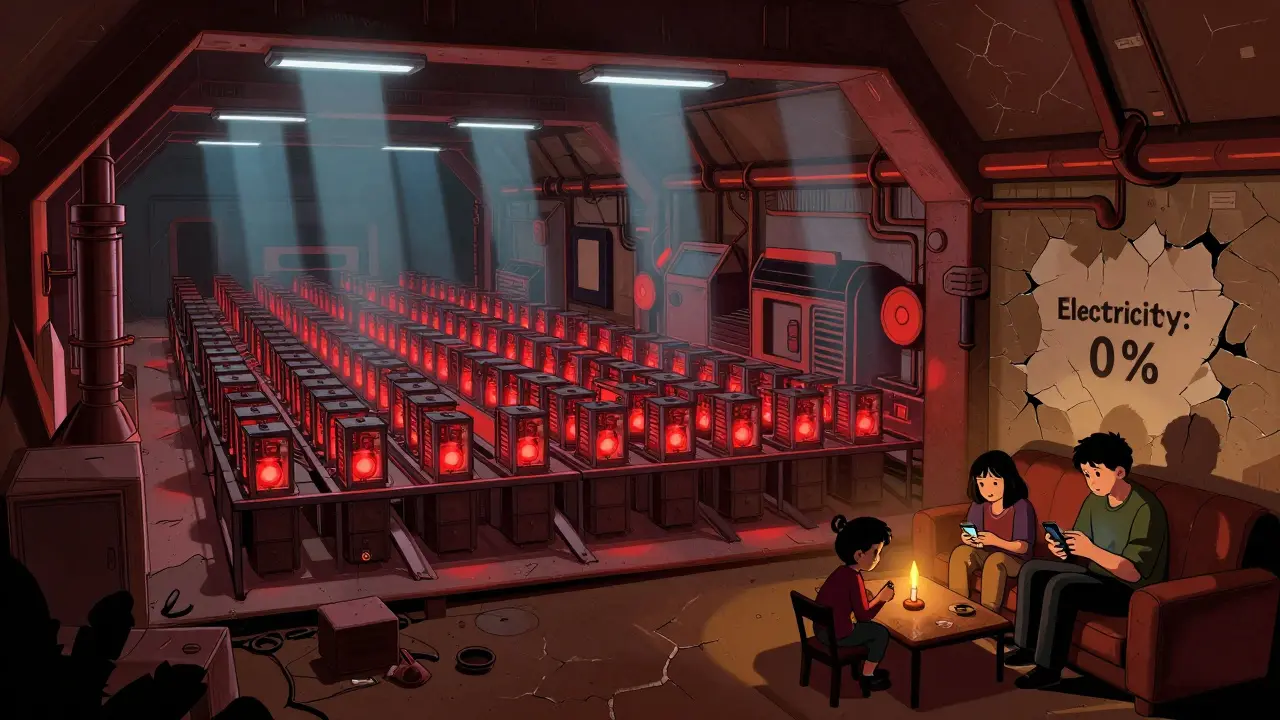
Most Iranians don’t have access to reliable power. In summer, 8 to 12 hours of blackouts per day are common. Families in cities like Ahvaz and Shiraz wait for hours just to charge a phone or run a fridge. Meanwhile, mining farms run 24/7 - often hidden in industrial zones, warehouses, or even inside the tunnels of Ahvaz Stadium. Social media is flooded with anger. On Twitter, @IranEnergyCrisis posted: “21 hours of blackouts this week while the IRGC’s mining farms in Ahvaz Stadium tunnels run 24/7 - this is economic terrorism against ordinary Iranians.” Reddit’s r/Iran had over 1,450 comments in June 2025. Ninety-two percent blamed crypto mining for the outages. Telegram channels like “Iran Electricity Crisis” now share real-time maps showing blackout patterns tied to known mining locations. One admin wrote: “Every time Bitcoin’s price surges, blackouts increase by 30-40% within 48 hours.” It’s not just frustration. It’s survival. People are choosing between turning on a fan or charging a medical device. Students study by candlelight. Hospitals rely on backup generators that cost more than they can afford. And yet, the government continues to protect the miners.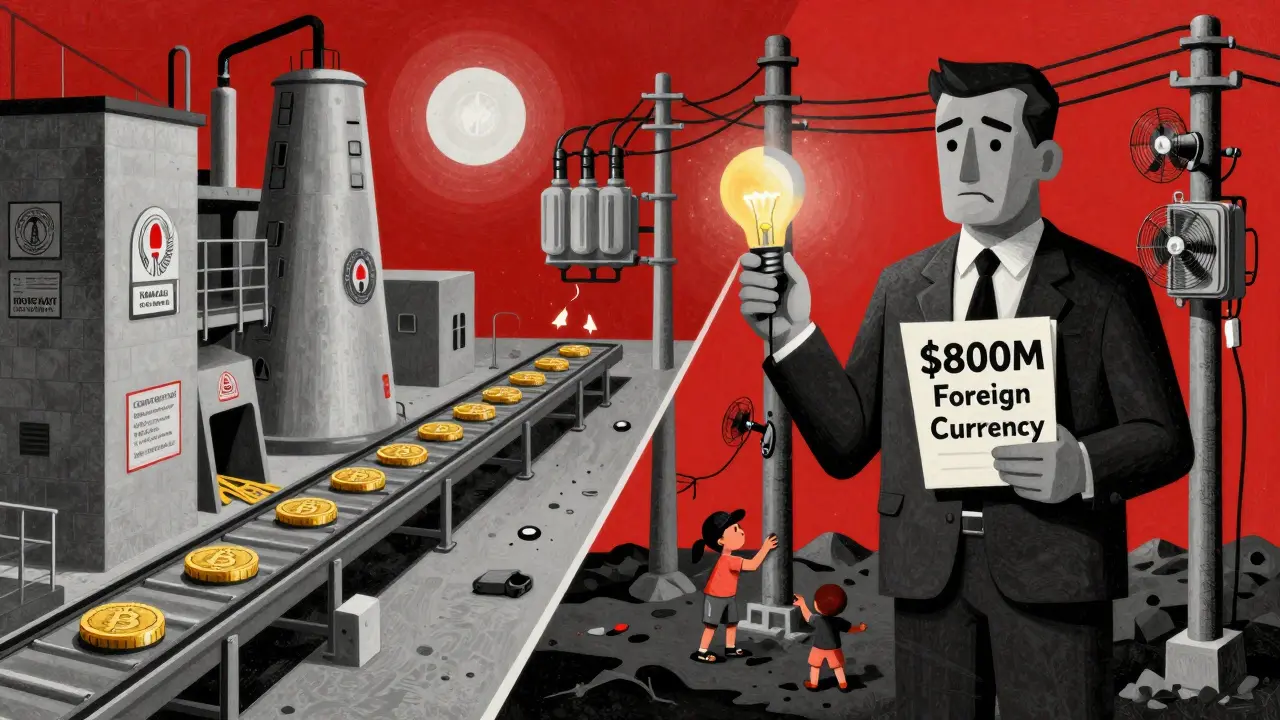
Who Really Benefits? The IRGC and the Black Market
The government claims licensed mining brings in $800 million annually in foreign exchange. But the real power lies elsewhere. According to multiple reports, the Islamic Revolutionary Guard Corps (IRGC) controls between 55% and 65% of all mining operations - either directly or through front companies. These aren’t small-time hobbyists. These are state-backed operations with access to subsidized power, imported equipment, and direct export channels. The CBI bans domestic cryptocurrency payments. So, Bitcoin can’t be used to pay for groceries or gas. But it can be used to buy medicine, machinery, and fuel from countries that ignore sanctions. That’s the real goal: bypassing the global financial system. The IRGC doesn’t care if a family in Kerman has no power. They care about the dollars they’re earning. This isn’t just corruption. It’s a parallel economy - one where the state controls both the energy supply and the output. Dr. Saeed Laylaz, economic advisor to former President Khatami, put it bluntly: “The government has created a system where the IRGC profits from stolen electricity, while ordinary citizens pay with their daily lives.”The Regulatory Maze: Licenses, Fees, and Fakes
To mine legally, you need four permits: from the Ministry of Industry (for equipment), Tavanir (for electricity), the CBI (for export), and the Iran Blockchain Council (for registration). The process takes 3 to 6 months. Approval rates? Below 40%. And even if you get approved, you pay $0.04 to $0.07 per kWh - still far below global prices. Meanwhile, illegal miners pay nothing. They tap into household lines, use stolen transformers, or install hidden rigs in public buildings. The government’s response? A reward program. Citizens who report illegal mining get 10% of the recovered electricity cost as cash. In the first half of 2025, 8,432 reports led to 2,157 shutdowns. But for every one they catch, ten more pop up. The real problem? The grid wasn’t built for this. Iran’s infrastructure is 60-70% below what it needs to function reliably. Transformers overheat. Power lines sag. Substations fail. And when they do, it’s not the miners who suffer. It’s the people.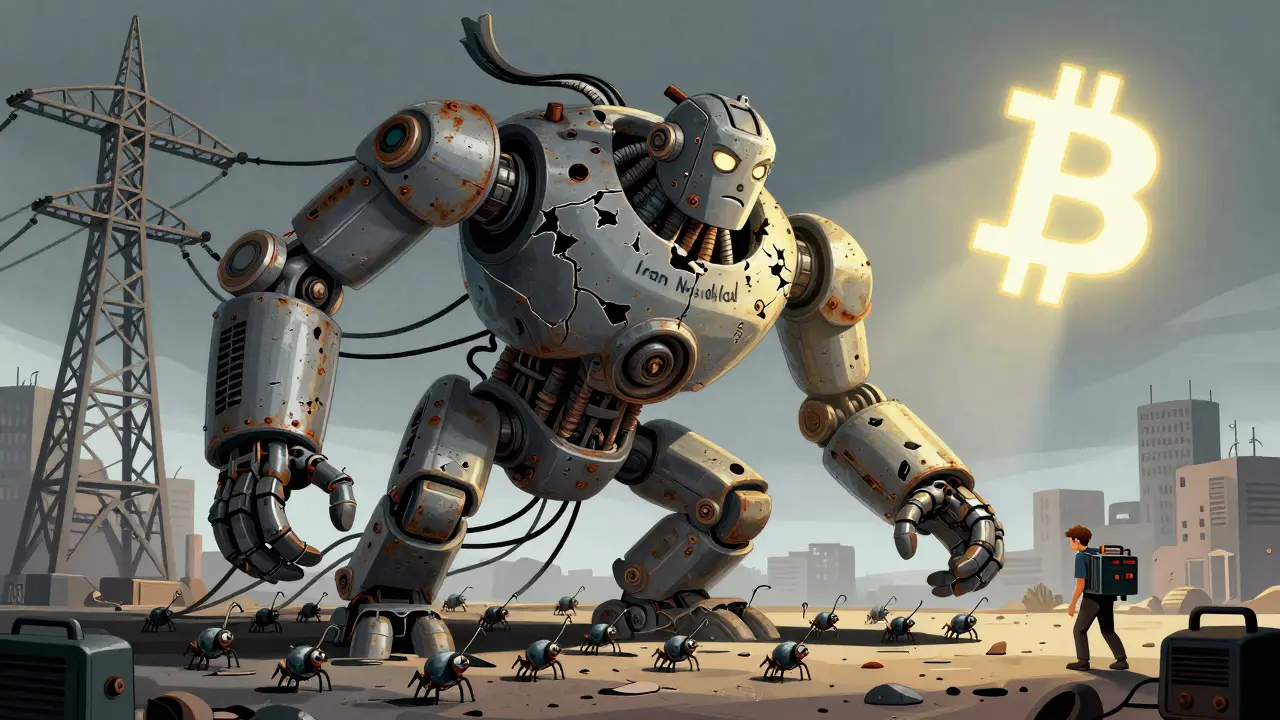
Why This Can’t Last
The International Energy Agency predicts that without major upgrades, Iran’s power shortages could increase by 25-30% by 2027. The Carnegie Endowment calls this situation “a microcosm of Iran’s broader energy policy challenges - short-term gains versus long-term collapse.” Kazakhstan, once Iran’s main competitor, now mines Bitcoin at $5,000 per coin. It’s more expensive, but its grid is stable. Iran’s advantage isn’t technology. It’s theft. Theft of public resources. Theft of electricity. Theft of dignity. The government keeps tweaking the rules - new smart meters, industrial zoning, real-time monitoring. But none of it fixes the core issue: why should a nation with 80 million people let a few thousand machines drain its power so a handful of elites can profit?What Comes Next?
There’s no easy answer. Cutting subsidies would crash the mining industry - and with it, the foreign currency flow the regime depends on. But keeping them means more blackouts, more anger, and a grid that will eventually fail. For now, Iran walks a razor’s edge. Miners still get cheap power. Citizens still lose electricity. And the world watches as one of the largest crypto mining operations on Earth runs on the backs of its own people.Why does Iran subsidize electricity for crypto mining?
Iran subsidizes electricity for crypto mining because it allows the government to generate foreign currency without using traditional banking systems. With international sanctions blocking access to dollars and euros, mining Bitcoin and selling it abroad became a way to bypass those restrictions. The state profits indirectly - mostly through the IRGC, which controls most large-scale operations - while the public pays with rolling blackouts and grid instability.
How much electricity does crypto mining use in Iran?
Cryptocurrency mining consumes an estimated 2,000 megawatts (MW) of electricity daily, which is about 5% of Iran’s total power generation. Illegal operations alone are estimated to use up to 2 gigawatts - equivalent to the entire electricity demand of Tehran. During peak summer months, mining accounts for 15-20% of the country’s electricity imbalance, meaning the grid struggles to meet basic household needs.
Is crypto mining legal in Iran?
Yes, but only under strict conditions. Licensed miners can operate if they get permits from multiple agencies, pay industrial electricity rates ($0.04-$0.07/kWh), and export their mined coins for trade. However, over 90% of mining is done illegally - using household power, stolen transformers, or hidden facilities. The government tolerates this because it still generates foreign currency, even if it’s not officially tracked.
Why do Iranians blame crypto mining for blackouts?
Because the timing matches. During summer, when air conditioning demand spikes, blackouts worsen. When Bitcoin prices surge, mining activity increases, and power consumption jumps. Social media data and blackout maps show clear correlations: when mining ramps up, households lose power. In July 2025, a nationwide internet outage caused a 2,400 MW drop in power use - directly linked to the shutdown of 900,000 illegal mining devices. For many Iranians, it’s not speculation - it’s lived experience.
Who controls most of Iran’s crypto mining?
The Islamic Revolutionary Guard Corps (IRGC) controls between 55% and 65% of all mining operations, either directly or through front companies. These aren’t small farms - they’re industrial-scale operations with access to subsidized power, imported equipment, and direct export channels. The IRGC uses the profits to fund operations outside the official economy, bypassing central bank oversight and international sanctions.
Can Iran stop crypto mining without crashing its economy?
Not easily. Cutting subsidies would collapse the mining industry overnight - and with it, the $1.5 billion in annual foreign exchange earnings the regime relies on. But continuing it means accelerating grid collapse. The government’s current strategy - periodic bans during summer, fines for illegal miners, and rewards for informants - is a temporary fix. Without major investment in power infrastructure, the system will eventually fail. The real choice isn’t between mining and no mining. It’s between saving the grid or saving the profits.
Ekaterina Sergeevna
February 14, 2026 AT 19:36Let’s be real - this isn’t about energy policy. It’s about rent-seeking kleptocracy with ASICs. The IRGC didn’t invent mining; they weaponized it. When your state’s entire foreign exchange strategy hinges on siphoning electricity from households like some dystopian Bitcoin vampire bat, you’re not solving sanctions - you’re just automating the collapse. And yes, I’m calling it *economic necromancy*.
Meanwhile, the West keeps pretending blockchain is about decentralization. Nope. It’s just a new vector for authoritarian capital accumulation. The grid doesn’t fail because of bad infrastructure. It fails because power is treated as a commodity to be extracted, not a public good. Welcome to 2025: where your fan is a liability and your neighbor’s rig is a national asset.
Desiree Foo
February 16, 2026 AT 17:00This is deeply unethical. We are talking about human suffering here - families without refrigeration for medicine, children studying by candlelight, hospitals running on donated generators. Meanwhile, state-backed mining operations consume the equivalent of a major city’s power needs, all to generate foreign currency for a regime that doesn’t even let its people spend Bitcoin locally. This isn’t innovation. It’s exploitation. And if we as a global community continue to ignore it, we become complicit.
The moral failure isn’t just Iran’s - it’s ours for doing nothing.
Ace Crystal
February 17, 2026 AT 23:55Look - if you want to solve this, stop talking about ethics and start talking about incentives. The government doesn’t care about blackouts. They care about dollars. So why not flip the script? Offer miners a deal: convert 30% of their hash power into grid-stabilizing load - like using waste heat for district heating or feeding excess capacity into smart microgrids during peak hours. Turn miners from parasites into partners.
It’s not magic. It’s engineering. We’ve done this with data centers in Iceland and Norway. Iran’s infrastructure is trash? Fix it with revenue from the very thing destroying it. The tech’s already here. The will? That’s the only thing missing.
Brittany Meadows
February 18, 2026 AT 04:50Okay but… what if this is all a psyop? 🤔
What if the IRGC isn’t mining Bitcoin at all? What if they’re just *pretending* to mine to trigger global panic? Like, imagine - they’re using the mining narrative to justify hoarding energy so they can blackout entire regions during protests. The 2,400 MW drop during the internet outage? That was a controlled demo. They wanted to show the world how easily they can turn off the lights. And now everyone’s blaming crypto. Genius. 😈
Also… who says Bitcoin is even real? 🤷♀️ Maybe it’s just a blockchain-shaped ghost in the machine. 👻
SAKTHIVEL A
February 18, 2026 AT 11:35It is imperative to note that the structural inefficiencies inherent in Iran's energy distribution architecture have been exacerbated by the unchecked proliferation of high-throughput computational apparatuses. The fiscal calculus underpinning the state's sanction-bypassing strategy is fundamentally unsustainable, as it externalizes social costs onto the citizenry while internalizing profits within the military-industrial complex. This constitutes a textbook case of rentier capitalism, wherein public infrastructure is monetized through clandestine commodification. The absence of regulatory parity between licensed and illicit operations further entrenches systemic inequity. A paradigm shift is not merely advisable - it is non-negotiable.
krista muzer
February 19, 2026 AT 00:14i just… i don’t know. i mean, i get that the irgc is stealing power and people are suffering, but like… what if mining is the only thing keeping the economy from total collapse? like, if they shut it down, would the government just stop paying salaries? would hospitals get even less funding? i’m not saying it’s fair, but sometimes the least bad option is still terrible.
also i read that some miners are just regular people trying to make rent. like, not irgc, just dudes with rigs in their garages. are we supposed to punish them too? idk. i feel sad.
blake blackner
February 20, 2026 AT 18:51Y’all are missing the point. 😔
It’s not about who’s mining. It’s about who’s *allowed* to mine. The IRGC doesn’t need a permit. They don’t pay a dime. They just… take. Meanwhile, the guy who got his license after 6 months and paid $0.06/kWh? He’s getting audited. His rig gets shut down. His wife cries. His kid misses school because the lights are out.
It’s not crypto. It’s corruption. And it’s not even subtle. 💔
Also… why are we still talking about Bitcoin? We’re talking about power. Human power. That’s the real blockchain.
Andrea Atzori
February 22, 2026 AT 09:48This situation is a tragic convergence of geopolitical isolation, infrastructural decay, and technological opportunism. The Iranian state, cornered by sanctions, has weaponized its most abundant resource - subsidized electricity - to create a parallel financial ecosystem. But the cost is not abstract. It is measured in the silent suffering of children who cannot study after dark, in the elderly who cannot refrigerate insulin, in the nurses who work double shifts because the hospital generator failed again.
While the West debates regulation, Iran is living the consequence of unregulated extraction. This is not a case study. It is a humanitarian emergency masked as economic policy. We must not mistake innovation for exploitation.
Grace Mugambi
February 23, 2026 AT 20:17I think we need to step back and ask: what does energy justice look like? Is it fair that a nation’s most vulnerable citizens bear the cost of a policy designed to circumvent global financial exclusion? The miners aren’t the enemy - the system is.
Maybe the real solution isn’t shutting down rigs. Maybe it’s building a new grid. One that doesn’t require theft. One that gives power back to the people - not as a privilege, but as a right.
And if we can’t do that… then what are we even doing here?
Beth Trittschuh
February 25, 2026 AT 03:29…
just… i looked at the numbers again.
2,000 MW. 5% of generation.
but 15-20% of imbalance.
so… the rest of the grid is failing because of the *other* 95%? 😕
or is it… that the 5% is the last straw?
i don’t know.
i just… feel heavy.
Benjamin Andrew
February 25, 2026 AT 23:26Let’s quantify the moral hazard. The IRGC’s mining operations yield approximately $1.5B annually in hard currency. The cost of blackouts? Estimated at $4.2B in lost productivity, healthcare disruptions, and informal economic contraction. So the regime is generating a net negative return on its energy policy. That’s not strategic. That’s incompetence wrapped in ideology. And the fact that they’ve created a reward system for citizens to inform on neighbors? That’s not policy. That’s psychological warfare. You don’t solve a grid crisis by turning your population into snitches. You solve it by upgrading transformers - not trust.
Holly Perkins
February 26, 2026 AT 18:47so like… the irgc mines bitcoin and people get blackouts? yeah that sounds about right. i mean… it’s not like they’re the first gov to screw over its people for cash. but still. wow. just… wow. 🤦♀️
Will Lum
February 27, 2026 AT 13:17People forget: energy isn’t just watts. It’s time. It’s safety. It’s dignity.
When your fridge dies, you don’t just lose food. You lose trust.
When your kid can’t study, you don’t just lose light. You lose hope.
They’re mining coins.
We’re mining trauma.
Sanchita Nahar
February 28, 2026 AT 22:08Why is everyone surprised? The government always chooses the rich. Always. In every country. In Iran, the miners are just the new rich. The rest of us? We’re the old poor. Same story. Different machines.
Ben Pintilie
March 1, 2026 AT 11:50lol imagine being so desperate for dollars you turn your whole country into a data center. 🤡
Sakshi Arora
March 3, 2026 AT 08:07if the grid is so bad why not just shut down the mining and fix it first
why wait till everyone is dead
why not act before it's too late
why always wait
bala murali
March 5, 2026 AT 02:23The structural vulnerability of Iran’s grid reveals a deeper truth: when energy policy is divorced from social welfare, it becomes a tool of exclusion, not inclusion. The licensed miner pays a subsidized rate - but the unlicensed miner pays nothing. The citizen pays everything. This asymmetry is not accidental. It is institutional. And until we recognize that energy access is a human right - not a commodity to be rationed by state interest - we will continue to see these tragedies repeat across borders.
Kaz Selbie
March 6, 2026 AT 06:17Let’s cut the euphemisms. This isn’t mining. It’s energy theft with a blockchain logo. The IRGC didn’t innovate - they looted. And the world? We’re just watching, like it’s a Netflix doc. Meanwhile, a kid in Shiraz is doing homework under a flashlight because the grid failed again. And we’re debating whether $0.04/kWh is ‘cheap’? That’s not economics. That’s moral bankruptcy.
Robbi Hess
March 7, 2026 AT 16:53The Iranian government has created a grotesque paradox: a national infrastructure collapse disguised as a sovereign financial strategy. The fact that 900,000 illegal mining rigs can be shut down overnight - and cause a 2,400 MW drop - is not evidence of resilience. It is evidence of catastrophic systemic dependency. This is not a nation mining Bitcoin. This is Bitcoin mining the nation. And the toll is measured in blackouts, not balances.
Ekaterina Sergeevna
March 8, 2026 AT 11:17Replying to Ace Crystal: You think turning miners into grid partners is the answer? Cute. But you’re assuming they’re rational actors. They’re not. They’re state proxies. The IRGC won’t give up control. They don’t care about microgrids. They care about dollars flowing offshore. Your ‘engineering solution’ ignores the political reality: this isn’t a technical problem. It’s a power play. And the only thing that fixes power plays? A revolution. Or a sanctions strike. Neither of which we’re going to get.