LaserSwap Crypto Exchange Review: Best for Base Chain Traders in 2025?
 Dec, 19 2025
If you're trading tokens on the Base blockchain, you’ve probably heard of LaserSwap. It’s not Binance. It’s not Uniswap. But for users deep in the Base ecosystem, it’s one of the few places where new memecoins and niche tokens get listed before they hit bigger platforms. The question is: should you be using it? And more importantly, is it safe, fast, and worth your time in late 2025?
What Is LaserSwap?
LaserSwap is a decentralized exchange (DEX) built entirely on the Base network - Coinbase’s Layer 2 blockchain built on Ethereum. Unlike centralized exchanges where your crypto is held by the company, LaserSwap lets you trade directly from your wallet. No deposits. No KYC. No middleman. You sign transactions with MetaMask or Coinbase Wallet, and your funds never leave your control.
It launched in 2024 and has since carved out a small but steady niche. As of November 2025, it handles around $8.7 million in daily volume. That’s tiny compared to Uniswap’s $1.2 billion, but for Base-native tokens? It’s often the first stop. Think of it as the local farmer’s market for crypto tokens that haven’t made it to the big supermarket yet.
How LaserSwap Works
LaserSwap uses the standard automated market maker (AMM) model. That means trades happen through liquidity pools - groups of token pairs locked in smart contracts. When you swap ETH for a new memecoin, you’re not buying it from someone else. You’re exchanging it with a pool of funds contributed by other users.
The fee structure is simple: 0.3% per trade. Of that, 0.25% goes to liquidity providers. The remaining 0.05% goes into the protocol treasury, used to fund future upgrades. That’s the same as Uniswap and most other DEXs.
Gas fees? That’s where LaserSwap shines. On Ethereum mainnet, swapping tokens can cost $2-$5 during busy times. On Base, it’s usually under $0.05. For frequent traders or those swapping small amounts, that adds up fast.
Security and Audits
LaserSwap’s smart contracts were audited by BlockSec in March 2025. That’s a solid firm - they’ve worked with Chainlink and Aave. But here’s the catch: no public audit report exists. You can’t see what they found, what they fixed, or if any high-risk issues were missed.
Compare that to Curve Finance, which underwent four separate audits from OpenZeppelin, Trail of Bits, and others. LaserSwap’s single audit is better than nothing, but it’s not industry-leading. And while there are no reported scams targeting LaserSwap users (per CryptoScamDB), GitHub shows 127 open issues - 43 of them marked as critical. One major front-running bug was patched in August 2025, but that’s the kind of thing that can wipe out a user’s position in seconds if unpatched.
Bottom line: LaserSwap is not risky because it’s a scam. It’s risky because it’s under-resourced. If a new exploit emerges, there’s no 24/7 security team waiting to respond.
Liquidity and Slippage
This is where most users get burned.
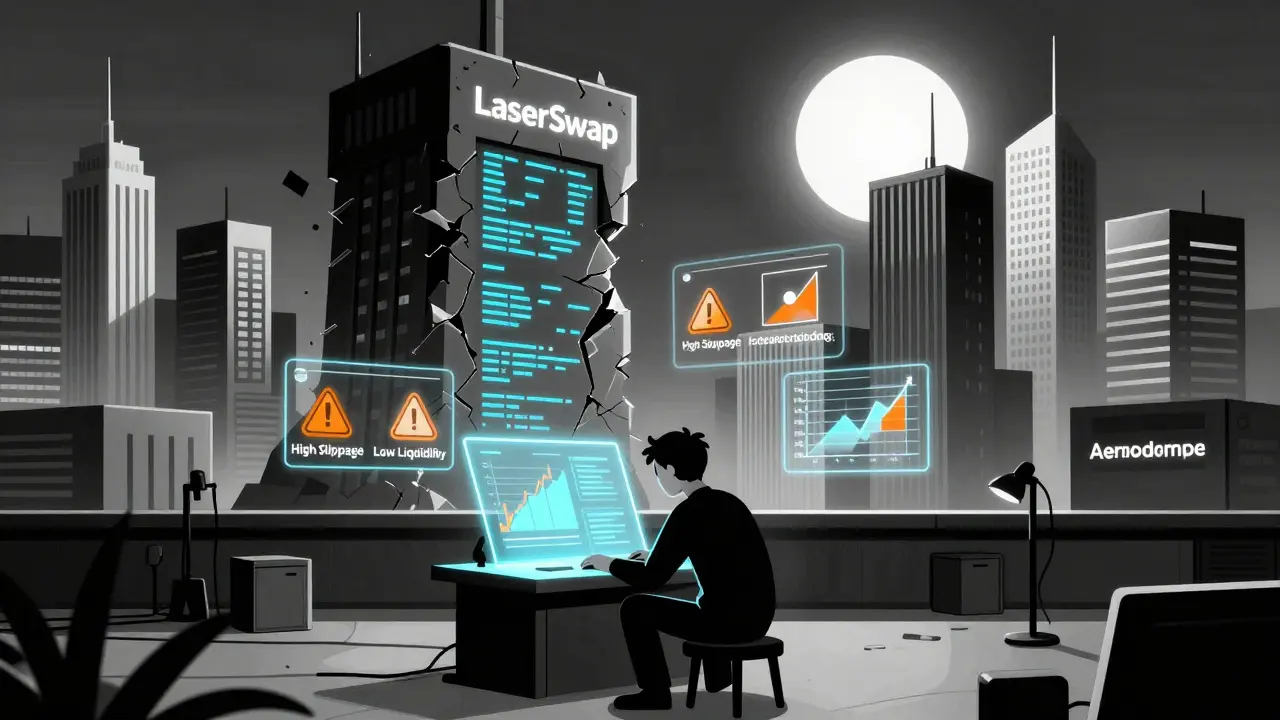
LaserSwap has about 1,200 tradable token pairs. Uniswap has over 15,000. That means if you’re trying to swap a lesser-known token, you’re likely dealing with thin liquidity. For a $10,000 trade, average slippage is 1.2%. On Uniswap, it’s 0.4%. That’s a 3x difference.
Slippage isn’t just a number - it’s money lost. If you’re buying a new token and the price moves 1.2% before your trade executes, you’re paying more than you expected. In volatile markets, that can turn a good trade into a bad one.
Also, many Base-native tokens have no stablecoin pairs. You can’t swap USDC for a new token directly. You have to go ETH → token, or worse, USDC → ETH → token. That’s two trades, two fees, and two chances for slippage to bite you.
What You Can’t Do on LaserSwap
Let’s be clear: LaserSwap is not a full-service exchange.
- No fiat on-ramps. You can’t buy crypto with a credit card here.
- No limit orders. Only market swaps.
- No charting tools. No technical indicators. No trading view integration.
- No customer support. If you mess up, you’re on your own.
- No mobile app. It’s web-only.
- No insurance fund. If a hack happens, you lose everything.
If you’re used to Binance or Coinbase, this will feel like using a flip phone in 2025. But if you’re hunting for early-stage tokens on Base? It’s one of the few tools that lets you get in before the price pumps.
Who Is LaserSwap For?
LaserSwap isn’t for everyone. It’s not for beginners. It’s not for traders who want to buy Bitcoin with a debit card. It’s not for people who want to sleep at night knowing their funds are insured.
It’s for three types of people:
- Base ecosystem early adopters - You’re already using Base. You’re holding $BASE. You want to trade new tokens before they list on bigger DEXs.
- Memecoin hunters - You’re chasing the next $BONK or $PEPE on Base. LaserSwap is often the first place these tokens get liquidity.
- DeFi-savvy traders - You know what slippage is. You understand impermanent loss. You’ve lost money before and learned from it.
If you fall into one of those buckets, LaserSwap is worth a look. If you don’t, stick with Uniswap or a centralized exchange.
User Experience and Interface
The interface is clean. Minimalist. It’s got three tabs: Swap, Pool, and Earn. That’s it. No clutter. No ads. No confusing menus.
Connecting your wallet takes one click. Swapping tokens is straightforward - pick the pair, set your slippage tolerance (always adjust this!), and confirm. Most users report their first successful swap takes 2-3 hours if they’re new to DEXs.
But here’s the problem: documentation is weak. The wiki on GitHub has basic instructions, but nothing explains how to avoid impermanent loss. Nothing warns you that liquidity pools for new tokens can vanish overnight. No one tells you that if your transaction takes longer than 20 minutes, it’ll fail and your gas fee is gone.
Support? Only on Discord. 12,340 members. Average response time: 4.7 hours. That’s not customer service. That’s crowd-sourced help. If you’re stuck at 2 a.m. with a stuck transaction, you’re on your own.
Competition on Base
LaserSwap isn’t alone on Base. There are dozens of DEXs there. The biggest? Aerodrome Finance, with 62% of trading volume. Then BaseSwap at 18.7%. LaserSwap sits at 4.3% - small, but not dead.
Aerodrome has advanced features: limit orders, veTokenomics, boosted yields. BaseSwap has better liquidity and more stablecoin pairs. LaserSwap’s only edge? It’s one of the earliest DEXs on Base. Some tokens list there first. That’s it.
And the trend? Smaller DEXs are dying. Twelve Base-native exchanges shut down or merged in 2025. Messari predicts only 3-4 specialized DEXs will survive per L2 ecosystem by 2027. LaserSwap is hanging on - but barely.
Future Plans
LaserSwap is working on v2, scheduled for Q1 2026. The big upgrade? Concentrated liquidity - the same feature Uniswap V3 uses. That means liquidity providers can set custom price ranges, making capital efficiency way better. If they pull this off, LaserSwap could become a serious contender.
They’ve also integrated with Snowflake for on-chain analytics. That’s a good sign - they’re trying to make their data useful for tax tools and portfolio trackers. Crypto Tax Calculator now includes LaserSwap in its US tax guides, which means more users are showing up.
But here’s the catch: Uniswap is also expanding on Base. Coinbase is pushing its own Base-native tools. If LaserSwap doesn’t deliver v2 on time, or if v2 has bugs, it could get buried under bigger players.
Final Verdict
LaserSwap is not a top-tier exchange. It’s not safe. It’s not easy. It’s not for beginners.
But if you’re serious about trading new tokens on the Base chain - and you know what you’re doing - it’s one of the few tools that gives you early access. The fees are low. The interface is simple. And for now, it’s still one of the few places where the next big memecoin might launch.
Use it like a scalpel, not a hammer. Only trade tokens you’ve researched. Never put in more than you can afford to lose. And always, always check the liquidity depth before swapping.
It’s not the future of crypto. But for now, on Base, it’s still a necessary tool for those who know where to look.
Is LaserSwap safe to use?
LaserSwap is non-custodial, so your funds stay in your wallet - that’s good. But its smart contracts were only audited once by BlockSec, with no public report. GitHub shows 43 critical open issues, including a past front-running bug. It’s not a scam, but it’s not secure by top-tier standards. Only use it if you understand the risks and don’t trade more than you can afford to lose.
Can I buy crypto with fiat on LaserSwap?
No. LaserSwap is a decentralized exchange and doesn’t support fiat on-ramps. You need to buy crypto like ETH or USDC on a centralized exchange like Coinbase or Binance first, then transfer it to your wallet and connect to LaserSwap.
What’s the average trading fee on LaserSwap?
LaserSwap charges 0.3% per trade. Of that, 0.25% goes to liquidity providers, and 0.05% goes to the protocol. Gas fees on Base are typically between $0.01 and $0.05 per transaction - far cheaper than Ethereum mainnet.
Does LaserSwap have a mobile app?
No. LaserSwap is a web-only platform. You need to use a browser on desktop or mobile, connect your wallet (like MetaMask), and interact through the website. There’s no official app in the App Store or Google Play.
How does LaserSwap compare to Uniswap?
Uniswap has 15,000+ token pairs, $1.2 billion daily volume, and better liquidity (0.4% slippage vs. LaserSwap’s 1.2%). It’s more stable and trusted. But LaserSwap has lower gas fees and often lists new Base-native tokens before Uniswap does. Uniswap is the supermarket. LaserSwap is the back-alley shop where the rarest finds are - if you’re willing to risk it.
Is LaserSwap regulated?
No. LaserSwap is a non-custodial DEX and doesn’t comply with KYC or AML regulations. The SEC is considering rules for DEXs that could force changes, but as of late 2025, no such rules are active. This makes LaserSwap anonymous but also riskier - there’s no legal recourse if something goes wrong.
What’s the biggest risk of using LaserSwap?
The biggest risk is thin liquidity. Many tokens on LaserSwap have very few users trading them. That means high slippage, sudden price drops, or even rug pulls. If you swap into a token with less than $50,000 in liquidity, you’re gambling. Always check the pool size before trading.
Should I provide liquidity on LaserSwap?
Only if you understand impermanent loss and are comfortable with high volatility. Liquidity pools for new Base tokens can be extremely risky - prices swing wildly, and you can lose more than you earn in fees. Stick to stablecoin pairs if you want to earn safely. Avoid new memecoins unless you’re speculating, not investing.
Brian Martitsch
December 21, 2025 AT 05:14Charles Freitas
December 22, 2025 AT 16:36Rachel McDonald
December 24, 2025 AT 07:33Vijay n
December 25, 2025 AT 00:58Alison Fenske
December 25, 2025 AT 21:35Grace Simmons
December 27, 2025 AT 11:41Collin Crawford
December 28, 2025 AT 13:22Jayakanth Kesan
December 28, 2025 AT 23:50Aaron Heaps
December 30, 2025 AT 02:49Earlene Dollie
December 31, 2025 AT 10:42Kevin Karpiak
January 2, 2026 AT 07:02Amit Kumar
January 4, 2026 AT 03:10Helen Pieracacos
January 4, 2026 AT 17:00Dustin Bright
January 5, 2026 AT 00:08chris yusunas
January 6, 2026 AT 13:21