NFT Art Ownership Rights Explained: What You Actually Own When You Buy an NFT
 Jan, 24 2026
When you buy an NFT of a digital artwork, you don’t own the art. You own a token on the blockchain. This sounds simple, but it’s the biggest misunderstanding in the entire NFT space. People spend thousands - sometimes millions - on NFTs thinking they’ve bought the right to use, print, or sell the image. They haven’t. Not unless the project explicitly says so.
What You Really Own: The Token, Not the Art
An NFT is a unique digital certificate stored on a blockchain. It points to a file - usually an image, video, or audio clip - hosted somewhere online. But owning that certificate doesn’t mean you own the file itself. Think of it like buying a signed poster of a famous painting. You own the poster, not the original painting hanging in the museum. The artist still holds the rights to reproduce, license, or sell copies of the painting. The same logic applies to NFTs.The legal documents behind most NFT projects make this crystal clear. Arnold Porter’s 2023 NFT agreement template states: "You do not gain any right, title, or interest in or to any of the artwork, images, music, audiovisual works, or other content associated with, or represented by, the NFT." That’s not a loophole. It’s the standard. Even when you buy a CryptoPunk for $1 million, you’re not buying the right to put it on a T-shirt, sell prints, or make a movie. You’re buying proof that you own that specific token.
Why This Confusion Exists
The confusion comes from how we think about ownership in the physical world. When you buy a painting, you can hang it on your wall, photograph it, or even resell it. You assume the same rules apply online. But digital files are different. They can be copied endlessly. A JPEG can be downloaded by a million people. The only thing that makes one copy "yours" is a blockchain record.Marketplaces like OpenSea don’t help. They show you the image. They let you click "Buy." But nowhere in the process do they clearly say: "You don’t own the copyright." A 2023 CoinGecko survey found only 32% of NFT marketplaces display IP rights information at checkout. Most buyers never read the terms. They assume. And that’s where trouble starts.
Reddit threads are full of stories: "I bought a Bored Ape. I printed it on a hoodie. Got a cease-and-desist letter." Or: "I used my NFT in my YouTube video. Now the project team is suing me." These aren’t rare cases. A DappRadar report from Q2 2023 found that 68% of NFT buyers admitted they didn’t understand the IP rights tied to their purchase.
The Three Types of NFT Licenses
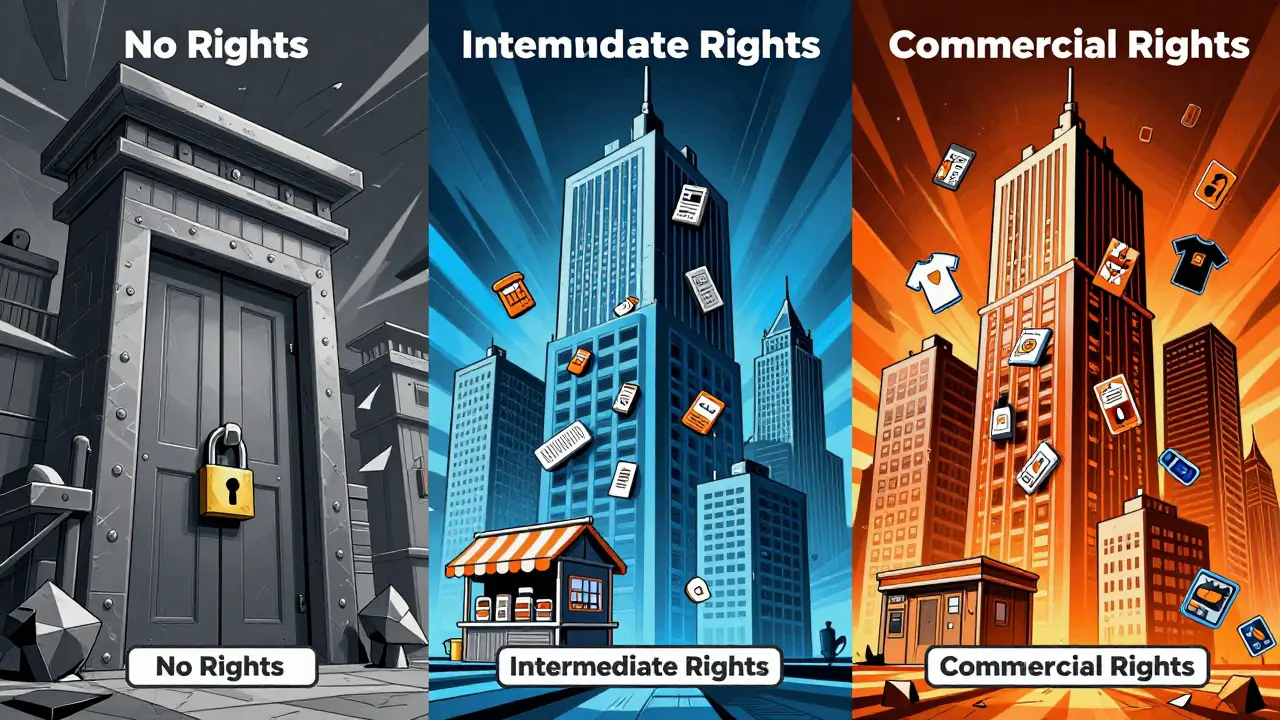
Not all NFTs are the same. The rights you get depend entirely on the project’s rules. There are three main models:- No Rights / Silence: Most early NFT projects - like the original CryptoPunks - didn’t grant any commercial rights. You could display the image on your profile, but that’s it. Printing it? Selling merch? Making a game? That’s copyright infringement. Some projects are silent, which legally means you have no rights at all.
- Intermediate Rights: Some projects let you use the image for personal use, maybe even sell prints in limited quantities. But you can’t build a brand around it. No merchandise lines, no licensing deals. This is common in smaller, artist-run collections.
- Broad Commercial Rights: This is the gold standard. Projects like Bored Ape Yacht Club (BAYC) and Mutant Ape Yacht Club (MAYC) give holders full commercial rights. You can make shirts, games, movies, NFTs based on your Ape, even sell the rights to others. The license is perpetual, worldwide, and transferable. That’s why BAYC NFTs have higher floor prices - they’re not just collectibles. They’re business assets.
The difference isn’t subtle. A DappRadar report showed that NFT collections with explicit commercial rights had, on average, 37% higher floor prices than those without. Buyers are paying extra for the ability to profit.
Real-World Examples That Changed Everything
In March 2022, Yuga Labs - the company behind Bored Apes - quietly changed their terms. They gave holders full commercial rights. Overnight, hundreds of businesses started using BAYC images. Clothing lines. Coffee brands. Video games. The value didn’t just rise. It exploded because the asset became usable.Contrast that with CryptoPunks. At launch, they had no commercial rights. In 2022, they did the same as BAYC. But by then, many buyers had already spent money thinking they owned nothing. The market reacted. Prices jumped. But the damage was done for early adopters who thought they had rights all along.
Then there’s the Nouns project. They released their NFTs under a CC0 license - meaning the artwork is in the public domain. Anyone can use it. But many buyers misunderstood. They thought they owned the "Nouns brand." They tried to trademark the name. They got shut down. The license lets you use the image. It doesn’t let you claim ownership of the entire project.
What Creators Should Know
If you’re an artist minting NFTs, your terms matter more than you think. If you keep all rights, your NFTs will sell to collectors who treat them like digital stamps. If you give away commercial rights, you open the door to a whole new economy - but you also lose control. Someone could make a bad product with your art. You can’t stop them.Legal experts like Rennoco warn: "Never mint an artwork you didn’t create yourself." If you use someone else’s image, even if it’s public domain, you could be liable. And if you use AI-generated art? That’s a legal gray zone. The U.S. Copyright Office ruled in September 2023 that AI-generated content without human authorship isn’t copyrightable. So if your NFT is made by Midjourney, you can’t claim copyright - even if you own the token.
What Buyers Should Do Before Buying
Don’t buy an NFT unless you know what rights come with it. Here’s your checklist:- Read the project’s official website. Look for a "License," "Terms," or "IP Rights" section. If it’s not there, assume you have zero rights.
- Check the smart contract. If it’s on Ethereum or Polygon, you can view it on Etherscan or Polygonscan. Look for terms like "license," "rights," or "grant." If it’s just code, you’ll need help reading it.
- Don’t trust the marketplace. OpenSea, Blur, LooksRare - they don’t enforce or define rights. They’re just exchanges.
- Ask for legal advice if it’s expensive. If you’re spending more than $10,000, get a lawyer who understands digital IP. Most won’t charge much for a quick review.
- Remember: The NFT is not the art. It’s a key. The art is behind the door. You only get the key unless the project says you also got the door.
The Future of NFT Ownership
The legal landscape is still evolving. The European Union’s Digital Markets Act (2023) is starting to address digital ownership, but there’s no global standard. The U.S. Copyright Office has received over 1,200 NFT-related copyright applications - almost all for the underlying artwork, not the token. That tells you who’s actually claiming rights.Major brands are catching on. A Deloitte report found that 73% of big companies now clearly define IP rights in their NFT terms - up from 41% in 2021. But independent artists? Only 28% do. That’s a problem. The wild west of NFTs is still out there.
As the market grows - projected to hit $136 billion by 2028 - clear licensing will be the difference between a collector’s item and a viable business. Projects that make rights obvious will win. Those that don’t will face lawsuits, confusion, and lost trust.
The bottom line? NFTs aren’t about owning art. They’re about owning a license. And licenses can be revoked, limited, or changed - unless they’re written in stone. Always read the fine print. Because in the world of NFTs, what you think you own is rarely what you actually own.
Do I own the copyright to an NFT artwork if I buy the NFT?
No. Owning an NFT does not transfer copyright ownership. The artist or creator retains all copyright and intellectual property rights unless they explicitly grant them in writing. Most NFT projects reserve all rights to the artwork, meaning you can’t reproduce, sell, or modify the image without permission.
Can I print my NFT art on a T-shirt and sell it?
Only if the project’s license explicitly allows commercial use. Most NFTs - including early CryptoPunks and many indie collections - do not. Selling merchandise without permission is copyright infringement. Projects like Bored Ape Yacht Club (BAYC) do allow it, but you must check the official terms before doing anything.
What happens if I use an NFT image without permission?
The copyright holder can send a cease-and-desist letter, file a DMCA takedown, or sue for damages. There have been multiple cases where NFT owners were sued for using their NFTs in ads, apps, or merchandise without a license. Even if you bought the NFT, you’re still violating copyright law if you use the image beyond what the license permits.
Are NFTs protected by copyright?
No. The NFT itself - the blockchain token - is not copyrightable. It’s just a digital certificate with metadata. Copyright protects the underlying artwork: the image, music, or video it points to. The token has value because it proves ownership of the unique version, not because it’s creative content.
Why do some NFTs cost more than others?
The price often reflects the rights included. NFTs with commercial usage rights - like BAYC or Mutant Apes - typically cost 37% more than those without, according to DappRadar. Buyers pay more because they can build businesses around them. A collectible with no rights is just a digital sticker. One with commercial rights is a license to earn.
Can I trademark my NFT character?
Only if you have explicit rights to do so. Many NFT holders tried to trademark Bored Ape or CryptoPunk images - and were shut down by the original creators. You can’t trademark something you don’t own the copyright to. Even if you own the NFT, the IP remains with the artist or company unless transferred.
Do NFT marketplaces like OpenSea guarantee my rights?
No. OpenSea and other marketplaces are just platforms for buying and selling. They don’t define or enforce intellectual property rights. The rights come solely from the project’s terms. Always read the project’s website, not the marketplace listing.
What if the NFT artwork was made with AI?
If the artwork was generated entirely by AI with no human creative input, it may not be copyrightable at all, according to the U.S. Copyright Office’s 2023 ruling. That means even the original creator can’t claim copyright. But the NFT token itself still exists - you own the record on the blockchain, but there may be no underlying legal rights to enforce.
Jonny Lindva
January 24, 2026 AT 17:48So many people think buying an NFT is like buying a painting. It’s not. It’s like buying a numbered receipt for a poster. You got the receipt, not the poster. I’ve seen folks get mad because they printed their Bored Ape on a shirt and got sued. Dude, the terms were right there. Read before you spend.
Jen Allanson
January 25, 2026 AT 23:39It is an egregious disservice to the public that marketplace interfaces do not prominently display intellectual property rights at the point of transaction. The absence of such fundamental disclosures constitutes a form of deceptive commercial practice, and regulatory bodies ought to intervene forthwith.
Harshal Parmar
January 27, 2026 AT 17:56Man, I feel you on this. I bought my first NFT last year thinking I could make merch out of it, you know? Like, it’s just a picture right? But then I read the fine print and realized I didn’t own jack. I felt so dumb. But hey, I learned. Now I always check the license before I click buy. It’s not about the art, it’s about the rights. And if the project doesn’t spell it out? I walk away. No regrets. Life’s too short to get sued over a JPEG.
Darrell Cole
January 28, 2026 AT 16:35Barbara Rousseau-Osborn
January 29, 2026 AT 21:20steven sun
January 30, 2026 AT 11:49Catherine Hays
January 31, 2026 AT 12:33Chidimma Catherine
February 2, 2026 AT 11:27Nathan Drake
February 3, 2026 AT 11:32It’s fascinating how we project physical-world ownership onto digital objects. The NFT is a symbolic gesture, a social contract encoded in code. The art is ephemeral, mutable, reproducible - the token is the only thing immutable. But we cling to the illusion that we possess the image because we crave permanence in a transient digital world. Maybe the real ownership is the belief we hold - not the blockchain record.
Melissa Contreras López
February 3, 2026 AT 20:40Y’all need to stop treating NFTs like they’re magic tickets to fame and fortune. It’s not about the hype, it’s about the license. Think of it like renting a Ferrari vs owning one. If the contract says you can’t drive it on the highway, guess what? You’re not getting behind the wheel. But if the project says you can make merch? That’s your golden ticket. Don’t be the person who buys the keys and then cries because the car won’t start. Read the manual. It’s right there.
Mike Stay
February 5, 2026 AT 09:26The evolution of NFT licensing mirrors the broader transition from physical to digital economies. In the 20th century, ownership was tangible - a deed, a title, a certificate. In the 21st, it’s contractual. The NFT is not the artifact; it is the license key. What we’re witnessing is not a collapse of value, but a redefinition of value itself. The future belongs to projects that articulate rights with clarity, not those that rely on ambiguity to inflate prices.
Taylor Mills
February 6, 2026 AT 22:15Arielle Hernandez
February 8, 2026 AT 02:20It’s critical to distinguish between the NFT as a cryptographic token and the intellectual property it references. The token is a non-fungible ledger entry; the artwork is a separate, copyrightable work. Without an explicit license transfer, no IP rights are conveyed. This is not a loophole - it’s foundational to copyright law. The U.S. Copyright Office’s 2023 guidance on AI-generated content further reinforces that ownership of a token does not equate to authorship or control of the underlying creative work.
HARSHA NAVALKAR
February 8, 2026 AT 21:19Ryan Depew
February 10, 2026 AT 12:40Look, I get it. You saw a cool ape on OpenSea, clicked buy, and now you’re wondering why you can’t sell merch. The truth? Most projects don’t care. They want you to buy the hype, not the rights. But the ones that do give you commercial use? Those are the ones that last. BAYC didn’t win because the art was better - they won because they gave you a business. If you’re spending more than $10k, get a lawyer. Seriously. Don’t be the guy who got owned by a cease-and-desist.
Mathew Finch
February 11, 2026 AT 11:23Jessica Boling
February 13, 2026 AT 05:29Tammy Goodwin
February 13, 2026 AT 21:38I think the real tragedy isn’t the confusion - it’s how many artists are scared to give away rights because they fear losing control. But the truth is, the most valuable NFTs aren’t the ones with locked-down IP. They’re the ones that let people run with the art. BAYC didn’t become a billion-dollar brand by hoarding rights. They let the community build around it. Maybe the real ownership is the community, not the token.
Shamari Harrison
February 15, 2026 AT 05:43Before you buy any NFT, ask yourself: if the project vanished tomorrow, what do you actually have? A link to a dead server? Or a license that lets you use the image forever? Most NFTs are just digital postcards. But the ones with clear, written commercial rights? Those are assets. Treat them like one. And if you’re an artist - give the community something real to build with. You’ll get more in the long run.
Jonny Lindva
February 16, 2026 AT 09:19Just saw someone say they used their NFT in a YouTube video and got hit with a DMCA. Dude, that’s not the platform’s fault. That’s your fault for not reading the license. I’ve seen this 100 times. The project doesn’t owe you rights. You owe it to yourself to check before you spend.