NRI Crypto Tax Guide: Exemptions, Benefits, and the 2025 Rules
 May, 13 2026
For decades, Non-Resident Indians (NRIs) have had a distinct advantage in Indian tax planning. You could leverage specific exemptions on foreign exchange assets, reinvest capital gains into approved instruments, and shield certain income from domestic taxation. But when it comes to cryptocurrency, that safety net has vanished. If you are an NRI holding Bitcoin, Ethereum, or any other virtual asset, the current Indian tax regime treats you almost identically to a resident taxpayer, with very few-and largely non-existent-specific benefits.
The landscape shifted dramatically with the introduction of Virtual Digital Assets (VDAs) under the Income Tax Act. By April 2025, the rules were fully entrenched, creating a rigid framework that offers little room for traditional NRI tax optimization. Understanding these restrictions is not just about compliance; it is about protecting your wealth from unexpected liabilities, especially as new residency rules take effect in 2026.
The Flat 30% Tax Reality
The most immediate hurdle for NRIs is the flat tax rate. Under the current framework, any profit made from selling or transferring a Virtual Digital Asset is taxed at a flat 30%. This applies regardless of how long you held the asset. Unlike stocks or real estate, where holding periods determine whether you pay short-term or long-term capital gains tax, crypto ignores time entirely. Hold Bitcoin for one month or ten years-the tax rate remains the same.
This uniformity removes a key lever for tax planning. For residents, this might be manageable if they have other deductions to offset against their income. For NRIs, however, the situation is tighter. The law allows only one deduction: the cost of acquisition. You cannot claim transaction fees, wallet storage costs, or gas fees used during transfers. Every rupee spent on network fees effectively increases your taxable gain because it reduces your net proceeds without reducing your tax base.
| Feature | Traditional Assets (Stocks/Real Estate) | Cryptocurrency (VDA) |
|---|---|---|
| Tax Rate | Slab rates or LTCG (up to 20%) | Flat 30% |
| Holding Period Benefit | Yes (Long-term vs. Short-term) | No |
| Deductions Allowed | Expenses, improvements, indexation | Cost of acquisition only |
| Loss Set-off | Allowed against other income/gains | Not allowed |
| NRI Exemptions (Section 115F) | Available for specific reinvestments | Excluded |
The Myth of NRI Exemptions
Many NRIs look to Section 115F of the Income Tax Act for relief. This section traditionally allows NRIs to claim exemptions on long-term capital gains if they reinvest the proceeds into specified Indian financial instruments like bonds, debentures, or shares of Indian companies. It is a powerful tool for preserving capital.
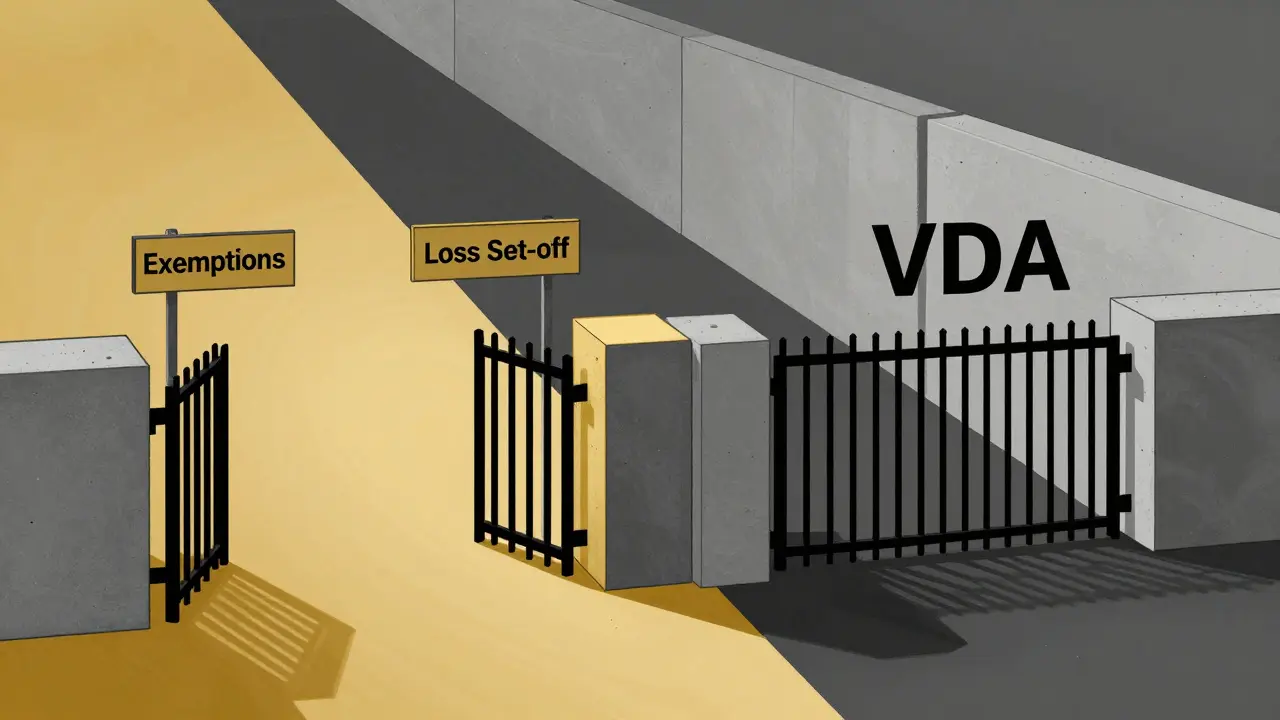
However, cryptocurrency is explicitly excluded from this benefit. The government does not recognize VDAs as eligible instruments for reinvestment under Section 115F. This means if you sell your crypto holdings for a profit, you cannot shelter that gain by buying Indian government bonds or equity shares. The 30% tax hits you immediately, and there is no mechanism to defer or eliminate it through reinvestment. This exclusion highlights the regulatory stance: crypto is treated as a high-risk, speculative asset rather than a stable investment vehicle worthy of preferential treatment.
TDS and the Compliance Trap
Beyond the tax rate itself, the collection mechanism poses significant challenges for NRIs. Under Section 194S, a Tax Deducted at Source (TDS) of 1% is levied on crypto transactions exceeding ₹50,000 (or ₹10,000 in some cases involving specified digital payment systems). This deduction happens at the source-typically the exchange-if the platform is registered in India.
For NRIs using international exchanges like Binance or Coinbase, this TDS may not apply directly at the point of sale. However, this creates a compliance risk. If you do not pay TDS upfront, you are responsible for self-assessment tax payments. Failure to file correctly can lead to penalties. Moreover, the ambiguity around what constitutes an "Indian source" transaction for offshore platforms leaves many NRIs in a gray area. Are you liable if you trade on a US-based platform while residing in London? The answer depends on complex interpretations of residency and source of income, which often require professional legal advice to navigate safely.
Residency Changes: The 2026 Shift
The stakes rise significantly with the new residency rules effective from April 1, 2026. The threshold for being classified as a tax resident in India has dropped from 182 days to 120 days. If you stay in India for 120 days or more in a financial year and earn over ₹15 lakhs from Indian sources, you will be deemed a resident for tax purposes.
This change is critical for NRIs who split their time between India and abroad. Previously, you could spend nearly six months in India and still maintain NRI status, shielding your global crypto gains from Indian taxation. Now, staying for four months triggers residential status. Once you become a resident, your entire worldwide income-including crypto gains earned on exchanges outside India-becomes taxable in India. This effectively eliminates the primary benefit of NRI status for crypto investors: the ability to keep foreign-sourced gains out of the Indian tax net.
Even the Resident but Not Ordinarily Resident (RNOR) category, which usually limits taxation to income earned or received in India, faces uncertainty with decentralized assets. Since crypto transactions occur on blockchains without a physical location, determining whether income was "received in India" is legally ambiguous. Tax authorities may argue that if you access your wallet while in India, the income is sourced here. This lack of clarity forces RNORs to adopt conservative filing strategies, potentially paying tax on global gains to avoid scrutiny.

Income Without Purchase: Mining and Airdrops
Not all crypto holdings come from buying tokens. If you acquire cryptocurrencies through mining rewards, airdrops, or gifts, the taxation rules differ. These acquisitions are not subject to the flat 30% VDA tax rate at the moment of receipt. Instead, they are taxed at your applicable slab rates as "income from other sources."
For NRIs in lower tax brackets, this might seem beneficial. However, when you eventually sell these tokens, the cost basis is the fair market value at the time of receipt. This compresses your potential capital gain. Furthermore, if your slab rate is higher than 30%, receiving mined coins becomes a tax disadvantage compared to buying them. You must track the value of every airdrop or mined coin at the exact moment of receipt, adding another layer of record-keeping complexity to your portfolio management.
Strategic Planning for NRIs
Given the lack of exemptions, what should an NRI do? First, meticulous record-keeping is non-negotiable. You need detailed logs of every transaction, including dates, values in INR at the time of transaction, and proof of acquisition cost. Second, consider the timing of your travel. With the 120-day rule starting in 2026, strictly limiting your stay in India to below this threshold is essential to maintaining NRI status and protecting your global crypto gains from Indian taxation.
Third, evaluate your exposure to Indian exchanges. Using platforms that enforce TDS simplifies compliance but reduces liquidity. Using offshore platforms avoids TDS but increases audit risk. Many advisors recommend a hybrid approach: use Indian-compliant platforms for smaller, frequent trades to ensure TDS is handled, and keep larger holdings on secure, private wallets or offshore exchanges, ensuring you file accurate self-assessment returns. Finally, consult a tax specialist familiar with cross-border crypto regulations. The intersection of NRI status, VDA laws, and evolving residency rules is too complex for generalist advice.
Do NRIs get any tax exemptions on cryptocurrency gains in India?
Currently, no. NRIs do not receive specific tax exemptions for cryptocurrency gains. The flat 30% tax rate applies uniformly, and traditional NRI exemptions under Section 115F do not cover Virtual Digital Assets.
How does the new 120-day residency rule affect NRI crypto taxes?
Effective April 1, 2026, staying in India for 120+ days (with earnings over ₹15 lakhs) makes you a tax resident. This subjects your global crypto gains to Indian taxation, removing the protection previously afforded by NRI status.
Can I set off crypto losses against other income as an NRI?
No. Losses from cryptocurrency transactions cannot be set off against any other income, nor can they be carried forward to offset future crypto gains. Each transaction is taxed independently.
Is TDS applicable if I trade on an international exchange?
Section 194S TDS typically applies to Indian reporting entities. If you use a foreign exchange, TDS may not be deducted automatically, but you remain liable for self-assessment tax and must report these gains in your Indian tax return if required by your residency status.
What is the tax rate for crypto acquired through mining or airdrops?
Crypto received via mining, airdrops, or gifts is taxed at your applicable income slab rates at the time of receipt, not the flat 30% VDA rate. However, the value at receipt becomes your cost basis for future sales.