Privacy Technology vs Surveillance Technology Arms Race in Crypto
 Jun, 26 2025
Crypto Transaction Privacy Calculator
Calculate Your Traceability Risk
Privacy Insights
Bitcoin Transaction Risk
Chainalysis can trace 70-80% of Bitcoin transactions through address clustering and timing analysis. Your risk increases with frequent transactions and address reuse.
Privacy Coin Protection
Monero and Zcash hide transaction amounts, sender/receiver addresses, and timing. With proper usage, your financial privacy can reach 99%+ with no visible transaction trail.
Your Privacy Risk Assessment
Your transactions show high traceability risk due to frequent Bitcoin usage with address reuse.
When you send Bitcoin, it’s not anonymous. It’s public. Every transaction lives forever on a global ledger. Anyone can see how much you sent, when, and to which address. If that address ever gets linked to your real identity-through an exchange, a public post, or a mistake-you’re exposed. That’s not a bug. It’s the design. And it’s why the battle between privacy tech and surveillance tech in crypto isn’t slowing down. It’s accelerating.
Privacy Tech: Built to Hide
Privacy coins like Monero and Zcash weren’t created to help criminals. They were built by developers who saw Bitcoin’s transparency as a flaw, not a feature. If your financial history is public, anyone can track your spending habits, income sources, even your relationships. That’s a risk in authoritarian regimes, for whistleblowers, for small businesses, or just for anyone who doesn’t want their grocery bills or rent payments broadcast to the world. Monero uses three key tricks to hide transactions. First, ring signatures mix your transaction with others, so you can’t tell who actually sent the money. Second, stealth addresses generate a new one-time address for every payment, so no one can link your incoming funds to your public wallet. Third, RingCT hides the amount being sent. Together, they make Monero transactions effectively untraceable. Zcash takes a different route with zk-SNARKs. These are mathematical proofs that let you prove you have the right to spend money without revealing any details about the transaction-sender, receiver, or amount. It’s like showing a bouncer a fake ID that says “you’re over 21” without showing your name, birthdate, or photo. The system verifies the claim, but learns nothing else. These aren’t theoretical. Monero processes over 300,000 transactions daily. Zcash’s shielded transactions, while less common, still handle tens of thousands. They work. They’re fast. And they’re cryptographically sound.Surveillance Tech: Built to Uncover
But the other side isn’t standing still. Companies like Chainalysis, Elliptic, and CipherTrace have turned blockchain analysis into a multi-billion-dollar industry. They don’t break cryptography. They don’t need to. They use patterns. Think of it like tracking a car through traffic cameras. Even if you change license plates, your driving habits-when you leave home, where you stop, how long you stay-create a fingerprint. Blockchain analysis does the same. If you send Bitcoin from Exchange A to Wallet B, then later send from Wallet B to Exchange C, analysts can link those addresses even if they’re technically different. They use clustering algorithms to group addresses that behave like one entity. They track timing: if two transactions happen within seconds of each other, they’re likely from the same person. They map out transaction graphs, tracing money flow across hundreds of addresses. In 2024, the U.S. Department of Justice shut down Samourai Wallet, a privacy-focused Bitcoin tool, and charged its founders with money laundering. The government didn’t claim Samourai broke the law. They claimed it was designed to help people break the law. The case set a precedent: tools that enable privacy can be treated as criminal instruments, even if they have legitimate uses. Exchanges like Coinbase and Binance now routinely delist privacy coins. Why? Compliance. Regulators demand they know who’s sending what. If a user deposits Monero, the exchange can’t trace it back to a real person. That’s a compliance nightmare. So they block it. That’s not because Monero is illegal. It’s because regulators don’t trust it.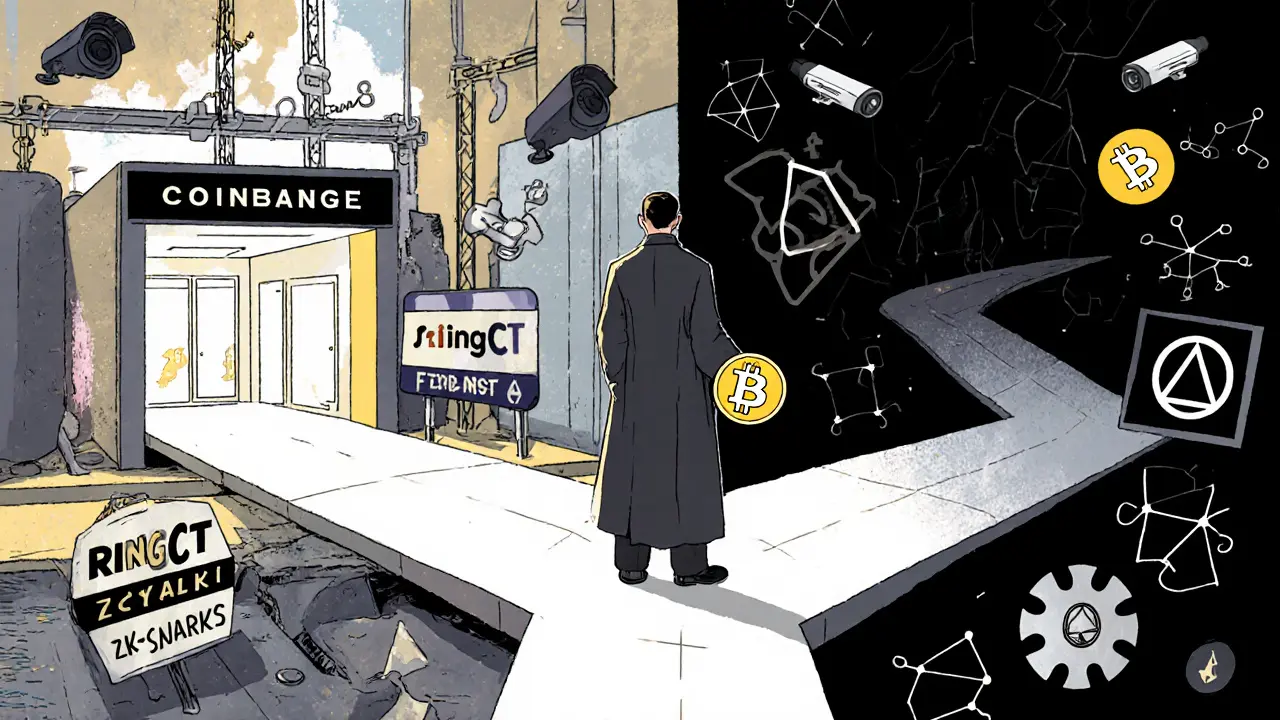
The Regulatory Crackdown
This isn’t just about U.S. law. Countries like China, Qatar, and Saudi Arabia have banned all cryptocurrencies, citing privacy risks. Russia is pushing toward the same. The European Union’s MiCA regulation doesn’t ban privacy coins outright, but it forces exchanges to collect KYC data and report suspicious activity-making privacy coins nearly impossible to trade legally on major platforms. The result? Monero’s market cap is less than 0.5% of Bitcoin’s. Zcash is even smaller. Adoption is stuck. Most people don’t use privacy tech because it’s hard to access. You can’t buy Monero with a credit card on Coinbase. You have to use a smaller exchange, move funds through multiple steps, and understand wallet security. It’s not user-friendly. And when regulators make it risky, even tech-savvy users back off.The Bigger Question: Privacy as a Right or a Risk?
Edward Snowden once said, “Privacy is not an option. It’s an absolute necessity.” That’s the core argument of privacy advocates. If your money is traceable, your freedom is conditional. Governments can freeze accounts. Corporations can deny service based on spending history. In places with unstable governments or corrupt institutions, privacy isn’t a luxury-it’s survival. But regulators say: if you can’t see the money, you can’t stop the crime. Drug cartels use Monero. North Korea hacks exchanges and launder funds through privacy coins. Terrorist groups exploit the anonymity. The data is real. The FBI has traced ransomware payments to Zcash. The problem isn’t the tech-it’s how it’s used. Here’s the catch: Bitcoin is used for more crime than Monero. But Bitcoin’s transparency makes it easier to track. Monero’s privacy makes it harder. So the focus shifts from the crime to the tool. That’s dangerous logic. If we outlaw tools because criminals use them, we outlaw encryption, anonymous browsers, and cash.
The Future: AI, Quantum, and the Next Round
The arms race isn’t ending. It’s evolving. AI is now used by surveillance firms to predict transaction patterns with 90%+ accuracy. But privacy teams are using AI too-to generate fake transaction trails, confuse clustering algorithms, and create decoy wallets that mimic real behavior. Then there’s quantum computing. Right now, both privacy and surveillance rely on elliptic curve cryptography. Quantum computers could break that in years. Privacy coins would need to switch to quantum-resistant algorithms like lattice-based crypto. Surveillance tools would need to adapt too. Whoever gets there first wins the next round. Meanwhile, new privacy layers are emerging. Projects like Tornado Cash (banned in the U.S.) and newer cross-chain mixers are trying to bring privacy to Ethereum. Layer-2 solutions like zk-Rollups are adding privacy to DeFi without sacrificing scalability. But regulators are watching closely. The next legal battle won’t be about Monero. It’ll be about whether you can privately swap tokens on a decentralized exchange.What This Means for You
If you care about financial privacy, you’re not alone. But you’re also not safe. Using privacy tech puts you on a watchlist. You’ll face higher fees, fewer options, and more scrutiny. If you’re just holding Bitcoin for investment, you’re probably fine. But if you’re sending money across borders, supporting dissidents, or protecting your business from corporate snooping-you need to understand the risks. There’s no perfect solution. Transparency helps law enforcement. Privacy protects human rights. The answer isn’t to ban one side or the other. It’s to build systems where privacy is possible without enabling crime. That means technical standards-like requiring privacy tools to allow court-ordered audits under strict oversight. It means international cooperation, not blanket bans. And it means recognizing that the same tech that hides a drug deal can also hide a journalist’s source or a victim’s escape fund. This isn’t a battle between good and evil. It’s a battle between two truths: that people deserve financial privacy, and that society needs to prevent abuse. The tech will keep advancing. The law will try to catch up. And in the middle, ordinary users are caught in the crossfire.Are privacy coins illegal?
No, privacy coins like Monero and Zcash are not illegal in most countries. But many exchanges and financial institutions refuse to support them due to regulatory pressure. In the U.S., using privacy tools isn’t illegal, but helping others evade detection-like running a mixing service without a license-can lead to criminal charges, as seen in the Samourai Wallet case.
Can Chainalysis track Monero?
No, Chainalysis and other blockchain analysis firms cannot track Monero transactions. Monero’s ring signatures, stealth addresses, and RingCT encryption make transaction details-sender, receiver, and amount-cryptographically hidden. While analysts can see that a transaction occurred, they cannot determine who sent it, who received it, or how much was transferred.
Why don’t more people use privacy coins?
Because they’re hard to buy, store, and use safely. Most major exchanges don’t list them. You need to use smaller, less secure platforms. You also need to understand wallet security and avoid reusing addresses. For most users, the hassle and risk outweigh the privacy benefit-especially when Bitcoin still offers some level of pseudonymity.
Is Zcash truly anonymous?
Zcash offers optional privacy through its shielded transactions using zk-SNARKs. But most Zcash transactions are transparent by default. Only users who actively choose shielded addresses get full anonymity. If you use a regular Zcash address, your transactions are visible on the blockchain, just like Bitcoin. So anonymity depends entirely on user behavior.
Will quantum computers break crypto privacy?
Potentially. Current cryptography-used by Bitcoin, Monero, and surveillance tools alike-relies on mathematical problems that quantum computers could solve quickly. If that happens, all current privacy and surveillance tech could be compromised. The solution is quantum-resistant cryptography, which is already being tested by privacy projects. The race is on to upgrade before quantum computers become practical.
Can I use privacy tech without getting in trouble?
Yes-if you’re not breaking the law. Using privacy tools to protect your financial data from corporate tracking or government overreach is legal in most places. But if you’re using them to hide illegal activity, avoid taxes, or evade sanctions, you’re at risk. The line isn’t in the tool-it’s in your intent. Always understand local laws and consult a legal expert if you’re unsure.
Masechaba Setona
November 1, 2025 AT 18:52Nabil ben Salah Nasri
November 2, 2025 AT 11:33Josh Serum
November 3, 2025 AT 02:13Helen Hardman
November 3, 2025 AT 13:49Genevieve Rachal
November 4, 2025 AT 18:16Eli PINEDA
November 4, 2025 AT 19:13Debby Ananda
November 5, 2025 AT 13:57Vicki Fletcher
November 5, 2025 AT 19:17Nadiya Edwards
November 7, 2025 AT 07:08Ron Cassel
November 9, 2025 AT 03:46Malinda Black
November 11, 2025 AT 02:00ISAH Isah
November 11, 2025 AT 07:47Chris Strife
November 11, 2025 AT 21:41