Private Blockchain Use Cases in Business: Real-World Enterprise Examples
 Apr, 11 2026
Think of a public blockchain like a town square where anyone can shout, listen, and trade. Now, imagine a private blockchain use cases scenario as a high-security boardroom. Only invited guests get in, the conversation is confidential, and the rules are set by the people in charge. For most companies, the "town square" approach is a nightmare for privacy and regulatory compliance. That is why businesses are pivoting toward permissioned ledgers.
The shift is happening fast. The World Economic Forum predicts that about 10% of global GDP could be tokenized and stored on-chain by 2027. We aren't just talking about digital currency anymore; we are talking about the actual plumbing of global commerce. By using a private network, a business gets the "trustless" benefits of a ledger-meaning no one can sneakily change a record-without exposing their trade secrets to the entire internet.
Key Takeaways for Business Leaders
- Control: You decide who joins the network and what data they can see.
- Speed: Fewer participants mean consensus is reached much faster than on public chains.
- Compliance: It is significantly easier to meet GDPR or HIPAA standards in a controlled environment.
- Automation: Smart contracts handle repetitive tasks, like releasing payment once a shipment is scanned.
Revamping Supply Chain and Logistics
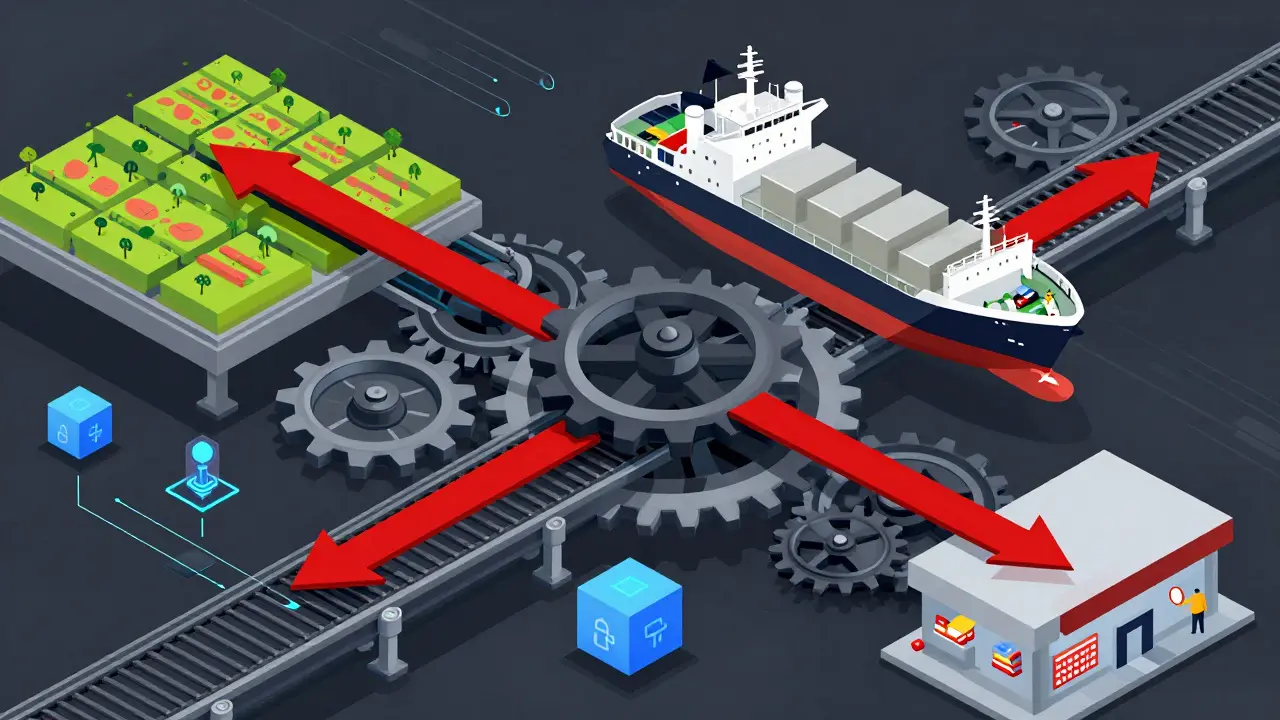
Supply chains are notoriously messy. You have ships, warehouses, customs agents, and trucks, all using different spreadsheets and emails. A Private Blockchain is a restricted distributed ledger where only authorized participants can validate transactions and view data. This creates a single source of truth.
Take Walmart, for example. They collaborated with IBM to build a food traceability system. If a batch of spinach is contaminated, they don't have to pull every bag from every store in the country. They can trace the specific farm and shipment in seconds. Similarly, De Beers uses this tech to track the provenance of diamonds, ensuring a stone isn't a "blood diamond" by recording its journey from the mine to the retail store.
It isn't just about tracking items; it's about money. Supply chain finance is being transformed by platforms like TradeIX. Instead of waiting weeks for a bank to verify a shipment before releasing payment, the blockchain triggers the payment automatically when the digital bill of lading is signed. This keeps cash flowing for smaller suppliers who can't afford long waiting periods.
Financial Services and Instant Settlement
Banking is where the technology is most mature. Traditional banking relies on "correspondent banking," which is basically a slow game of telephone between banks. Private blockchains cut out the middleman. Santander famously issued a blockchain-based bond that settled instantly. No intermediaries, no three-day waiting period, and millions saved in processing fees.
Most big banks don't build these from scratch. They use Blockchain-as-a-Service (BaaS), which are cloud-hosted platforms provided by giants like AWS, Azure, or Google Cloud. This allows them to run Know-Your-Customer (KYC) checks across a network. If Bank A has already verified a client's identity and uploaded a hash of that verification to the private chain, Bank B can trust that verification without making the client fill out the same 20 pages of paperwork.
| Feature | Public Blockchain | Private (Permissioned) Blockchain |
|---|---|---|
| Access | Open to anyone | Invitation only |
| Transaction Speed | Slower (High latency) | Very Fast (Low latency) |
| Privacy | Transparent/Pseudonymous | Confidential/Controlled |
| Governance | Decentralized (Community) | Centralized or Consortium-led |
| Energy Cost | High (usually) | Low (efficient consensus) |
Healthcare: Balancing Privacy and Portability
Healthcare is a tough nut to crack because of laws like HIPAA. You can't just put a patient's medical history on a ledger. However, private blockchains are being used for "consent management." Instead of the record itself being on the chain, the permission to see the record is stored there. When a doctor requests access, the system checks the private blockchain to see if the patient has granted that specific doctor access.
In the pharmaceutical world, this is a lifesaver for drug authenticity. Ekotek has developed solutions where a pharmacy scans a medicine's code to verify it came from the original manufacturer and hasn't been swapped for a counterfeit during transit. This prevents dangerous fake drugs from entering the supply chain.
Real Estate and Insurance Automation
Real estate is famous for being slow and paper-heavy. Platforms like Propy are changing this by using private networks to handle title transfers. Instead of a week of escrow and endless emails between agents, banks, and government offices, the transaction happens on a ledger. The records are immutable, meaning once the deed is transferred, nobody can forge a claim to the property later.
Insurance follows a similar pattern. The B3i consortium-a group of major insurers-uses a private blockchain to handle reinsurance contracts. Normally, when an insurance company insures itself against a massive disaster, the paperwork is a nightmare. By using Smart Contracts, which are self-executing contracts with the terms written directly into code, the claim payout can trigger automatically based on verified data, cutting approval times from weeks to mere days.
Manufacturing and the Industrial IoT
In a factory, you have thousands of sensors. When you combine IoT (Internet of Things) with a private blockchain, you get a tamper-proof audit trail. For example, IBM integrates sensors into shipping containers. If a shipment of vaccines must stay between 2 and 8 degrees Celsius, the sensor records the temperature every minute onto the blockchain. If the temp hits 10 degrees, the smart contract automatically flags the shipment as spoiled.
This removes the "he said, she said" argument between the shipping company and the buyer. The data is right there, it hasn't been edited, and it's timestamped. It transforms a dispute process that used to take months into a data-driven decision made in seconds.

Government and Digital Identity
Estonia is the gold standard here. They've built a society where almost every government service is on a blockchain. This is their e-ID system. Citizens have total control over their data. When a government agency accesses your record, you can see exactly who did it and when. This isn't a public Bitcoin-style chain; it's a highly controlled infrastructure that ensures the state can't secretly alter records and citizens can't forge their identities.
Solving the Connectivity Problem
One big problem with private chains is that they often become "islands." A shipping company might have one chain, while the port has another. To fix this, businesses are using interoperability frameworks. Hyperledger Cactus and Chainlink CCIP act as bridges, allowing different private networks to talk to each other or even interact with a public chain for final settlement without compromising their internal privacy.
Is a private blockchain actually decentralized?
Not in the way Bitcoin is. While a public chain is fully decentralized, a private blockchain is "distributed." This means the data is shared across multiple nodes, but the power to add new members or change rules is held by a central entity or a consortium of companies. It's decentralized enough to prevent a single point of failure, but centralized enough for corporate governance.
Does a private blockchain require mining?
Usually, no. Private chains don't use Proof-of-Work (mining) because it's too slow and energy-intensive. Instead, they use more efficient methods like Proof-of-Authority (PoA) or Raft consensus, where a few pre-approved nodes validate transactions. This is why they are so much faster than public networks.
What are the main costs of implementing a private blockchain?
The biggest costs aren't the software, but the talent and the coordination. You need engineers who understand distributed systems and a governance agreement between all partners. If you are in a consortium, agreeing on who owns the data and who pays for the nodes can be a long, legal process.
Can a private blockchain be hacked?
Anything can be hacked, but the attack vector is different. In a public chain, you worry about a 51% attack. In a private chain, the risk is more about unauthorized access to the permissioning system. If an attacker steals the admin keys to the network, they could potentially alter the ledger's rules.
Why not just use a traditional database?
A database is controlled by one admin who can delete or edit any entry. In a blockchain, even the admin cannot silently change a past transaction without it being obvious to everyone else on the network. This creates "trust" between companies that might not actually trust each other.
Amanda Faust
April 12, 2026 AT 13:07Basically just a glorified database with a fancy name to attract VCs
Omotola Balogun
April 13, 2026 AT 11:55Actually, it's not just a database. The immuatability comes from the hashing algorithm and the consensus mechanism among nodes. If you think a standard SQL server can provid the same level of auditability across multiple organizatons, you're mistaken. The whole point of a consortion blockchain is the shared trust model without a single central admin who can just "undo" a transaction secretly.
James Bone
April 14, 2026 AT 04:55Look at this corporate propaganda. We're just swapping one set of overlords for another. Instead of a bank, now it's a "consortium" of banks. Same garbage, just more efficient at tracking us. It's a digital panopticon wrapped in the buzzword of the week. Truly pathetic how people fall for this.
Heather Warren
April 14, 2026 AT 06:10I think the supply chain examples are really the strongest part here! Using this for food safety is a huge win for everyone. It's so great to see tech being used to actually save lives by stopping contaminated food faster. Maybe we could also look into how this helps small farmers get paid quicker?
Rob Mitchell
April 15, 2026 AT 06:25Spot on. The real-world utility is in the efficiency gains.
Aaliyah BROTHERS
April 16, 2026 AT 20:51Estonia is just a testing ground for the NEW WORLD ORDER!!! Why is this being pushed on us??!! They want our IDs on a ledger so they can flick a switch and erase us from existence if we don't comply with their globalist agenda!!! Wake up people!!! This is a trap set by the elites to monitor every single move we make across borders!!! ABSOLUTE MADNESS!!!!
Scott Fenton
April 17, 2026 AT 23:54I would like to offer a perspective regarding the regulatory aspects. While the convenience of a private ledger is evident, organizations must remain vigilant about the legal implications of data residency. It is imperative that the governance frameworks are established with utmost precision to avoid future jurisdictional disputes.
Prasanna Shembekar
April 19, 2026 AT 16:58omg i can't believe how slow banking is still lol this makes me so sad
Tracie and Matthew Hartley
April 21, 2026 AT 06:46pls... just use a cloud db lol. why make it complicated for no reason? its just a trend to make stock prices go up. totaly useless in real life
Jessie Tayaban
April 22, 2026 AT 06:26OMG wait but the part about the diamonds is so cool!! Like imagine actually knowin where your ring came from!! Its just so amazing how tech can actually be a force for good in the world even if it sounds super complicatd at first!! I love it!!
EDOZIEM MICHAEL
April 22, 2026 AT 10:40trust is just a ghost in the machine man we think we find it in code but it really lives in the heart
Rebecca Violette
April 24, 2026 AT 06:49why does everythng have to be a blockchain now i just want things to work without a whitepaper
Jonathan Chamma
April 25, 2026 AT 03:20It is interesting to see how this could bridge gaps between different cultures in trade. By reducing the need for blind trust in a foreign entity and replacing it with a verifiable system, we can create a more inclusive global market where smaller players aren't squeezed out by the giants.
Stanly Hayes
April 26, 2026 AT 13:51America is the only place that can actually scale this stuff properly. Forget the rest, the US infrastructure is where the real money and power are. This is just another way we're going to dominate the global tech scene for the next century.
Alan Seiden
April 26, 2026 AT 18:07Utterly rubbish. The British banking system was fine before these American-led 'innovations' started breaking everything. It is nothing more than a solution searching for a problem, driven by people who cannot operate a simple ledger without a million-dollar software package.
Lane Montgomery
April 27, 2026 AT 09:21Who owns the keys though?
logan bates
April 28, 2026 AT 03:22Whatever. Just keep the US economy leading.