Risks of Liquid Staking Protocols: What You Might Be Missing
 Jan, 18 2026
When you stake your ETH, you lock it up to help secure the network and earn rewards. Simple enough. But with liquid staking, you get a token like stETH or rETH that represents your staked ETH - and you can trade it, use it in DeFi, or lend it out while still earning rewards. Sounds perfect, right? Liquid staking has exploded in popularity, with over $14 billion locked in protocols as of late 2023. But behind the convenience lies a web of hidden dangers that most users don’t see until it’s too late.
De-Pegging: When Your stETH Isn’t Worth 1 ETH
The biggest promise of liquid staking is that 1 stETH = 1 ETH. That’s the peg. But in practice, that’s not always true. During the 2022 Celsius collapse, stETH dropped to as low as 0.94 ETH on major DEXs. Why? Because the Curve Finance pool that let people swap stETH for ETH ran dry. Users couldn’t exit. Panic spread. And suddenly, your ‘1:1’ token was worth 6% less - and it stayed that way for weeks.
This isn’t rare. CoinGecko data shows stETH traded below 0.99 ETH 15 times in just six months in 2023. Even in calm markets, liquidity gaps can cause temporary de-pegs. If you’re using stETH as collateral in a DeFi loan and it de-pegs, your position could get liquidated. You didn’t lose ETH - you lost the *value* you thought you had.
Slashing: You Pay for Other People’s Mistakes
When a validator on Ethereum goes offline or acts maliciously, the network penalizes them by slashing - burning a portion of their staked ETH. That’s fine if you’re running your own node. But with liquid staking, you’re trusting someone else’s validator. And if that validator gets slashed, you lose part of your stake.
Galaxy Research found slashing can cost up to 1 ETH per event. Lido and Rocket Pool try to mitigate this by spreading validators across many operators, but they can’t eliminate it. And here’s the catch: you don’t get to choose which validator your ETH is assigned to. You’re exposed to risks you can’t see or control.
Smart Contract Bugs: The Silent Killer
Liquid staking protocols rely on smart contracts to hold your ETH, issue LSTs, and distribute rewards. One bug. One exploit. And your funds could vanish. Ankr’s 2023 risk analysis warned that ‘smart contracts that hold the original unstaked assets will have bugs which makes them susceptible to hacking.’
It’s not theoretical. In 2022, a bug in a lesser-known liquid staking protocol wiped out $3.2 million in user funds. Even big names aren’t immune. Lido and Rocket Pool have been audited by OpenZeppelin and Trail of Bits - but audits don’t guarantee safety. They just reduce risk. And many smaller protocols skip audits entirely, or only get one. If you’re using a protocol with no public audit history, you’re gambling.
Centralization: The Systemic Threat
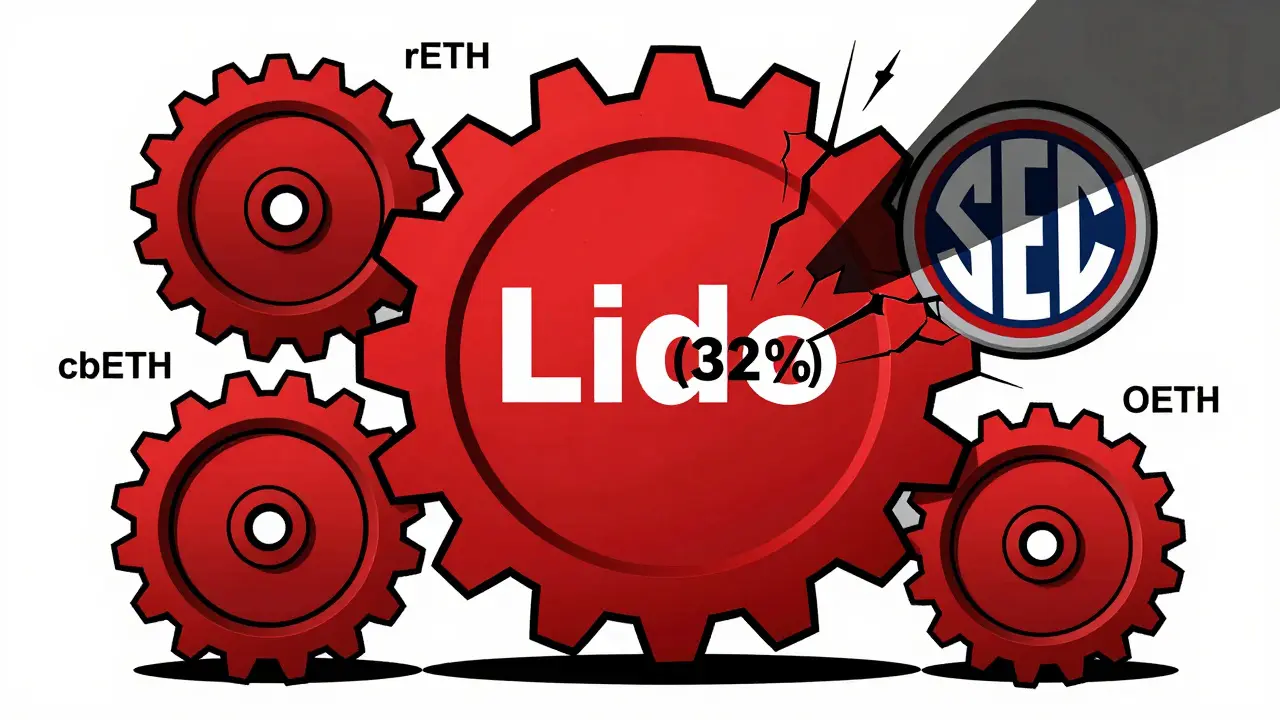
Lido controls about 32% of all staked ETH. That means nearly one-third of Ethereum’s security is managed by a single entity. If Lido’s node operators are compromised, or if their governance is hijacked, it could destabilize the entire network.
That’s not just a risk to your staked ETH - it’s a risk to Ethereum itself. The whole point of blockchain is decentralization. Liquid staking, as it stands, is centralizing validation power. And when one player dominates, regulators take notice. The SEC issued a formal statement in August 2025 on ‘Certain Liquid Staking Activities,’ hinting that LSTs might be classified as securities. That could trigger legal action, delistings, or even shutdowns.
Token Models: Rebasing vs. Reward-Bearing - And Why It Matters
Not all LSTs work the same. Some, like stETH, are reward-bearing: your token count stays the same, but its value grows as rewards accumulate. Others, like some Solana-based tokens, are rebasing: your token count increases automatically. This affects taxes, accounting, and how DeFi protocols interact with them.
Most users don’t know the difference. But if you’re using rebasing tokens in a lending protocol, you might get taxed on phantom income - even if you didn’t sell anything. Or worse, the protocol might not support rebasing tokens at all, causing your position to break. This isn’t a bug - it’s a design flaw you didn’t know existed.

Operational Risks: Downtime, Delays, and Broken Redemption
After Ethereum’s Shanghai upgrade in April 2023, users could finally withdraw staked ETH. But liquid staking protocols didn’t magically fix everything. The withdrawal queue is still congested. If you try to redeem your stETH for ETH, you might wait days or even weeks.
And what if the protocol’s infrastructure goes down? What if their oracle fails? What if their multi-sig wallet gets frozen by regulators? These aren’t edge cases - they’re real operational risks. Ankr’s report lists ‘system downtime, network outages, or other technical problems’ as direct threats to staked assets. And there’s no insurance. No FDIC. No recourse.
What You Can Do: Practical Risk Mitigation
Don’t panic. But do act smart.
- Diversify your LSTs. Don’t put all your ETH into stETH. Use Rocket Pool’s rETH, Origin’s OETH, or even Coinbase’s cbETH. Each has different risk profiles. Spread your exposure.
- Check audits. Only use protocols with multiple audits from reputable firms: OpenZeppelin, Trail of Bits, Quantstamp. If it’s not on their website, walk away.
- Monitor liquidity. Check the trading volume of your LST on Uniswap, Curve, or SushiSwap. If daily volume is under $10 million, avoid it. Low liquidity = high de-peg risk.
- Understand the token model. Know if your token is rebasing or reward-bearing. Use tools like DeFiLlama or CoinGecko to track price deviations.
- Watch governance. If a protocol lets a small group of large holders vote on key decisions (like Lido’s LDO token holders), you’re at their mercy. Look for more distributed governance.
And if you’re new to this? Spend 20-40 hours learning. Read the documentation. Join Lido’s Discord. Read Reddit threads from 2022. You’re not just investing in a token - you’re entering a complex system with real, measurable risks.
The Bigger Picture: Why This Matters
Liquid staking was supposed to make staking accessible. And it did. But it also turned Ethereum’s security model into a financial product - one that’s now deeply entangled with DeFi, exchanges, and institutional investors. That’s powerful. But it’s also dangerous.
As Galaxy Research predicts, liquid staking could represent half of all staked assets by 2025. If the risks aren’t addressed - if de-pegs keep happening, if centralization grows, if regulators crack down - the whole ecosystem could face a cascading failure. Your stETH might be fine today. But tomorrow? That’s not guaranteed.
Don’t assume safety because it’s popular. Don’t trust a 1:1 peg because it’s written on a website. Liquid staking gives you liquidity - but it also gives you new, complex, and often invisible risks. Know them. Manage them. Or lose your money.
Is liquid staking safe?
Liquid staking is convenient, but not inherently safe. It introduces new risks like de-pegging, smart contract exploits, slashing exposure, and centralization that don’t exist in direct staking. While top protocols like Lido and Rocket Pool have strong security measures, no protocol is immune to failure. Treat it like any DeFi product: assume risk, verify audits, and never invest more than you can afford to lose.
Why did stETH drop below 1 ETH?
stETH dropped below 1 ETH during the 2022 Celsius collapse because the Curve Finance pool that allowed users to swap stETH for ETH ran out of liquidity. As panic spread, users rushed to exit, but there weren’t enough ETH reserves to meet demand. This exposed a structural flaw: LSTs rely on deep liquidity to maintain their peg, and when that liquidity vanishes, the peg breaks. Similar de-pegs occurred during the FTX collapse and other market crashes.
Can I get hacked through liquid staking?
Yes. If the smart contract holding your ETH has a vulnerability, attackers can drain funds. This happened in 2022 with a smaller protocol that lost $3.2 million. Even major protocols like Lido have had minor exploits in the past, though none resulted in user fund loss. Always check if a protocol has been audited by multiple top-tier firms like OpenZeppelin or Trail of Bits. If they haven’t, avoid it.
Is Lido too big to fail?
Lido isn’t too big to fail - it’s too big to ignore. With 32% of all staked ETH under its control, a failure or compromise at Lido could destabilize Ethereum’s entire security model. That’s why regulators and Ethereum core developers are concerned. While Lido has strong security and governance, its dominance creates systemic risk. Diversifying your staking across multiple protocols reduces this exposure.
Should I use liquid staking if I’m new to crypto?
If you’re new, avoid liquid staking until you understand basic DeFi mechanics. You need to know what staking is, how smart contracts work, what liquidity means, and how token models affect your taxes and DeFi usage. Start with direct staking on Ethereum’s official client (like Lighthouse or Prysm) to learn the fundamentals. Once you’re comfortable, then consider liquid staking - and only with reputable, audited protocols.
What’s the difference between stETH and rETH?
stETH (from Lido) is a reward-bearing token: your balance stays the same, but its value increases over time as you earn staking rewards. rETH (from Rocket Pool) is also reward-bearing, but it’s backed by a more decentralized validator network where users must lock up RPL tokens as collateral. This reduces centralization risk but increases complexity. rETH also has built-in slashing protection through its pooled collateral system, making it slightly safer than stETH in that regard.
Will regulators ban liquid staking?
A full ban is unlikely, but regulators like the SEC are already treating LSTs as potential securities. The August 2025 SEC statement flagged liquid staking as a high-risk activity, suggesting future enforcement actions against unregistered offerings. This could lead to delistings on centralized exchanges, reduced liquidity, and higher compliance costs for protocols. It’s not a ban - but it’s a warning sign that the regulatory environment is shifting.
Can I lose all my money in liquid staking?
Yes - though it’s rare. Total loss usually requires multiple failures: a smart contract exploit, a liquidity crisis, and a governance attack all happening at once. But history shows it’s possible. The Celsius collapse wiped out billions in staked assets. While major protocols haven’t lost user funds yet, the risk is real. Never assume your LST is as safe as ETH. Treat it like a high-risk DeFi asset - not cash.
Hailey Bug
January 18, 2026 AT 17:40Liquid staking isn't magic-it's just financial engineering with extra steps. The 1:1 peg is a social contract, not a law of physics. When Curve pools dry up during stress events, it’s not a bug, it’s a feature of illiquid markets. If you’re using stETH as collateral without monitoring its price on-chain, you’re already one bad liquidation away from a nasty surprise. I’ve seen people lose 15% of their position in a single hour because they assumed ‘it’s ETH’ and didn’t check the actual market rate. Do your homework, or get rekt.
Haley Hebert
January 19, 2026 AT 17:36I get why people love this stuff-it’s so convenient to have your staked ETH floating around in DeFi like it’s just spare change. But honestly? It feels like buying a fancy-looking toaster that might explode if you use it with a metal fork. I tried rETH for a few months, kept checking the price, and every time I saw it dip to 0.992, I got this weird anxiety. Like, am I losing money or is it just being weird? I ended up moving half to direct staking just to feel like I wasn’t gambling with my life savings. Not glamorous, but peaceful.
Kelly Post
January 20, 2026 AT 02:28Let me tell you something nobody’s talking about: the real danger isn’t the protocol-it’s the people who think they’re ‘earning yield’ while doing zero research. You see these TikTok videos saying ‘stETH = free money’ and suddenly everyone’s maxing out their crypto wallets like it’s a Black Friday sale. But here’s the truth: if you don’t understand slashing, liquidity pools, or rebasing mechanics, you’re not investing-you’re handing your keys to strangers on a train. And when things break? You’ll be the one sobbing in a Reddit thread asking ‘why did this happen?’ while the devs have already moved on to their next project. Knowledge isn’t optional here. It’s survival.
Jill McCollum
January 21, 2026 AT 07:32ok so i just found out that steth and reth are different and i didnt even know that until like 2 weeks ago 😅 i thought they were the same thing?? now im like… wait does that mean my taxes are messed up?? i used it in aave and now im scared to check my wallet. also why do people keep saying ‘depeg’ like its a bad word?? is it like… bad?? help. i just wanted free eth. 🥲
Chidimma Okafor
January 21, 2026 AT 15:24What we are witnessing here is not merely a financial innovation, but a profound recalibration of decentralized trust mechanisms. The structural fragility of liquid staking tokens reveals a deeper paradox: the very tools designed to democratize access to blockchain rewards are simultaneously concentrating systemic risk within centralized entities. Lido’s 32% dominance is not merely a market share-it is a vulnerability vector of existential magnitude. The Ethereum network, conceived as an anarchic ledger of peerless resilience, now teeters upon the precarious scaffolding of corporate stewardship. One must ask: is this evolution-or entropic regression?
ASHISH SINGH
January 21, 2026 AT 16:21Big Tech is running this whole thing. You think Lido’s just some ‘open protocol’? Nah. They’re backed by VCs who got their money from Wall Street. That 1:1 peg? It’s a lie. The Fed and SEC are letting it slide because they want you to think crypto is ‘safe’ while they quietly prepare to shut it all down. Remember how they froze bank accounts during the pandemic? Same playbook. They’re building a trap: let you get rich on stETH, then pull the rug when they need to bail out the banks. I’m not paranoid-I’m just paying attention.
Vinod Dalavai
January 22, 2026 AT 10:06bro i just use stETH cause its easy and it works. i dont care about all this depeg stuff or slashing or whatever. if it drops, i wait. if it goes up, i cash out. been doing it for 2 years, never lost a cent. maybe you guys are overthinking it? 😎
Tony Loneman
January 22, 2026 AT 16:22Oh wow, another ‘educational’ post pretending to warn people while secretly promoting Rocket Pool. Let’s be real-you’re just trying to shift attention away from Lido’s dominance because you’re holding RPL. The ‘diversify’ advice is just FUD dressed up as wisdom. If stETH is so dangerous, why is it still the #1 LST with 80% market share? Because it works. The rest of you are just scared of success. Also, ‘check audits’? OpenZeppelin audits are just marketing fluff. I’ve seen more bugs in a WordPress plugin than in Lido’s code. Wake up.
Chris Evans
January 23, 2026 AT 14:32The metaphysical instability of liquid staking tokens reveals the ontological collapse of value in post-blockchain financial systems. When stETH trades at 0.94 ETH, it is not merely a market inefficiency-it is the epistemological failure of consensus-based valuation. The peg is not a price-it is a myth, a performative illusion sustained by liquidity arbitrage and herd psychology. The real question is not whether we can mitigate risk, but whether we can still believe in the ontology of digital assets when their value is contingent upon the operational integrity of opaque, corporate-governed intermediaries. We are not staking ETH. We are staking faith.
Pat G
January 24, 2026 AT 01:23Why are we even talking about this? This is why America is falling behind. We let some random devs in Singapore and India create financial instruments that aren’t regulated, aren’t insured, and can vanish overnight. Meanwhile, real people lose their homes because they can’t get a mortgage. This isn’t innovation-it’s chaos. And you people are proud of it? You’re not ‘crypto natives’-you’re financial anarchists. And you’re going to crash the whole system. I hope you’re happy.
Alexandra Heller
January 24, 2026 AT 07:25You think you’re being smart by diversifying your LSTs? You’re just spreading your ignorance across multiple protocols. The real sin isn’t using stETH-it’s believing that any of this is ‘safe.’ You’re not an investor. You’re a participant in a Ponzi narrative dressed up as decentralization. Every time you say ‘it’s just DeFi,’ you’re ignoring the fact that you’re trusting code written by people who don’t even know how to spell ‘immutable.’ You want to be free? Then don’t touch liquid staking. Just hold ETH. Simple. Clean. Uncomplicated. The fact that you need a 10-point checklist just to not lose your money? That’s not progress. That’s surrender.