Underground Crypto Trading in China: Risks and Reality
 Jan, 16 2026
China banned cryptocurrency trading in 2021. Banks can’t touch it. Exchanges are shut down. Mining rigs were seized. Yet, between July 2022 and June 2023, Chinese traders moved $86.4 billion in crypto - more than all of Hong Kong during the same period. How? Because bans don’t kill demand. They just push it underground.
What’s Actually Illegal - and What’s Not
The Chinese government doesn’t outlaw owning Bitcoin or Ethereum. You can hold it in a wallet. No one’s coming to your door to take your coins. But if you try to buy, sell, or trade it inside China? That’s a violation. The People’s Bank of China (PBOC) made it clear: no exchanges, no banking support, no payment processing. Even advertising crypto services is risky. Here’s the twist: in 2025, Chinese courts started calling cryptocurrency legal property. That means if someone steals your Bitcoin, you can sue for damages. But if you use that Bitcoin to buy something? You’re breaking the law. It’s a legal contradiction that creates confusion - and opportunity.How People Are Still Trading
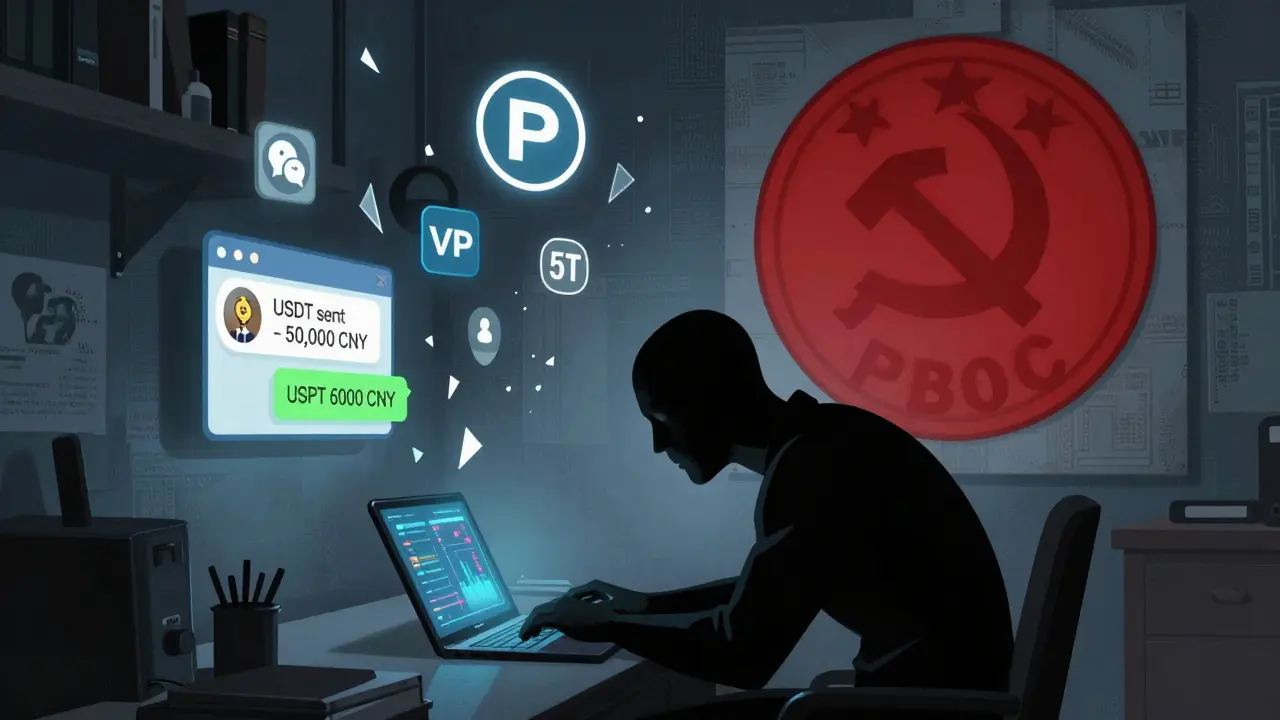
You won’t find a Binance app on your Chinese phone. But you’ll find people using VPNs to access foreign exchanges. Not just any VPN - layered ones. Traders stack multiple services, switch servers constantly, and use private proxy networks to avoid detection. Some even route traffic through Hong Kong, where crypto is legal, to make transactions look like they’re happening outside mainland China. The real engine behind this underground market? Over-the-counter (OTC) brokers. These aren’t flashy platforms. They’re individuals or small groups with Telegram channels, WeChat groups, or encrypted forums. They match buyers and sellers directly. A trader in Shanghai wants to buy Bitcoin. They find a broker in Guangzhou who has dollars. The broker buys BTC on a foreign exchange, then the buyer pays in yuan via bank transfer or Alipay. Escrow systems keep things fair - for now. Stablecoins like USDT are the glue holding this system together. Why? Because they’re easier to move across borders and less volatile than Bitcoin. You can convert yuan to USDT, send it to a Hong Kong account, then trade it for other cryptos. It’s a workaround that’s become standard.
Who’s Doing This - And Why
This isn’t just hobbyists buying Dogecoin. The average trade size in China’s underground crypto market is nearly double the global average. Around 3.6% of trades globally are between $10,000 and $1 million. In China, it’s closer to 7%. These are serious investors. Why? Because traditional markets are collapsing. China’s CSI 300 index fell 35% over three years. Corporate earnings have missed forecasts for ten straight quarters. The government threw 2 trillion yuan into the stock market to prop things up - it didn’t work. People are desperate for better returns. Crypto, despite the risks, offers something stocks don’t: a chance to escape the system. High-net-worth individuals use Hong Kong bank accounts and corporate structures to trade legally on global platforms. Retail traders rely on trusted friends or local OTC brokers. Some even use family connections abroad to move money. It’s not just about profit - it’s about control over your own wealth.The Real Risks
You think you’re safe because you’re not using an exchange? Think again. First, the law can change overnight. In May 2025, rumors swirled that personal crypto holdings might be restricted too. No official announcement came - but the uncertainty alone froze some traders. If the government decides to crack down on ownership next, your wallet could be flagged. Your bank account could be frozen. You could face fines - or worse. Second, there’s no safety net. If your OTC broker disappears with your yuan? No recourse. No customer service. No insurance. You’re on your own. Scams are common. Fake wallets, fake trades, fake escrow services - they all exist. And because everything is hidden, authorities won’t help you recover losses. Third, your digital footprint is a liability. Using a VPN doesn’t make you invisible. Authorities monitor traffic patterns. If you’re sending large sums to Hong Kong accounts every month, that pattern gets noticed. Banks are required to report suspicious activity. One flagged transaction can lead to a full investigation.
The Bigger Picture
China isn’t just trying to stop crypto. It’s building something else: the digital yuan, or e-CNY. This isn’t Bitcoin. It’s a state-controlled digital currency that tracks every transaction. The government wants to eliminate cash, increase financial oversight, and prevent capital flight. Crypto threatens all of that. The underground market proves one thing: people will find ways to move money when they feel trapped. Even with surveillance cameras on every street, firewalls blocking global websites, and banks under strict orders - people still trade crypto. It’s not rebellion. It’s adaptation. Shanghai regulators are now talking about stablecoin rules. That’s a signal. Maybe they’re not trying to eliminate crypto forever - just control it. Maybe the goal is to replace decentralized money with state-backed digital money. If that’s the case, the underground market might shrink… or evolve into something even harder to stop.What Happens Next?
The underground market isn’t going away. Not yet. Not unless China fixes its economy. As long as stocks keep falling, savings lose value, and people feel powerless over their finances, crypto will be the escape hatch. Traders are getting smarter. They’re using more secure tools. They’re diversifying their methods. Some are even moving assets to Singapore or Dubai. Others are waiting to see if the government softens its stance. But here’s the truth: no matter how advanced the tech gets, no matter how many VPNs you use - you’re always one policy change away from losing everything. The risks aren’t just financial. They’re personal. They’re legal. They’re psychological. If you’re thinking about joining this market, ask yourself: is the potential return worth the constant fear? The sleepless nights? The risk of losing not just money, but freedom? There’s no guarantee you’ll profit. But there’s a 100% chance you’ll be watching your back.Is it legal to own Bitcoin in China?
Yes, owning Bitcoin or other cryptocurrencies is not explicitly illegal in China. You can hold them in a personal wallet. However, trading, exchanging, or using them to pay for goods or services violates regulations set by the People’s Bank of China. Courts have recognized crypto as "legal property," meaning you can sue if it’s stolen - but you can’t legally buy or sell it within mainland China.
Can Chinese banks handle cryptocurrency transactions?
No. Since 2021, Chinese banks are strictly prohibited from processing any cryptocurrency-related transactions. This includes deposits, withdrawals, or even facilitating payments for crypto purchases. Banks must report suspicious activity, and violating this rule can lead to heavy fines or loss of operating licenses.
How do people in China buy crypto if exchanges are banned?
Most use peer-to-peer (P2P) platforms and over-the-counter (OTC) brokers via encrypted apps like Telegram or WeChat. Traders connect directly, agree on a price, and use yuan transfers through Alipay or bank payments. To access global exchanges, they use layered VPNs and route transactions through Hong Kong, where crypto is legal. Stablecoins like USDT are commonly used as intermediaries to avoid direct yuan-to-Bitcoin conversions.
What are the biggest risks of trading crypto in China?
The biggest risks are legal, financial, and operational. Legally, you could face asset seizures, fines, or criminal charges if caught trading. Financially, there’s no protection - if your OTC broker scams you, you can’t get your money back. Operationally, VPNs can fail, platforms can shut down, and bank accounts can be frozen. The constant fear of enforcement and lack of recourse make this a high-stress activity.
Why is the underground crypto market so large in China?
Because there are few alternatives. China’s stock market lost 35% over three years. Corporate earnings have missed forecasts for ten straight quarters. Savings accounts offer near-zero returns. With limited investment options and weak trust in traditional finance, crypto offers a way to preserve wealth and seek higher returns - even if it means breaking the rules.
Will China ever legalize cryptocurrency?
Full legalization is unlikely. China’s goal is to control money, not decentralize it. Instead, it’s exploring regulated digital assets like stablecoins - possibly as a bridge to integrate crypto-like features under state control. The digital yuan (e-CNY) is the real focus. It’s not about allowing Bitcoin - it’s about replacing it with something the government can track and manage.
How does Hong Kong fit into China’s crypto underground?
Hong Kong is the critical gateway. It’s the only major city near China where crypto trading is legal. Many mainland traders open bank accounts there, set up shell companies, or use family members to move funds. Transactions appear to originate from Hong Kong, bypassing mainland restrictions. It’s not just a hub - it’s a lifeline for the underground market.
Is the digital yuan a threat to crypto trading in China?
Yes - but not directly. The digital yuan isn’t designed to compete with Bitcoin. It’s designed to replace cash and give the government total visibility into every transaction. By making digital payments mandatory and traceable, it reduces the need for crypto as a privacy tool. If people can’t move money anonymously, crypto loses its appeal - unless they’re willing to take greater risks to avoid detection.
Josh V
January 17, 2026 AT 13:54China bans crypto but people still trade $86B? That’s not rebellion, that’s human nature. You can’t stop demand, you can only make it riskier. I’ve seen this with weed, alcohol, guns - same pattern. The state thinks it’s in control but it’s just playing whack-a-mole with cash.
And yeah, USDT is the real MVP here. No one’s buying BTC with yuan directly. They turn cash into stablecoin, ship it to HK, then flip it. Simple. Elegant. Illegal. Perfect.
Stephen Gaskell
January 17, 2026 AT 15:57China is not weak. It is strategic. The digital yuan is the future. Crypto is a threat to sovereignty. Anyone trading it is aiding a financial insurgency. No sympathy. No excuses. Follow the law or face the consequences.
Alexandra Heller
January 18, 2026 AT 22:53It’s fascinating how we’ve turned finance into a moral battleground. On one hand, the state claims to protect citizens from speculative ruin. On the other, it ignores the real ruin - stagnant wages, collapsing pensions, zero-interest savings. So people turn to crypto not because they’re gamblers, but because they’re desperate. And desperation doesn’t care about legality.
It’s not about Bitcoin. It’s about dignity. The right to control your own wealth when the system refuses to let you grow it. That’s not criminal. That’s human.
And let’s be real - if the government truly believed crypto was evil, why did courts declare it legal property? They’re caught in a contradiction they can’t resolve. That’s not policy. That’s panic disguised as law.
nathan yeung
January 19, 2026 AT 19:05Been following this for a while. The OTC brokers in Guangzhou are wild. One guy I know uses his mom’s WeChat to move money. No one questions it. People trust their neighbors more than banks now.
Also, the fact that HK is the loophole says everything. China’s economy is so closed, the only way out is through a former colony. Irony doesn’t even cover it.
Chris O'Carroll
January 19, 2026 AT 19:38Okay but imagine this: you’re sitting in Shanghai, scrolling through your WeChat, and suddenly your bank account gets frozen because you sent 50K to a buddy who ‘bought a car’ in Hong Kong. No warning. No appeal. Just gone. And you’re not even the one trading crypto - you just helped your cousin wire cash.
That’s the real horror story. Not the tech. Not the VPNs. It’s the paranoia. The constant fear that your next transfer could be your last. This isn’t finance. It’s a psychological thriller with a 10% return.
Christina Shrader
January 20, 2026 AT 15:44I’ve never traded crypto in China but I know people who have. They say the real danger isn’t the government - it’s the brokers. One guy lost $200K because the ‘escrow’ guy vanished. No police report. No lawyer. Just silence.
It’s like playing poker with strangers in a dark room… and the dealer holds all the cards.
Andre Suico
January 21, 2026 AT 06:09The legal ambiguity surrounding cryptocurrency in China is a classic case of regulatory lag. The state recognizes crypto as property for civil litigation purposes, yet prohibits its use as a medium of exchange. This creates a fragmented legal landscape where enforcement is inconsistent and unpredictable.
From a compliance standpoint, individuals engaging in OTC trading expose themselves to multiple risk vectors: anti-money laundering violations, capital flight statutes, and potential violations of financial services regulations. The absence of formal channels increases systemic fragility.
While the motivations are understandable, the structural risks remain unmitigated. The digital yuan’s rollout may offer a controlled alternative, but only if it addresses the underlying economic anxieties driving crypto adoption.
Chidimma Okafor
January 22, 2026 AT 18:33What strikes me most is not the ingenuity, but the quiet resilience. In Lagos, we know what it means to bypass broken systems - black market forex, informal remittance chains, WhatsApp-based savings circles. China’s underground crypto network is the same story, just with better tech and bigger numbers.
The government fears decentralization because it fears loss of control. But the people? They’re not trying to overthrow the state. They’re trying to survive it. And in that, there’s a dignity that no firewall can erase.
Let me say this plainly: when a nation’s citizens must turn to shadow markets to preserve their wealth, the fault lies not with the people - but with the system that failed them.
ASHISH SINGH
January 23, 2026 AT 05:13They say the digital yuan is about efficiency but let’s be real - it’s a surveillance net with a user interface. Every transaction tracked. Every movement logged. Every purchase tied to your ID. And they call that progress?
Meanwhile, crypto is the only thing that lets you say ‘fuck you’ to the state without saying it out loud. They ban it? Fine. But they can’t ban the blockchain. They can’t ban the math. They can’t ban the fact that money doesn’t need permission to exist.
And don’t even get me started on how the PBOC is secretly mining Bitcoin through shell companies. The whole thing’s a lie. They’re scared because they know they can’t win this war. They’re just trying to buy time.
Vinod Dalavai
January 24, 2026 AT 05:50My cousin in Shenzhen uses Telegram to trade USDT. He says the key is using small amounts over time. Don’t send 10K at once. Send 500 every few days. Mix it with normal transfers. It’s like hiding a needle in a haystack.
Also, he uses a VPN that changes servers every 15 mins. Says the Chinese AI can’t keep up. Not sure if it’s true but he’s still got his money.
Just be smart. Don’t be greedy. And never trust anyone you don’t know IRL.
Peace out 🙏
Tony Loneman
January 26, 2026 AT 03:45Everyone’s acting like this is some revolutionary act. Newsflash: this isn’t crypto. This is just a fancy way of laundering money. You think the PBOC doesn’t know about these OTC brokers? Of course they do. They’re letting it happen. Why? Because it’s a controlled pressure valve. Let the rich gamble in the shadows so the masses don’t riot.
This isn’t freedom. It’s a distraction. The real power move? The digital yuan. That’s the endgame. Crypto’s just the decoy.
And don’t tell me about ‘legal property’ - if you can’t spend it, it’s just digital graffiti.
Callan Burdett
January 26, 2026 AT 09:52Man. I read this and I felt something I haven’t felt in years - hope.
People are still finding ways to build wealth. Still fighting for control. Still refusing to accept a future where money is a leash. That’s powerful. Even if it’s illegal. Even if it’s dangerous.
Let them have their VPNs. Let them have their USDT. Let them have their quiet rebellion.
Because the world needs more of this. Not less.
Anthony Ventresque
January 27, 2026 AT 17:26I’m curious - if the courts recognize crypto as legal property, why hasn’t anyone sued to force the government to recognize its use in transactions? Is there a legal precedent being tested somewhere? Or is this just a loophole that nobody wants to push too far?
Also, how many of these OTC brokers are actually connected to state-backed entities? Just wondering if this underground market is partly engineered to funnel capital into approved channels.
Nishakar Rath
January 28, 2026 AT 13:58China is not banning crypto because it’s dangerous - it’s banning it because it’s free. Free from control. Free from surveillance. Free from the party’s grip. And that terrifies them more than any market crash.
They want your money. But they want to own your money. Not you. Not your choices. Not your future.
So they ban it. They threaten you. They freeze your accounts. They pretend they’re protecting you.
But we know the truth.
Their fear is our power.
Josh V
January 30, 2026 AT 07:05They’re not banning crypto because they think it’s evil. They’re banning it because they know it’s better. And that’s the scariest thing of all.
When your own citizens start trusting decentralized money more than your central bank? You don’t arrest them. You try to replace them.
That’s why the digital yuan is the real story here. Not the underground trades. The replacement.