What Are Blockchain Oracles? Explained for Developers and Users
 Mar, 14 2026
Blockchain oracles are the bridge between smart contracts and the real world. Without them, smart contracts would be stuck inside their own digital bubble, unable to react to anything happening outside the blockchain-like the price of Bitcoin, the weather in London, or whether a flight was delayed. Think of oracles as trusted messengers. They fetch real-world data, verify it’s accurate, and deliver it to the blockchain so smart contracts can do what they’re supposed to do: automatically trigger actions when conditions are met.
Why Do Oracles Even Exist?
Blockchains are designed to be deterministic. That means every node on the network must see the exact same input and produce the exact same output. If one node says the price of ETH is $3,200 and another says $3,150, the network can’t agree. That breaks consensus. But the real world doesn’t work like that. Prices change. Sensors update. Events happen. So how do you bring real-world data into a system that refuses to accept uncertainty? That’s the oracle problem. And it’s one of the biggest hurdles to blockchain adoption. Without oracles, smart contracts can’t power things like insurance payouts after a hurricane, automated loan repayments based on stock prices, or supply chain tracking that updates when a shipment crosses a border. Oracles solve this by acting as secure intermediaries. They don’t generate data-they collect, verify, and deliver it.How Do Blockchain Oracles Work?
At their core, oracles have two parts: an on-chain component and an off-chain component.- On-chain component: This is a smart contract deployed on the blockchain. It’s the interface that smart contracts talk to. It defines what data is needed, who can deliver it, and how to validate it.
- Off-chain component: These are external servers or nodes that go out into the real world, fetch data from APIs, IoT sensors, or web scrapers, and send it back to the blockchain.
- A smart contract on Ethereum needs the current price of Bitcoin.
- The contract sends a request to its oracle contract.
- The oracle contract triggers off-chain nodes to fetch Bitcoin’s price from multiple exchanges like Coinbase, Binance, and Kraken.
- Those nodes return their data. The oracle uses a consensus algorithm-like taking the median of all responses-to filter out outliers or fake data.
- The verified price is sent back on-chain.
- The smart contract executes: if BTC is above $60,000, release funds to the user.
Types of Oracles
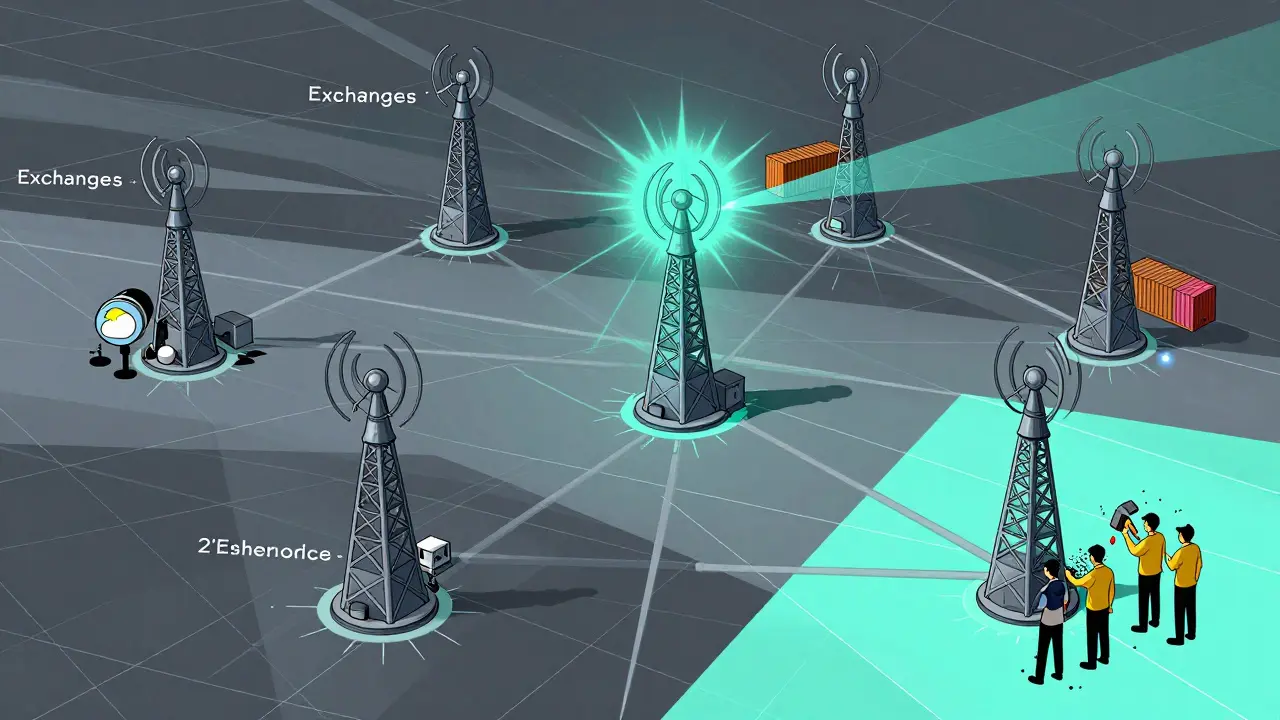
Not all oracles are the same. They’re categorized by what they do and where they get data.- Inbound oracles: Bring data into the blockchain. Examples: stock prices, weather reports, sports scores. These are the most common.
- Outbound oracles: Send data out from the blockchain. These trigger real-world actions-like paying a bank account, unlocking a smart lock, or updating a database.
- Compute-enabled oracles: Do more than just fetch data. They can run complex calculations off-chain (like verifying a ZK proof) and return the result. This saves gas and enables advanced DeFi functions.
- Cross-chain oracles: Connect different blockchains. Chainlink’s CCIP lets a smart contract on Polygon trigger an action on Solana, for example. This is critical as more chains emerge.
- Centralized oracles: One source-like a single API from a company. Fast and simple, but risky. If that API goes down or gets hacked, the whole contract fails.
- Decentralized oracle networks (DONs): Use dozens or hundreds of independent nodes, each pulling data from multiple sources. This is the gold standard. It removes single points of failure. Chainlink, the biggest player, uses over 1,000 nodes across 50+ data providers.
Who Uses Oracles-and Why?
Oracles aren’t just theoretical. They’re powering real-world applications right now.- DeFi lending: Aave and Compound use oracles to track collateral values. If ETH drops too far, loans get liquidated automatically. Chainlink powers over $7 billion in DeFi TVL for Aave alone.
- Insurance: Etherisc uses weather oracles to auto-payout crop insurance. If rainfall in Texas drops below 2 inches in June, farmers get paid-no paperwork needed.
- Supply chains: Walmart and Maersk use oracles to track shipment locations and temperature. If a vaccine shipment warms above 8°C, the system flags it.
- Gaming and NFTs: Oracles verify real-world events to unlock in-game items. Win a football match? Your NFT upgrades.
Oracles are also finding use beyond finance. In digital legacy planning, for instance, Vaulternal relies on oracle networks to monitor real-world events and automatically trigger the secure transfer of encrypted vault contents to designated recipients — ensuring that critical data is never lost.
Big Players in the Oracle Space
The market is dominated by a few key networks:| Network | Market Share | Blockchains Supported | Key Feature |
|---|---|---|---|
| Chainlink | 70% | Ethereum, Polygon, BNB Chain, Avalanche, Solana, and 11+ more | Decentralized network with 1,000+ nodes; CCIP for cross-chain |
| API3 | 12% | Ethereum, Arbitrum, Optimism | Direct API access-no middleman nodes |
| Pyth Network | 9% | Solana, Ethereum, Polygon | High-frequency financial data; built by Jump Crypto |
| Band Protocol | 5% | Ethereum, Cosmos, BNB Chain | Strong focus on Web3 and mobile data |
What Can Go Wrong?
Oracles aren’t magic. They have real weaknesses.- Data manipulation: In November 2022, a price oracle was manipulated on Euler Finance. Attackers flooded it with fake data, making ETH look cheaper than it was. They borrowed millions, then crashed the price. $197,000 was lost.
- Single-source failure: If an oracle relies on one API (like a single exchange), and that exchange goes offline or gets hacked, the contract breaks.
- Gas costs: Every oracle request costs gas. On Ethereum, it can run $0.45-$2.50 per call. For apps that need constant updates, that adds up fast.
- Stale data: If data isn’t refreshed often enough, contracts act on outdated info. Most oracles refresh every 5-30 minutes. That’s fine for prices, but not for real-time sensor data.
What’s Next for Oracles?
The field is evolving fast.- CCIP (Cross-Chain Interoperability Protocol): Launched in September 2023, this lets Chainlink move data between any two blockchains. Imagine a DeFi loan on Arbitrum triggering a payment on Solana. This is the future of multi-chain DeFi.
- DECO protocol: Launched in Q2 2023, DECO lets oracles fetch data from HTTPS websites (like bank portals or government records) without revealing your private info. No more trusting third-party APIs.
- Regulation: The EU’s MiCA law, effective in 2024, requires oracle networks serving financial services to prove data integrity. This will push adoption of audited, transparent networks.
- Enterprise adoption: 63% of Fortune 500 companies are now testing oracle-based blockchain solutions. Think logistics, insurance, and compliance.
Getting Started
If you’re a developer:- Learn Solidity basics.
- Use Chainlink’s documentation-it’s rated 4.7/5 by over 1,200 developers.
- Deploy a simple price feed. Most basic integrations take 3-5 hours.
- Fund your oracle contract with LINK tokens (the native currency).
- Test on a testnet first. Never go live without redundancy.
Can a blockchain work without oracles?
Technically, yes-but only for simple, self-contained logic. You can build a smart contract that transfers tokens when one wallet sends to another. But if you want it to respond to real-world events-prices, weather, events, payments-you need oracles. Without them, blockchains are isolated systems with limited use.
Are oracles centralized or decentralized?
Both exist. Centralized oracles use one data source and are faster but risky. Decentralized oracle networks (DONs) use multiple independent nodes and data sources, making them far more secure. Most serious projects use DONs. Chainlink is the most widely adopted.
What’s the difference between an oracle and an API?
An API is just a way to pull data from a server. An oracle is a full system that retrieves data from multiple APIs, verifies it using consensus, and delivers it securely to a blockchain. Think of an API as a single phone line. An oracle is a secure call center with 50 lines, cross-checking answers before speaking.
Can oracles be hacked?
Yes-but not easily. Attacks usually target poorly designed centralized oracles or apps that rely on a single data source. Decentralized networks with 100+ nodes and multiple data feeds are extremely hard to manipulate. Since 2021, there have been no successful large-scale attacks on properly built DONs.
Do I need to pay for oracle services?
Yes, indirectly. When you use a smart contract that calls an oracle, you pay gas fees for the transaction. Many oracle networks (like Chainlink) also require payment in their native token (LINK) to incentivize node operators. This ensures the system stays secure and reliable.
Blockchain oracles are what make smart contracts useful in the real world. They’re not perfect, but they’re getting better, faster, and more secure. As more industries adopt blockchain, oracles will become as essential as electricity.
Lauren J. Walter
March 15, 2026 AT 06:54So let me get this straight-we built a whole system to trust strangers on the internet to tell us what the price of Bitcoin is... and we call this "decentralization"? 🤔
Meanwhile my grandma’s toaster has more security than this.
Carol Lueneburg
March 16, 2026 AT 05:30OMG YES THIS IS SO IMPORTANT!! 💖
Oracles are like the unsung heroes of DeFi-no one talks about them but they’re the ones making sure your loan doesn’t get liquidated because a server hiccuped 😭
Chainlink is literally the MVP of Web3. Give these devs a medal!! 🏅✨
Brenda White
March 16, 2026 AT 16:20so like… if the oracle goes down… does the whole contract just… freeze?? like a frozen pizza in a blackout??
no jk i’m serious tho why dont we just use like… a blockchain of oracles??
wait is that what dons are??
Tobias Wriedt
March 16, 2026 AT 23:31People act like oracles are some revolutionary tech when all they are is glorified APIs with a blockchain tax.
You’re paying gas fees so a bunch of nodes can check if BTC is $60K… why not just use CoinGecko directly?
It’s not innovation-it’s overengineering with a side of crypto bro ego.
shreya gupta
March 17, 2026 AT 10:17While the article presents a compelling overview, one cannot help but notice the absence of any critical discussion regarding the regulatory arbitrage enabled by decentralized oracle networks.
When a financial oracle operates across jurisdictions without compliance, is it truly secure-or merely untraceable?
Derek Lynch
March 17, 2026 AT 19:54Hey everyone-just wanted to say this is one of the clearest breakdowns of oracles I’ve seen. Seriously.
For all the haters out there saying "it’s just APIs," you’re missing the point: it’s about *trust minimization*.
Multiple nodes. Multiple sources. No single point of failure. That’s not overkill-that’s resilience.
Keep building, devs. We need more of this.
Shreya Baid
March 19, 2026 AT 17:08I appreciate the depth of this explanation. However, I must emphasize that the ethical implications of oracle data sourcing must not be overlooked.
When weather data from developing nations is aggregated without local consent, or when financial feeds rely on proprietary corporate APIs, we risk replicating colonial data extraction models.
Decentralization without equity is just another form of extraction.
Christopher Hoar
March 20, 2026 AT 21:11Chainlink? lol. I’ve seen better security in a Windows 95 firewall.
1000 nodes? More like 1000 bots paid in LINK to say "yes" to the same data.
Real devs use Pyth. It’s built by Jump Crypto-people who actually trade this stuff. The rest is theater.
Robert Kunze
March 21, 2026 AT 06:29wait so if the oracle gives bad data… like if it says ETH is $2k when its $3k… does the smart contract just pay out the wrong amount??
so like… its like a robot that gets tricked by a lie?
that seems… kinda scary
how do we even know its not hacked??
why dont we just use like… a voting system??
Sarah Zakareckis
March 21, 2026 AT 14:28Oracles are the secret sauce in hybrid smart contracts. Think of them as the middleware layer between on-chain logic and off-chain truth.
Without them, you’re stuck in a deterministic sandbox. With them? You unlock real-world composability-DeFi, insurance, supply chain, gaming. All of it.
Key insight: it’s not about data-it’s about *verifiable data*. That’s the paradigm shift.
Heather James
March 22, 2026 AT 15:56Oracles = blockchain’s oxygen. No one notices until they’re gone.
Sarah Hammon
March 23, 2026 AT 00:08Just wanted to add-I tried setting up a Chainlink price feed last week and it took me 4 hours. The docs are actually really good. I was scared at first but it was kinda fun.
Also, I accidentally sent 0.1 LINK instead of 1 and my contract didn’t work. Oops. Lesson learned: always check your token decimals. 😅
iam jacob
March 23, 2026 AT 04:48you guys are all so excited about oracles like its the second coming
but what about the people who just want to send money without paying $3 in gas to find out if a weather sensor says it rained
who are we really serving here
is this for farmers or for degens?
Jesse Pals
March 24, 2026 AT 20:03Oracles are the unsung heroes of Web3 🙌
Like… imagine if your smart lock could unlock when you paid your rent… and it actually worked
that’s magic. not tech. magic.
thank you to every node operator out there. you’re doing god’s work. ☁️⚡
Diane Overwise
March 25, 2026 AT 20:58While the Western-centric narrative celebrates Chainlink as the "gold standard," one must acknowledge that in many Global South economies, access to reliable APIs is nonexistent.
Oracles built on U.S.-based exchanges are irrelevant to a farmer in Bihar who relies on local market prices.
Decentralization must include diversity of data sources-or it is merely colonialism with a blockchain logo.
Ann Liu
March 27, 2026 AT 14:20The distinction between inbound and outbound oracles is critical and well-articulated. However, the article omits mention of predicate oracles-a growing class that evaluates boolean conditions off-chain before triggering on-chain execution. These are essential for complex DeFi strategies such as dynamic collateral ratios or time-weighted average price (TWAP) triggers. This omission reduces the technical completeness of the overview.
Dionne van Diepenbeek
March 28, 2026 AT 21:52oracles are just middlemen who charge gas fees
why not just hardcode prices
or use a simple api
why do we need 1000 nodes to tell us if bitcoin is up
its 2025 not 2018
we dont need this
Graham Smith
March 29, 2026 AT 20:44It’s amusing how the industry refers to these as "oracles" as if they’re divine entities delivering truth. In reality, they’re distributed systems with economic incentives and Byzantine failure modes. The term is marketing fluff. We should call them "data feed aggregators"-honest, functional, and devoid of mysticism.
And yes, I’ve audited three of them. None are perfect.