What Crypto Exchanges Are Banned in China? The Full List and How the Ban Works in 2026
 Jan, 6 2026
China doesn’t just discourage cryptocurrency trading-it actively blocks it. Since 2017, the government has been systematically shutting down access to every major crypto exchange. By 2026, if you’re in China and trying to use Binance, Coinbase, Kraken, or Huobi, you’re not just breaking rules-you’re risking legal trouble.
Which exchanges are officially banned in China?
The list is long and growing. Every centralized exchange that lets users trade Bitcoin, Ethereum, or altcoins is blocked. That includes:
- Binance-the world’s largest exchange, banned outright in 2021 after it tried to keep serving Chinese users through offshore subsidiaries.
- Coinbase-cut off from Chinese traffic after refusing to comply with local data and KYC demands.
- Kraken-no longer accessible via Chinese IP addresses; accounts linked to Chinese IDs are frozen.
- Huobi-originally a Chinese company, forced to relocate its operations overseas and shut down its domestic platform.
- OKX-once China’s biggest exchange, now banned and its founders have been investigated.
- Bitfinex, Bybit, Gate.io, KuCoin-all blocked by China’s Great Firewall and financial regulators.
These aren’t suggestions. They’re enforced bans. If you try to log in from within China, you’ll get a connection error. If you use a VPN, your internet provider may throttle your speed or flag your activity. If you’re caught funding an account with a Chinese bank card, your account could be frozen-and you might face investigation for "illegal fundraising" or "capital flight."
How does China block these exchanges?
It’s not just about blocking websites. China uses a multi-layered system to crush access:
- The Great Firewall actively blocks domain names and IP addresses of crypto exchanges. Even if you find a mirror site, it’s likely taken down within hours.
- Banking restrictions-Chinese banks are forbidden from processing payments to any crypto platform. No Alipay, WeChat Pay, or bank transfer can fund a Binance account.
- VPN crackdowns-while VPNs aren’t technically illegal, the government targets providers that help users bypass censorship. Many popular ones are shut down or forced to comply with surveillance.
- Identity tracking-if your ID card, passport, or phone number is linked to a foreign exchange, regulators can trace it. Thousands of accounts have been frozen since 2021 based on this.
- Legal threats-Chinese courts have prosecuted people for holding crypto outside the country. In 2024, a man in Guangdong was fined 500,000 RMB ($70,000) for transferring Bitcoin to an offshore wallet.
It’s not just about stopping trading. It’s about erasing crypto from daily life.
Is it illegal to own crypto in China?
This is where things get messy. In 2025, rumors spread online that China had made it illegal to even own Bitcoin. Posts claimed, "Crypto is now completely banned in China." But those claims were false.
As of January 2026, there is no law that says you can’t hold crypto in your personal wallet. The ban targets exchanges and financial services-not private ownership. You can still buy Bitcoin on a peer-to-peer platform, store it in a hardware wallet, and never touch a regulated exchange.
But here’s the catch: if you’re caught buying crypto through an OTC dealer who uses a Chinese bank, you’re at risk. If you use a Chinese phone number to register on a decentralized exchange like Uniswap, you might still be flagged. Authorities don’t care if you own crypto-they care how you got it and whether you used the Chinese financial system to do it.
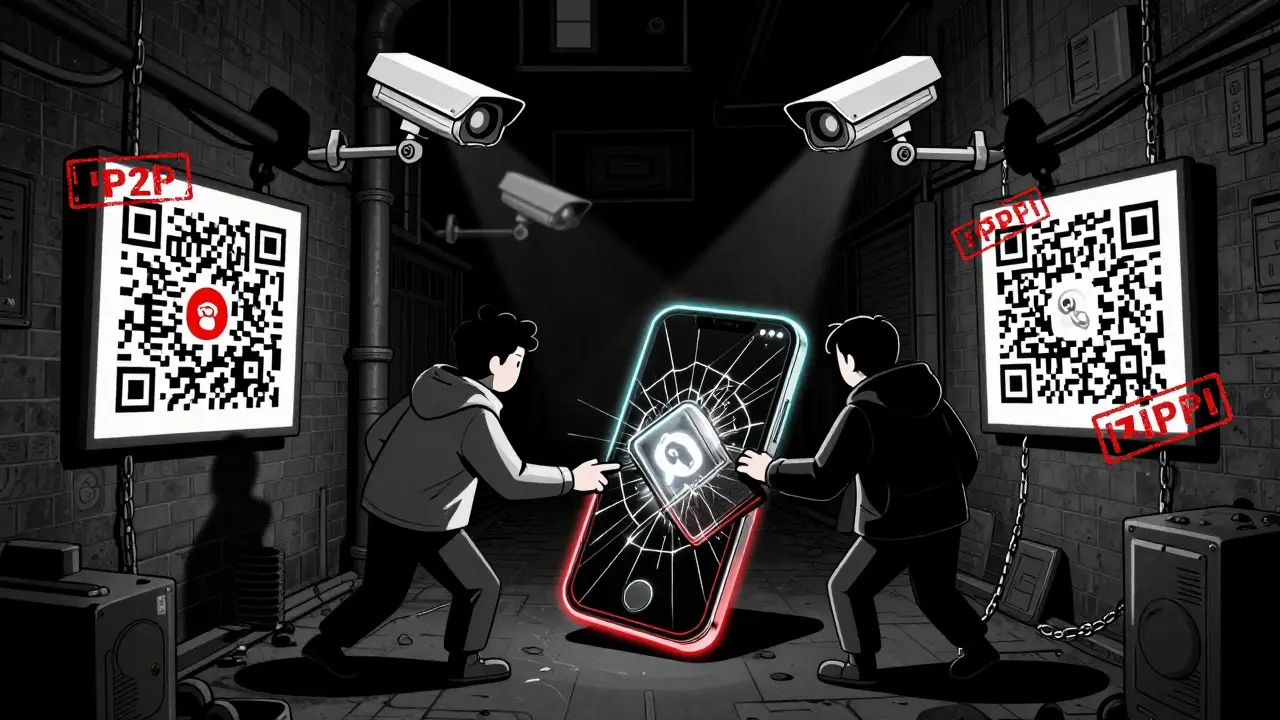
What about decentralized exchanges (DEXs) and P2P trading?
Some users have shifted to decentralized platforms like Uniswap, PancakeSwap, or local P2P networks. These don’t require KYC, and they run on blockchain-so technically, they’re outside China’s control.
But the reality is harsh. P2P trading in China is risky:
- Most traders use WeChat or QQ to arrange deals, which are monitored by the government.
- Payments often go through bank transfers, which leave a trail.
- Scams are rampant. In 2024, over 1,200 P2P crypto fraud cases were reported in Shanghai alone.
- Even if you avoid scams, your transaction history can be traced if you use a Chinese IP or phone number.
Decentralized exchanges don’t offer protection. If you’re using MetaMask or Trust Wallet from within China, your device can still be monitored. The government doesn’t need to shut down Uniswap-it just needs to make sure you can’t safely use it.
What’s the impact of the ban?
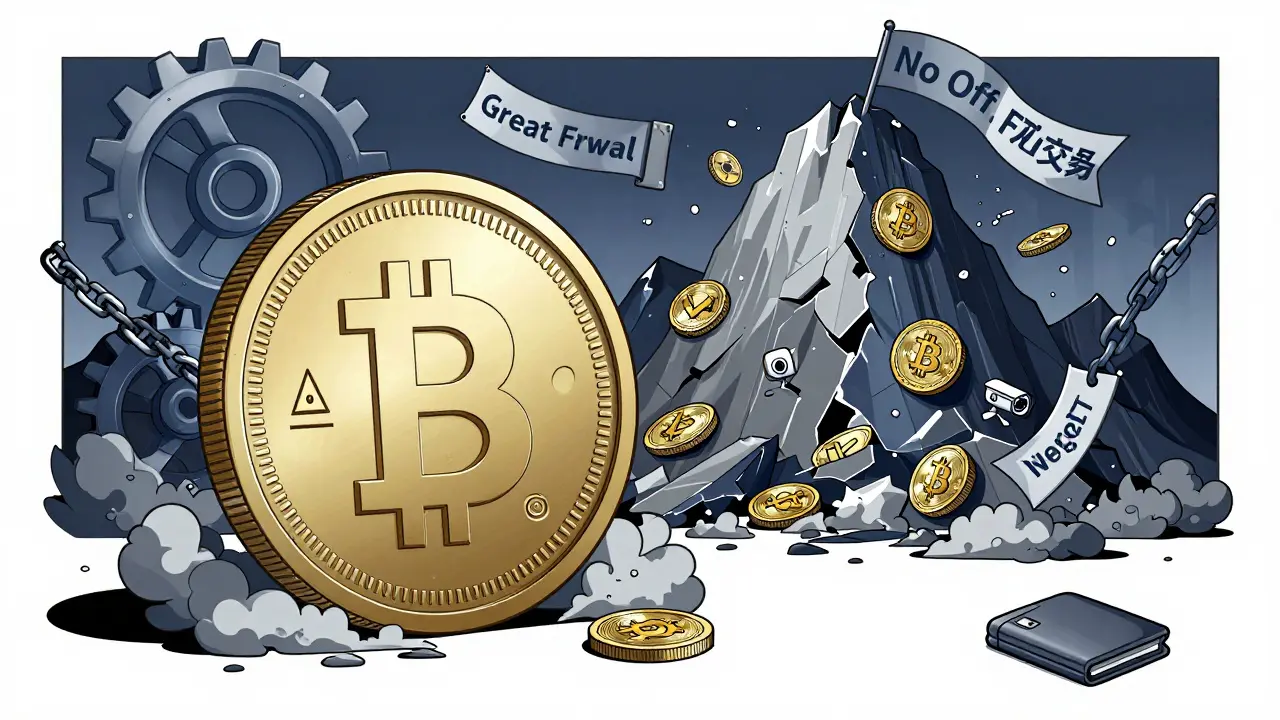
The ban has reshaped global crypto markets. Before 2021, China accounted for nearly 70% of Bitcoin mining and a huge chunk of global trading volume. Today, that’s gone.
When the ban hit in 2021, Bitcoin dropped 20% in a week. In May 2025, false rumors of a new ban caused Bitcoin to plunge from $111,000 to $104,000 in under an hour-purely because traders feared China might crack down harder.
But the biggest effect isn’t price. It’s isolation. China has cut off 1.4 billion people from the global crypto economy. That’s not just a policy-it’s a digital firewall.
Meanwhile, China is pushing its own digital currency: the e-CNY, or digital yuan. It’s not crypto. It’s not decentralized. It’s a state-controlled digital dollar that lets the government track every transaction, freeze accounts, and set spending limits. It’s the opposite of Bitcoin.
Will the ban ever end?
Don’t hold your breath. There’s no sign China will reverse course. In fact, enforcement has gotten stricter.
Since 2023, Chinese courts have processed over 800 crypto-related cases annually. Fines, asset seizures, and even prison sentences are becoming more common for those caught facilitating crypto transactions.
Some analysts think China might one day allow licensed exchanges-similar to how it regulates stock trading. But that would mean creating a government-approved crypto market, not opening the door to Binance or Coinbase.
For now, the message is clear: if you want to trade crypto in China, you’re on your own. No banks. No exchanges. No safety net.
What happens if you get caught?
Most people won’t go to jail for holding Bitcoin. But if you’re running an OTC desk, helping others buy crypto, or using a Chinese bank to fund an exchange account-you’re in danger.
Penalties include:
- Fines up to 1 million RMB ($140,000)
- Freezing of bank accounts and crypto wallets
- Blacklisting from financial services
- Criminal charges for "illegal fundraising" or "money laundering"
In 2024, a Shenzhen man was sentenced to 2 years in prison for operating a P2P crypto trading group. He didn’t profit-he just helped friends buy Bitcoin. The court called it "a threat to financial order."
The risk isn’t theoretical. It’s happening every day.
Surendra Chopde
January 6, 2026 AT 23:57Tre Smith
January 8, 2026 AT 21:13Natalie Kershaw
January 9, 2026 AT 01:03Jacob Clark
January 9, 2026 AT 04:17Jon Martín
January 9, 2026 AT 16:55Mujibur Rahman
January 11, 2026 AT 06:11Danyelle Ostrye
January 11, 2026 AT 08:13Jennah Grant
January 12, 2026 AT 14:04Dennis Mbuthia
January 13, 2026 AT 17:36Becky Chenier
January 15, 2026 AT 00:24