What is Angle Protocol and EURA? A Guide to the Decentralized Euro Stablecoin
 Apr, 23 2026
Most people think of stablecoins as just another way to hold US dollars on the blockchain. But for anyone living or doing business in Europe, relying on USD-pegged assets means constantly gambling on the exchange rate between the dollar and the euro. That's where Angle Protocol is a decentralized, over-collateralized stablecoin protocol designed to issue Euro-pegged digital assets . By removing the need for a central bank or a corporate custodian, it gives users a way to keep their value stable in euros without trusting a single company with their money.
The Core of Angle Protocol: Understanding EURA
At the center of this ecosystem is EURA (previously known as agEUR). Unlike centralized coins like USDT, which rely on bank accounts and audits that you have to take on faith, EURA is a decentralized stablecoin. This means its value is backed by a transparent basket of cryptocurrency collateral that anyone can verify on-chain.
The protocol uses a system of agTokens, which are the stablecoins minted through the platform. To keep EURA pinned to exactly €1, Angle uses an oracle-based convertibility mechanism. If the market price of EURA climbs above €1, traders can mint new EURA by depositing collateral and selling the excess for a quick profit. If it dips below €1, they buy the cheap EURA and redeem it for the full oracle value of the collateral. This constant tug-of-war between arbitrageurs keeps the price stable without needing a central authority to step in.
How the System Actually Works
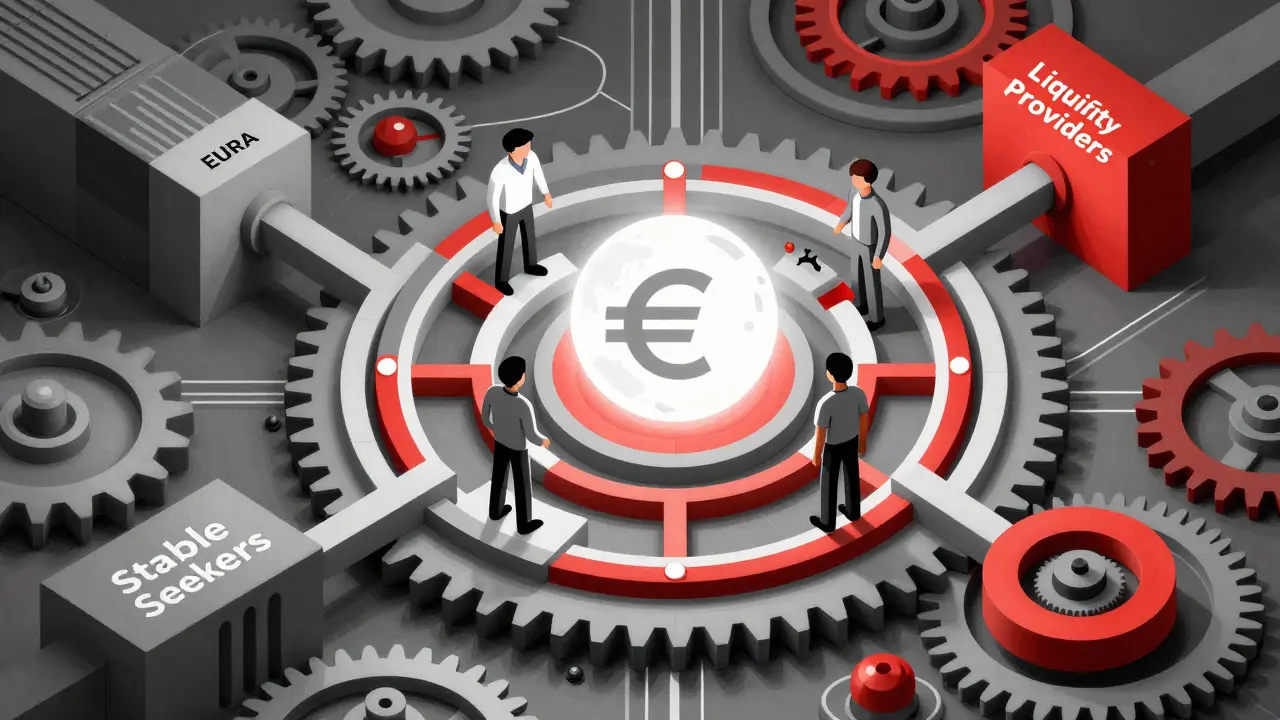
Angle Protocol doesn't just rely on one type of user; it creates a small economy with different roles to ensure the system stays healthy. Think of it as a machine with several moving parts:
- Stable Seekers: These are users who want EURA. They deposit crypto collateral to mint the coin and can later redeem their EURA to get their original assets back.
- Hedging Agents: These participants use perpetual futures contracts to protect the protocol from the volatility of the collateral. They essentially act as a safety net.
- Liquidity Providers: These users deposit extra collateral into the reserves. In exchange, they earn transaction fees and rewards through sanTokens (LP tokens).
This structure is supported by the ANGLE token, which is the governance heart of the project. Holders of ANGLE can vote on how the protocol evolves and how the treasury is spent, ensuring that no single person can suddenly freeze your funds-a common fear with centralized stablecoins.
Collateral and Security Measures
A stablecoin is only as good as what's backing it. EURA is over-collateralized, meaning there is always more value in the reserves than there is EURA in circulation. This is a crucial safety feature; if the market crashes, the protocol still has enough assets to cover every single coin.
| Attribute | Value / Detail |
|---|---|
| Accepted Collateral | Ethereum (ETH), Wrapped Bitcoin (wBTC), USDC |
| Backing Method | Over-collateralization via Oracle pricing |
| Safety Buffer | Surplus Buffer + Large Equity Buffer |
| Institutional Backing | $5 million seed round led by a16z |
Beyond just holding assets, Angle Protocol employs a Surplus Buffer. This is the amount of money that would be left over if every single person decided to withdraw their money at the same time. It acts as a shock absorber for the protocol, ensuring that a sudden market dip doesn't lead to a systemic failure.
Beyond Stability: Yield and Trading
Angle isn't just a digital wallet; it's a tool for generating income. Through products like stUSD and stEUR, the protocol automatically moves funds between DeFi lending platforms and tokenized securities. This means you can hold a stable asset but still earn a competitive yield, effectively turning your holdings into a productive investment.
For more aggressive users, Angle enables decentralized Forex trading. You can open leveraged long positions on currency pairs with up to 100x leverage. This brings the high-stakes world of currency trading on-chain, allowing professional traders to speculate on the Euro without needing a traditional brokerage account.
Multi-Chain Reach and Real-World Use
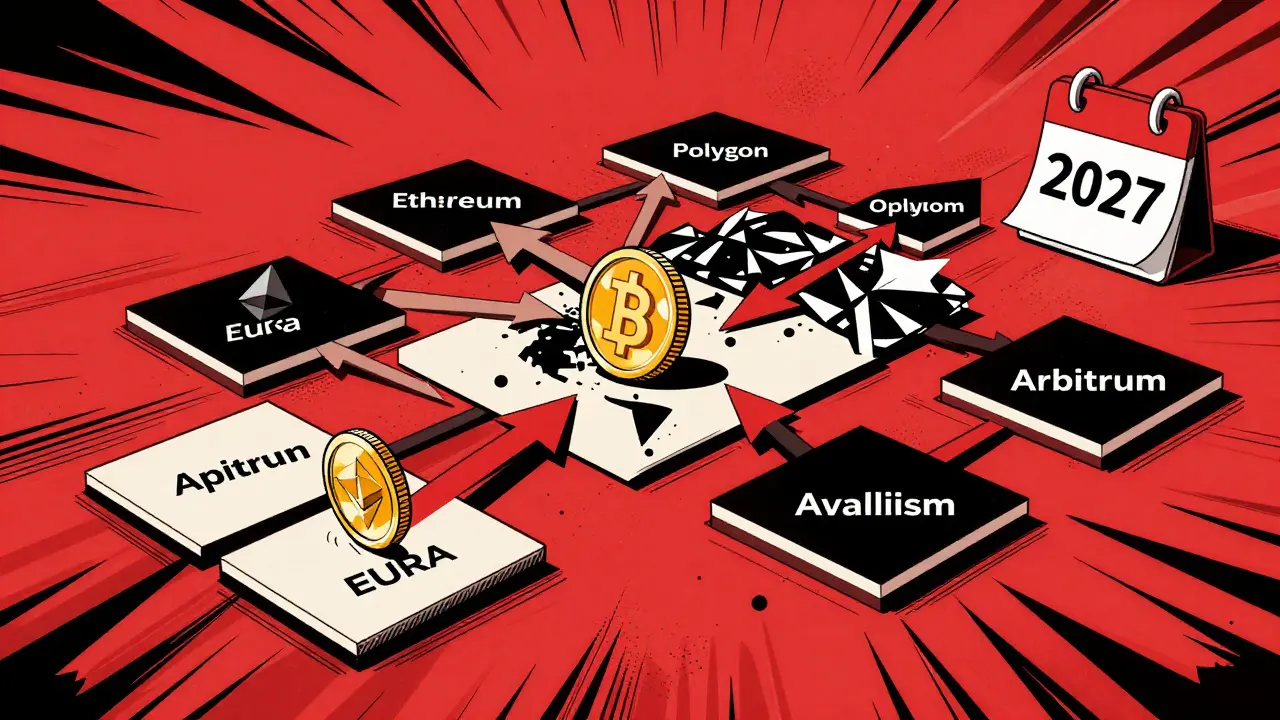
One of the biggest hurdles for any crypto project is accessibility. To solve this, Angle integrated LayerZero, a technology that allows tokens to move across different blockchains without the usual friction of bridges. Today, EURA isn't stuck on one network; it lives on five:
- Ethereum: The primary home and deployment site.
- Polygon: For faster, cheaper transactions.
- Arbitrum: A high-performance Layer 2 solution.
- Optimism: Another Ethereum scaling solution for efficiency.
- Avalanche: Expanding the reach to a different ecosystem.
The protocol has also pushed into the "real world." By integrating with the Bleap payment platform, EURA is moving from a speculative asset used in DeFi to a currency that can actually be used to pay merchants. This is the critical jump from being a "crypto coin" to becoming a functional payment instrument.
The Sunset: What You Need to Know
There is a very important detail that any current or future holder of EURA must understand: Angle Protocol has announced it is entering its final chapter. This doesn't mean the coin is crashing or the system is broken, but it does mean there is an end date.
The protocol has set a redemption deadline of March 1, 2027. Until then, the protocol remains fully collateralized, and every single EURA unit can be redeemed at a 1:1 rate for the collateral tokens in the reserves. If you're using EURA for short-term trading or as a treasury asset, it's still a powerful tool, but you shouldn't plan to hold it indefinitely beyond that 2027 date.
Is EURA a safe stablecoin?
EURA is designed for safety through over-collateralization, meaning it holds more assets than it has issued. It also uses an equity buffer and a surplus buffer to protect against market crashes. However, like all DeFi protocols, it carries smart contract risk and is subject to the overall health of its collateral assets.
How does EURA differ from USDT or USDC?
The main difference is centralization. USDT and USDC are issued by companies that hold dollars in bank accounts. EURA is decentralized; its value is managed by code, oracles, and a basket of crypto assets, meaning you don't have to trust a company's balance sheet.
What happens after March 1, 2027?
March 1, 2027, is the official redemption deadline. Users are encouraged to redeem their EURA for the underlying collateral before this date. After this point, the protocol's operational chapter will have closed.
Can I earn interest on my EURA?
Yes, through the stEUR and stUSD products, Angle Protocol automatically rebalances funds across DeFi lending and securities to provide a yield for holders, allowing you to earn a return on your stable assets.
Which blockchains support EURA?
EURA is available on Ethereum, Polygon, Arbitrum, Optimism, and Avalanche, thanks to its integration with LayerZero for cross-chain transfers.
Greg Reynolds
April 24, 2026 AT 16:32Decentralization is mostly a buzzword here since they're still relying on oracles for the convertibility mechanism. If the oracle fails or gets manipulated, the whole "trustless" facade collapses instantly. It's just swapping one form of dependency for another.
Larry Yang
April 26, 2026 AT 06:56imagine thinkin a "redemption deadline" is a la feature. it's literally just a slow-motion rug pull or a failure to find a sustainible model. honestly who in their right mind would lock assets into a protocol with an expiration date. totally laUGHable.
Jennifer Taylor
April 27, 2026 AT 19:20The a16z money is the real story here. They want us using these coins so they can track every single cent we spend in Europe. It is all a trap to get us into a digital cage. Don't trust the code.
Alex Wan
April 28, 2026 AT 15:29Oh my goodness! What a truly marvelous explnation of a complex system! I feel so enlightned by this a-proach to stablecoins, though I might have misread a few bits here and there! It is such a joy to see innovation in the Euro space!!
Paige Raulerson
April 29, 2026 AT 17:03The writing is a bit basic but the concept of a sunset date is just quaint. It's almost as if they're admitting the model is fundamentally flawed and they're just winding down the clock to avoid a messy exit. Truly pedestrian.
Clair Geary
April 30, 2026 AT 05:47this is such a sparkly way to handle the euro problem!! love the idea of a safety buffer to keep things cozy and safe for everyone
Benjamin Forg
April 30, 2026 AT 10:40the 2027 date is a psychological operation to make you feel safe while they harvest your data it is all a simulation of stability and we are just the cattle for the big banks who secretly run the oracles anyway
Findlay Duncan Lyon
April 30, 2026 AT 21:13Great to see more Euro utility. Very handy.
Ali Tate
May 2, 2026 AT 15:55absolutely stellar engineering for the most part though the 100x leverage is where the real spice is at. purely American levels of risk appetite being brought to the euro zone and i love to see that absolute chaos
praveen subbiah
May 3, 2026 AT 04:18It is wonderful to see such global tech reach! Even though I love my own country most of all, seeing these tools expand is a thrilling journey for all of us in the digital age!! My heart beats fast for this innovation!!