What is DragonCoin (DRAGON) crypto coin? A deep look at the Solana meme coin with zero trading volume
 Feb, 18 2026
DragonCoin (DRAGON) isn't another Bitcoin or Ethereum. It’s not even another Dogecoin or Shiba Inu. It’s something quieter, weirder, and far more fragile - a Solana-based meme coin with a market cap of just $34,740 as of late 2024. That’s less than the cost of a used laptop. But despite its tiny size, DRAGON has drawn attention from a small group of retail traders who see it as a lottery ticket: buy a few trillion tokens for a few cents, and maybe - just maybe - it’ll go viral. The problem? No one’s actually buying or selling it.
What exactly is DragonCoin?
DragonCoin (DRAGON) is a cryptocurrency built on the Solana blockchain. It launched in late 2023 with no whitepaper, no team, and no utility. Its entire identity is built around the Chinese dragon - a symbol of power, luck, and prosperity in East Asian culture. The project claims its goal is to "create wealth for people" by reviving the community-driven spirit of early crypto days. But unlike projects like Shiba Inu that at least have a token economy or staking system, DRAGON does absolutely nothing. It doesn’t power a game. It doesn’t pay fees. It doesn’t reward holders. It’s just a number on a blockchain.
The token’s total supply is 98.908 quadrillion DRAGON. That’s 98,908,000,000,000,000 tokens. To put that in perspective: if you owned one DRAGON token, you’d own 0.0000000000005094% of the entire supply. Its price per token is so low that even major exchanges like Bitget list it as $0.0000000000005094. You need to buy trillions just to make a dollar’s worth.
How does DragonCoin work technically?
Technically, DRAGON is an SPL token - the standard format for tokens on Solana. That means it inherits Solana’s speed: transactions settle in under a second, and fees cost about $0.00025. It’s not slow. It’s not expensive. But that’s not the issue. The problem is that DRAGON doesn’t use any of Solana’s advanced features. It has no smart contracts. No staking. No liquidity pools of its own. It’s just a token contract with a name and a symbol.
The contract address is GiBrdwGJQ9cPqyBkKtRfEnw5R, visible on Solscan. That’s the only official documentation anyone has. No GitHub repo. No Telegram announcement channel with regular updates. No developer updates. No roadmap progress. Just a static contract and a few hundred people holding it.
Market performance: A ghost coin
DRAGON hit its all-time high on January 30, 2024, at $0.00000000000105119 - a market cap of about $103,900. Since then, it’s been in steady decline. As of October 2024, its market cap sits at $34,740. Its all-time low? $0.000000000000131582, reached in December 2023.
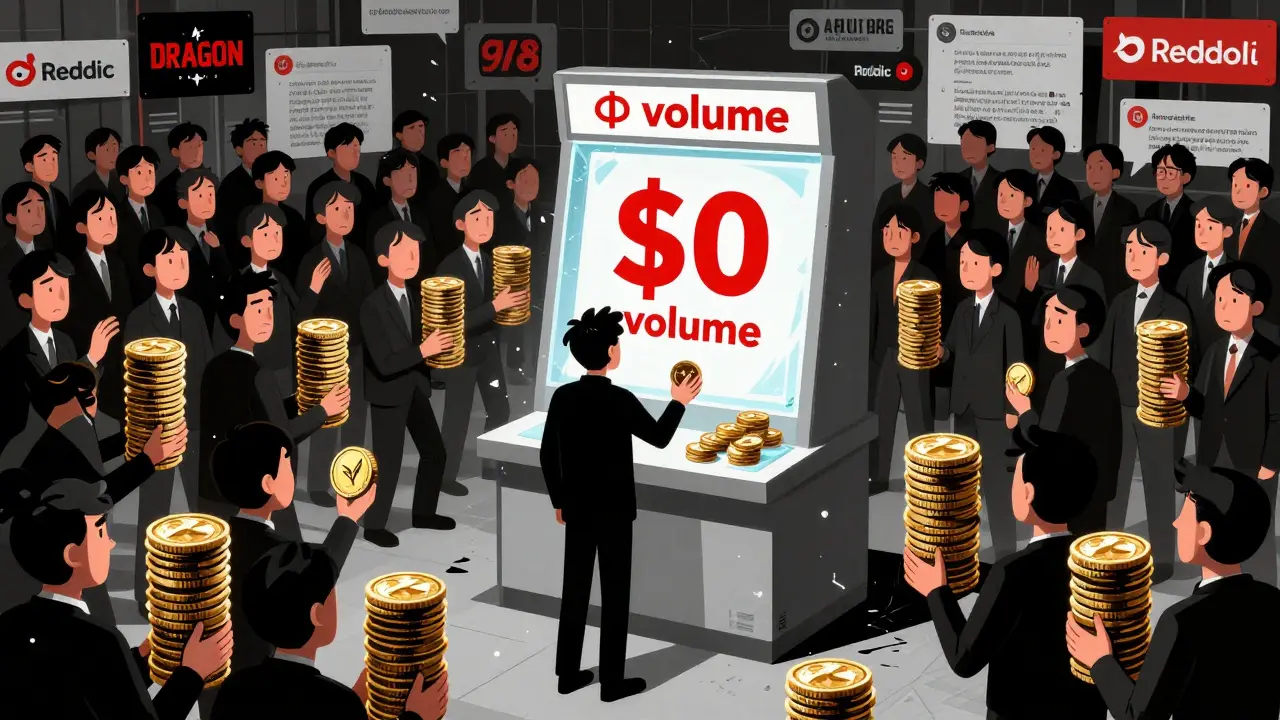
Here’s the most telling stat: 24-hour trading volume is $0. Across every exchange, including Raydium - the only place where DRAGON trades - there are no buyers and no sellers. Not $10. Not $1. Zero. That means if you bought DRAGON last week, you can’t sell it. Not because the price is low - but because no one wants to buy it.
There are only 5,090 unique holders. That’s fewer than a small Reddit community. For comparison, Shiba Inu has over 1.2 million holders. Pepe has over 800,000. DRAGON? Less than 5,100. And those holders? Most of them are stuck. Reddit threads are full of posts like: "Bought 100 trillion DRAGON. Now I can’t sell. Help?" The answer? There is none.
Why does anyone still hold it?
Because of hope. And price.
With DRAGON trading at $0.0000000000005094, you can buy 196 billion tokens for just $1. That’s the lure. If the price goes up 10x - which seems impossible given the lack of volume - you’d make $10. If it goes up 100x? $100. The math is simple: tiny price = huge percentage gains. It’s the same psychology that made Dogecoin popular in 2021. But Dogecoin had community, media, and Elon Musk. DRAGON has nothing.
Some claim it’s "the next big meme coin." But there’s no evidence. No influencer posts. No exchange listings beyond Raydium. No partnerships. No developer activity. The only "news" is a single Reddit thread from January 2024 with 247 upvotes and 87 skeptical comments. One user summed it up: "This is just another Solana meme coin pump and dump scheme with zero innovation."
How to buy DragonCoin (if you dare)
If you still want to try, here’s how:
- Get a Solana wallet. Phantom Wallet is the most popular and easiest to use.
- Fund it with SOL. You need at least 0.1 SOL to cover transaction fees.
- Go to Raydium, the only DEX listing DRAGON.
- Trade SOL for DRAGON using the DRAGON/USDC pair.
That’s it. No KYC. No account. No verification. You’re trading a token with no liquidity, no future, and no support. If your transaction fails, it’s likely because you don’t have enough SOL for gas. That’s a common issue - 63% of Solana forum questions about DRAGON are about failed transactions due to low SOL balance.
The risks: You’re gambling, not investing
DragonCoin doesn’t fit any definition of a legitimate asset. It has no revenue. No team. No product. No roadmap. No community growth. Just a price chart that’s been falling for months.
Here’s what you’re risking:
- Illiquidity: You might not be able to sell. Ever.
- Abandonment: The creators could vanish tomorrow. No one knows who they are.
- Rug pull: Even though no evidence exists, the structure is perfect for one. All it takes is one person to drain the liquidity pool.
- Zero value: If no one buys it for six more months, it could become worthless. Kaiko Research says tokens with zero volume for consecutive months typically die within 6-12 months.
Delphi Digital’s analysis is blunt: "The survival rate for micro-cap meme coins with no utility or development activity is less than 5% beyond 18 months from launch." DRAGON launched in late 2023. That puts it at risk right now.
Who is DragonCoin for?
It’s not for investors. It’s not for traders with strategy. It’s not for long-term holders.
It’s for one type of person: someone who sees crypto as a game. Someone who’s willing to risk $5 or $10 on a token that has no chance of success… but could, in theory, return 100x if the moon somehow happens. It’s the digital equivalent of buying a lottery ticket at a gas station. You know the odds. You know the house always wins. But you do it anyway.
If that’s you - go ahead. But don’t call it investing. Call it gambling. And never invest more than you’re okay with losing completely.
Final thoughts: A lesson in crypto’s dark side
DragonCoin isn’t a failure. It’s a symptom. It shows how easy it is to create a cryptocurrency today. Anyone with a Solana wallet and a few hours can launch a token, name it after a dragon, and call it the future. The blockchain doesn’t care. Exchanges don’t care. The market barely notices.
But for the few who bought in, it’s real. They’re holding something with no value, no buyers, and no way out. That’s not innovation. That’s exploitation dressed up as opportunity.
DRAGON might disappear tomorrow. Or it might linger for years as a ghost token - a digital monument to the wild west of meme coins. Either way, it’s not something to build on. It’s something to learn from: if a project has no team, no utility, and zero volume, it’s not a coin. It’s a trap.
Is DragonCoin (DRAGON) a good investment?
No. DragonCoin has no utility, no development team, and zero trading volume. It’s a micro-cap meme coin with a market cap under $35,000. The chances of it gaining real value are near zero. If you buy it, you’re gambling, not investing. Only risk money you’re prepared to lose entirely.
Can I sell my DragonCoin tokens?
Technically, yes - if you bought it on Raydium. But practically, no. There’s been $0 in trading volume for months. Even if you place a sell order, no one will buy. Thousands of holders are stuck because there are no buyers. If you need to exit, you likely can’t.
Where can I trade DragonCoin?
DragonCoin trades only on Raydium, a decentralized exchange on Solana. It’s listed as the DRAGON/USDC pair. No major exchanges like Binance, Coinbase, or Kraken list DRAGON. You need a Solana wallet (like Phantom) to trade it.
Is DragonCoin a scam?
There’s no proof it’s a scam - but there’s also no proof it’s real. The team is anonymous. There’s no whitepaper. No GitHub. No updates. It follows the classic pattern of a meme coin that was launched to attract attention, then abandoned. It’s not a confirmed rug pull, but it’s one bad actor away from being one.
Why does DragonCoin have such a high supply?
A high supply like 98.9 quadrillion tokens allows the price per token to be extremely low - around $0.0000000000005094. This makes it seem affordable. Retail traders buy trillions of tokens thinking they’re getting "a lot," but the total value remains tiny. It’s psychological pricing - common in meme coins like Shiba Inu - but without the community or volume to back it up.
What’s the difference between DragonCoin (DRAGON) and Dragon Coin (DGN)?
They’re completely different. DragonCoin (DRAGON) is a Solana meme coin with no utility. Dragon Coin (DGN) is a separate project focused on gaming and blockchain rewards. DGN has a website, a team, and real use cases. DRAGON has none of those. Don’t confuse them - they’re not related.
Beth Erickson
February 19, 2026 AT 04:27Alex Williams
February 19, 2026 AT 15:23yogesh negi
February 21, 2026 AT 08:32jennifer jean
February 21, 2026 AT 21:44Jeremy Fisher
February 22, 2026 AT 12:40Anandaraj Br
February 24, 2026 AT 05:27AJITH AERO
February 25, 2026 AT 07:03Ian Plunkett
February 26, 2026 AT 22:53Avantika Mann
February 28, 2026 AT 05:30Tarun Krishnakumar
February 28, 2026 AT 10:04george chehwane
March 1, 2026 AT 23:55Alan Enfield
March 2, 2026 AT 21:38Jennifer Riddalls
March 4, 2026 AT 14:52Kyle Tully
March 6, 2026 AT 08:18kieron reid
March 7, 2026 AT 19:33Andrew Edmark
March 8, 2026 AT 00:25Dominica Anderson
March 9, 2026 AT 21:08sruthi magesh
March 11, 2026 AT 04:18Rajib Hossaim
March 13, 2026 AT 00:23