What is Lift Dollar (USDL)? A Guide to the Former Yield-Bearing Stablecoin
 Apr, 25 2026
If you've come across Lift Dollar (USDL) while browsing crypto charts or old portfolios, you might be wondering what exactly it was and why you can't trade it today. The short answer is that USDL was a bold experiment in the stablecoin world-a regulated token that paid you just for holding it-but it is no longer active. As of April 2026, the coin has been discontinued.
To understand the impact of USDL, you first have to understand the problem it tried to solve. Most stablecoins are like digital cash; they keep their value, but they don't grow. If you keep money in a standard vault, it just sits there. USDL changed that by turning a stable asset into a yield-generating tool. It allowed regular users to get a piece of the interest that usually only big banks and institutional investors earn from US government bonds.
Quick Summary: The Rise and Fall of USDL
- What it was: A regulated, yield-bearing stablecoin issued by Paxos International.
- Key Feature: Distributed daily interest (3-8% APY) directly to holders' wallets.
- Regulatory Status: Oversight by the FSRA in the Abu Dhabi Global Market (ADGM).
- Current Status: Discontinued and wound down as of December 8, 2025.
- The Transition: Most holdings were converted into USDG.
How Lift Dollar Actually Worked
At its core, Lift Dollar was an ERC-20 stablecoin launched on June 5, 2024. Unlike some "algorithmic" coins that rely on complex math and hope to stay stable, USDL was backed by real, boring assets: US dollar deposits, US Treasuries, and cash equivalents. This meant for every 1 USDL in circulation, there was a dollar's worth of safe assets sitting in a reserve.
The real magic was in the yield. Most people are used to "staking," where you lock your coins in a contract and hope for a reward. USDL used a process called "rebasing." This is a fancy way of saying the smart contract automatically increased the number of tokens in your wallet every day. You didn't have to click a button or sign a new transaction; your balance simply grew as the interest from the reserve assets was distributed.
This system operated primarily on the Ethereum and Arbitrum blockchains. By using these networks, Paxos ensured that the token was accessible to anyone with a compatible digital wallet, whether they were a retail trader or a hedge fund.
The Regulatory Edge: Why It Wasn't Just Another Coin
The crypto world is full of "trust me" projects, but USDL took a different path. It was issued by Paxos Issuance MENA Ltd. and fell under the strict eye of the Financial Services Regulatory Authority (FSRA) of the Abu Dhabi Global Market. This wasn't just a badge of honor; it meant there were actual laws governing how the reserves were held and how the company operated.
For the average user, this meant a much lower risk of a "rug pull" or a sudden collapse. The regulatory framework required transparency and custody standards that mirrored traditional finance. If you held USDL, you weren't just betting on a piece of code; you were using a financial instrument that had to meet international compliance standards.
Comparing USDL to Other Stablecoins
To see where USDL fit in the market, it helps to look at it alongside its peers. While most stablecoins focus solely on maintaining a 1:1 peg, USDL focused on utility and income.
| Feature | Standard Stablecoins (e.g., USDC) | Lift Dollar (USDL) |
|---|---|---|
| Primary Goal | Price Stability | Stability + Passive Income |
| Yield Method | External Staking/Lending | Automatic Daily Rebasing |
| User Effort | Active Management | Passive (Hold and Earn) |
| Reserve Assets | Cash/Treasuries | Cash/Treasuries (Yield-generating) |
| Typical Returns | 0% (unless lent out) | 3% to 8% APY |
The Wind-Down: What Happened to the Coins?
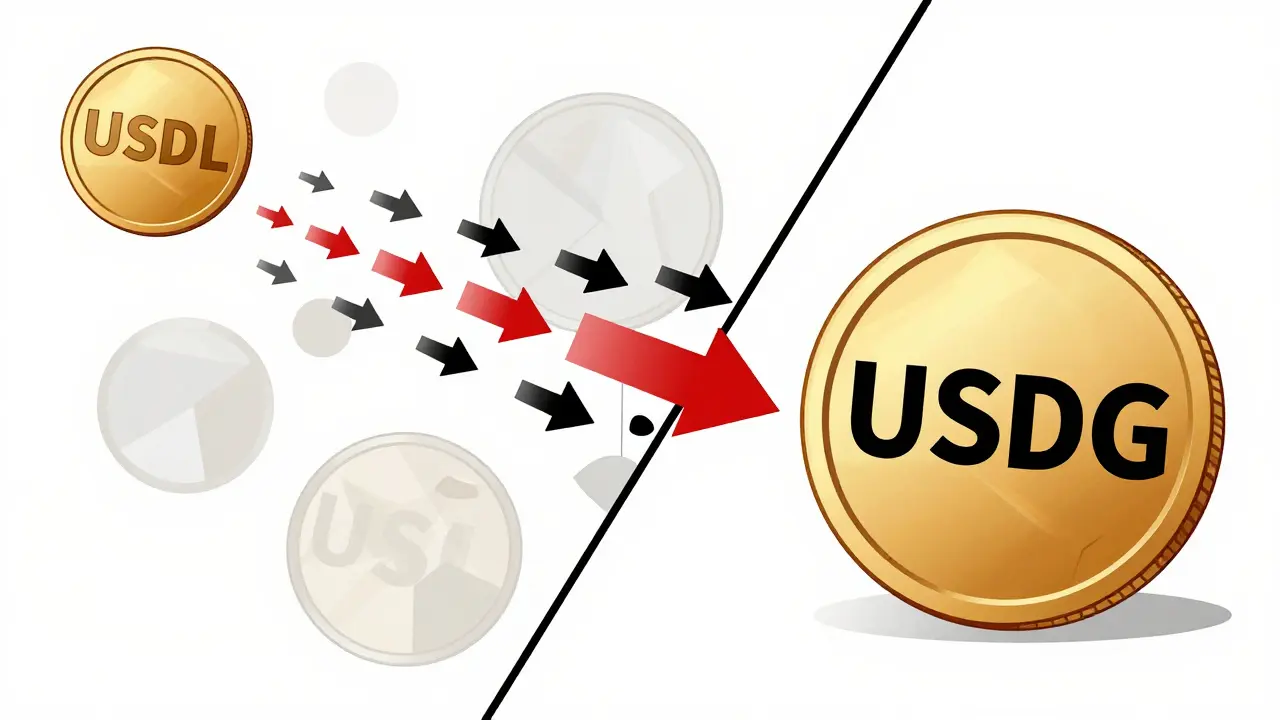
Despite the innovation, Paxos decided to simplify its product line. On December 8, 2025, the USDL project officially ended. This wasn't a crash or a hack, but a strategic "wind-down." The goal was to consolidate their offerings into a single, streamlined stablecoin: USDG.
If you held USDL during the transition, the process was mostly automatic. Paxos checked the blockchain addresses and converted the USDL balance into an equivalent amount of USDG. However, there was a catch for the "dust" holders. If your balance was less than $1, the amount was too small to be recovered and was essentially lost during the burn process. For anyone with more than $1, as long as they passed the required compliance checks, their funds were safely migrated.
Lessons from the USDL Experiment
The life of Lift Dollar teaches us a few things about the future of money. First, it proved that people really want "smart cash"-money that stays stable but still works for you in the background. Second, it showed that regulation is becoming a requirement, not an option, for any asset that wants to handle billions of dollars in volume.
The shift to USDG suggests that while yield-bearing tokens are attractive, managing them as a separate product can be complex. It's likely that future stablecoin iterations will find a better way to blend yield and stability without needing to launch entirely new tokens every few years.
Can I still buy USDL today?
No. USDL was discontinued on December 8, 2025. It is no longer an active stablecoin, and you cannot buy it through official channels or reputable exchanges.
What happened to my USDL tokens?
If you held more than $1 worth of USDL, Paxos converted your balance into USDG tokens automatically, provided you passed the compliance checks. If you held less than $1, those tokens were burned and not recovered.
Was USDL a scam?
No, it was not a scam. It was a regulated product issued by Paxos International and overseen by the FSRA in Abu Dhabi. The project ended due to a strategic business decision to consolidate products, not due to failure or fraud.
How did USDL pay interest?
USDL earned interest from the high-quality US government securities and cash equivalents held in its reserves. This profit was then distributed daily to token holders through a smart contract mechanism called rebasing.
Which blockchains supported USDL?
USDL primarily operated on the Ethereum and Arbitrum blockchains, allowing for broad compatibility with wallets and decentralized finance (DeFi) platforms.
Next Steps for Former Holders
If you're checking an old wallet and see a balance of USDL, don't expect it to be tradable. If you didn't receive USDG in return, it's likely because your balance was under the $1 threshold or you didn't meet the compliance requirements at the time of the wind-down.
For those looking for similar assets today, look for regulated stablecoins that offer integration with lending platforms or official yield-bearing accounts. The era of the "automatic rebasing" stablecoin like USDL may have paused, but the demand for passive income on stable assets is higher than ever.
Jan Conrad
April 26, 2026 AT 06:09The rebasing mechanism was honestly the most interesting part of this whole project. It basically eliminated the friction of manually claiming rewards, which is a huge pain point in most DeFi protocols. I wonder how the transition to USDG handled the yield aspect since the original USDL was so focused on that passive stream.
Aaron Zeiler
April 26, 2026 AT 14:38most people forget that rebasing coins can be a nightmare for some accounting software because your balance changes without a trade happening
Jimmy vasquez
April 27, 2026 AT 12:46That's a great point about the accounting! For anyone who used it for business, the daily changes in token count make the spreadsheets look like a mess, even if the dollar value is stable. It's definitely a trade-off between user convenience and bookkeeping clarity.
its me
April 28, 2026 AT 22:05It's just fascinating how we've conditioned ourselves to believe that "passive income" is a fundamental right. We've moved from owning land to owning tokens that simulate the behavior of land, yet we've lost the actual connection to value. It's almost poetic in its emptiness, really.
Carli Bates
April 29, 2026 AT 18:00oh look another "bold experiment" that ended in a consolidation move because the market actually wanted something that works without a thousand rules lol
Ryan Nakielny
May 1, 2026 AT 11:41Yeah, because nothing says "future of finance" like a corporate wind-down after eighteen months of existence. Truly groundbreaking stuff.
Ipsita Seal
May 2, 2026 AT 05:10Whatever.
Gabrielle Danis
May 2, 2026 AT 22:25The regulatory oversight provided by the FSRA was a critical component of the USDL framework. While many users prioritize yield, the institutional-grade custody standards ensured that the underlying US Treasuries were managed with a level of transparency that is sadly lacking in many other stablecoin projects.
Abhishek Verma
May 3, 2026 AT 13:40Imagine thinking "regulated" means you're safe in crypto. That's cute. The regulator just makes sure the paperwork is pretty while the company decides to just "consolidate" your assets away.
Tracy McBurney
May 5, 2026 AT 12:24Actually, the transition to USDG was a blatant admission that the USDL model lacked sustainable liquidity. If you actually analyze the volume, it was clear that the rebasing feature didn't attract enough institutional capital to justify the overhead of a separate token. It was an inefficient product from the start, and the "strategic wind-down" is just a corporate euphemism for failing to hit KPIs.
Kathleen Warren
May 6, 2026 AT 19:37It's okay for things to change and for projects to end. The important part is that people got their money back. I think we can all learn from this and just be a bit more careful with where we put our savings!
Rushell Perry
May 8, 2026 AT 06:52just keep learning and stay curious everyone it is all part of the process
Rachel S
May 8, 2026 AT 12:16The sheer audacity of losing funds just because you had less than one dollar is simply tragic! 😱 It is truly an absolute catastrophe for the small holders who just wanted a tiny piece of the pie! 📉 One must wonder where the empathy is in these corporate structures! 💔
Barbara Jones
May 10, 2026 AT 04:12I totaly get why the small amounts got burned... it probably costs more in gas to move them than the value of the coin anyway lol. Hope evryone who had a decent amount got thier USDG safe!
Janis Naglis
May 10, 2026 AT 13:02The synergy between the regulatory framework and the smart-contract-driven distribution was truly exemplary!!! Even if the project was deprecated, the conceptual paradigm of "smart cash" remains highly viable for future iterations of synthetic assets!!! We should all embrace this evolution!!!
Brendan Thraxton
May 11, 2026 AT 10:55I agree with the sentiment here. Even if this specific token is gone the tech is still very promising. It shows a clear path toward combining traditional finance security with crypto efficiency. We are just in the early stages of seeing how this all fits together
Andrew Todd
May 11, 2026 AT 22:48Why do we care about some random coin from Abu Dhabi? This is all garbage. US dollar is the only thing that matters and we dont need this fake digital nonsense to tell us how to make money. Only real Americans know how real money works.
Sri Astuti
May 12, 2026 AT 16:53It's just so typical that we are praising a product that didn't even last two years as a "lesson" in finance when in reality it was just a failure of product-market fit that Paxos tried to dress up as a strategic move to avoid looking bad to their remaining stakeholders 🙄. I mean honestly who actually thinks that rebasing is the future when the volatility of the underlying ecosystem often wipes out the 3-8% gain anyway and the sheer amount of gas spent on Ethereum to even hold these things for a while makes the yield basically zero for any retail user who isn't a whale 🤡.