What is Malinka (MLNK)? A Complete Guide to the Liquidity Token
 Apr, 26 2026
Imagine a world where you don't need a massive warehouse of energy-hungry computers to earn new coins. Instead of spending thousands on hardware to mine Bitcoin, you simply provide a bit of liquidity to a trading platform and watch your balance grow every single second. That is the core idea behind Malinka is a specialized liquidity token launched in 2021 that fuels the PayCashSwap decentralized exchange ecosystem. Commonly referred to by its ticker MLNK, it flips the traditional mining script on its head by rewarding users for helping the market function rather than solving complex math problems.
How Malinka Actually Works
Most people are used to Proof of Work or Proof of Stake. Malinka does something different. It uses a distribution model tied directly to liquidity pools. If you've ever wondered how a decentralized exchange (DEX) keeps prices stable, it's because of these pools. When you put your funds into a pair like EOS/MLNK, you aren't just holding assets; you're providing the "oil" that lets other traders swap their coins without friction.
The magic happens in the background via Smart Contracts-self-executing pieces of code that manage the entire economy. These contracts distribute MLNK tokens to liquidity providers on a second-by-second basis. It's not a monthly dividend or a yearly reward; it's a constant stream of tokens flowing into your wallet as long as your funds are in the pool. However, there is a catch: the amount of MLNK distributed decreases over time. This means the early birds who joined the ecosystem get a much higher rate of return per dollar than those who join later.
The Tokenomics: Supply, Burn, and Scarcity
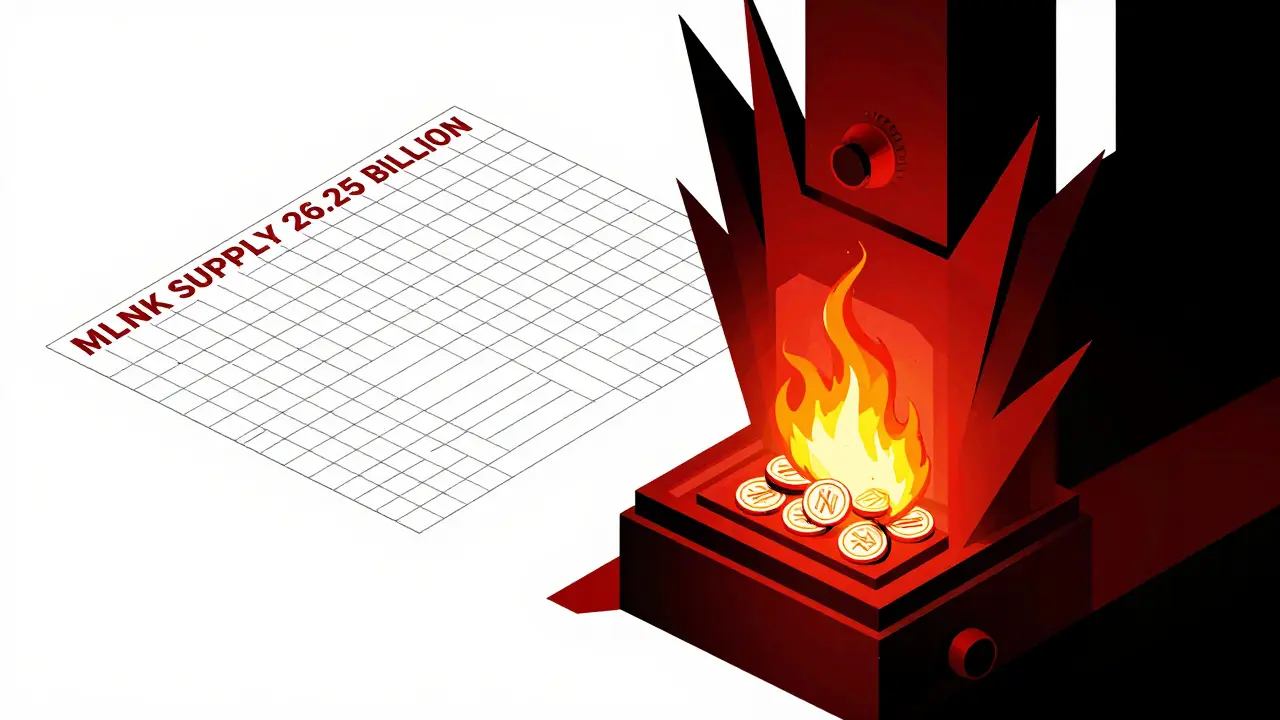
To understand if a coin has long-term potential, you have to look at its supply. Malinka has a hard cap of approximately 26.25 billion coins. This prevents the "infinite print" problem that plagues some newer projects. The emission of these coins is programmed to last for about eight years (roughly 500 million blockchain blocks), after which no new MLNK will ever be created.
But they didn't stop at a capped supply. To fight inflation and potentially push the price up, Malinka uses a Burning Mechanism. Every day, a portion of the tokens is permanently removed from circulation. Where does the money for this come from? The commissions earned from currency exchanges on the PayCashSwap platform. By using a slice of the platform's revenue to buy back and destroy tokens, the system creates deflationary pressure. In simple terms: as the platform gets more popular, more tokens are burned, and the remaining supply becomes more scarce.
| Attribute | Value/Detail |
|---|---|
| Maximum Supply | 26,242,678,247 MLNK |
| Emission Duration | ~8 Years (500M blocks) |
| Distribution Method | Second-by-second (Liquidity Pools) |
| Deflationary Tool | Daily token burning via exchange fees |
| Blockchain Base | EOS-based infrastructure |
Real-World Use Cases and Utility
Is MLNK just a speculative asset? Not exactly. While many buy it hoping for a price jump, the token has built-in utility. First, it allows for instant, fee-free transfers between wallets. In a world where some networks charge a fortune just to move your own money, this is a breath of fresh air.
One of the more interesting features is the automatic inheritance setup. Because it's all handled by decentralized code, you can set up protocols that pass your tokens to designated recipients automatically. This solves a massive problem in crypto: the risk of assets being lost forever if a private key holder passes away without leaving a "will" for their digital assets.
Furthermore, MLNK serves as a bridge. By providing liquidity on PayCashSwap, users enable others to move between different cryptocurrencies more efficiently. The token essentially acts as the glue holding the exchange's liquidity together.
Market Reality: Price and Volatility
If you look up the price of Malinka right now, you might get confused. Depending on where you look, you'll see wildly different numbers. For example, as of April 2026, some platforms like Coinbase might show a price around $0.039, while others like LBank show it closer to $0.022. Why the gap? This usually happens because of low liquidity on certain exchanges or delays in how data is reported from the blockchain to the tracking site.
The coin has seen an all-time high reaching up to $0.08 in some reports. However, it remains a small-cap asset, often ranked outside the top 2,000 cryptocurrencies by market cap. This means it's highly volatile. You might see a 16% jump in one day and an 11% drop the next. This is typical for "altcoins" with smaller trading volumes, where a few large trades can move the needle significantly.
How to Store and Secure Your MLNK
Since Malinka operates on an EOS-based infrastructure (specifically using the MLNK-eos-swap.pcash address format), you can't just send it to a standard Ethereum address. You need a wallet that supports the underlying blockchain.
You have a few choices depending on how much you value convenience versus security:
- Custodial Wallets: These are the wallets on exchanges like WhiteBIT. They're easy to use because the exchange manages the keys, but you don't actually "own" the coins in a technical sense.
- Self-Custody Wallets: Browser extensions or mobile apps where you hold the private keys. This is a huge step up in security.
- Hardware Wallets: The gold standard. These keep your keys offline, making it nearly impossible for a hacker to steal your funds unless they physically have your device.
- Paper Wallets: An old-school method of printing your keys on a piece of paper. It's safe from hackers, but risky if you lose the paper or it gets damaged.
Risks and Rewards: The Final Verdict
The appeal of Malinka is clear: it's an environmentally friendly way to earn crypto without expensive hardware, and it has a built-in mechanism to combat inflation. The fact that the smart contract keys were used irreversibly is also a big plus-it means no one, not even the creators, can suddenly change the rules or steal the funds from the contract.
However, the risks are equally real. The token's success is tied almost entirely to the adoption of the PayCashSwap ecosystem. If the exchange doesn't grow, the demand for the token may stall. The wide price gaps across different exchanges also suggest that the market is still very fragmented. If you're considering jumping in, treat it as a high-risk, high-reward play rather than a stable savings account.
Do I need to mine Malinka?
No, you don't mine MLNK with computers. Instead, you earn it by adding funds to liquidity pools on the PayCashSwap platform. The more you invest and the earlier you join, the more tokens you receive.
Is Malinka a safe investment?
Like all small-cap cryptocurrencies, it carries significant risk. While the smart contracts are decentralized and irreversible, the price is highly volatile and depends heavily on the growth of the PayCashSwap ecosystem.
What happens to the burned tokens?
Burned tokens are sent to an inaccessible address, effectively removing them from the total supply forever. This is intended to create scarcity and support the token's value over time.
Can I withdraw my investment at any time?
Yes. Users can withdraw their original deposit along with any earned MLNK from the liquidity pools at any time without facing penalties.
Why does the price vary so much between exchanges?
This is usually due to low trading volumes or lagging data updates on tracking websites. Because MLNK isn't traded on as many markets as Bitcoin, the price can differ based on the specific trading pair or the exchange's local demand.
Jan Conrad
April 27, 2026 AT 10:04The second-by-second distribution is a pretty unique way to handle rewards. Most liquidity farms just have these clunky epoch-based rewards that make you wait days to see any progress. Having a constant stream is way more motivating for the average user.
Carli Bates
April 28, 2026 AT 11:01oh wow another liquidity token to save the world... truly revolutionary stuff here
Aaron Zeiler
April 29, 2026 AT 18:10the eos infrastructure is actually decent for this kind of thing because the transaction speeds are way better than legacy chains and you dont get hammered by gas fees every time you want to move your funds around
Rachel S
April 30, 2026 AT 11:15It is absolutely imperative to note that the price discrepancy mentioned is a classic hallmark of low-volume assets! 😱 One must be exceedingly cautious when interacting with fragmented markets as arbitrage opportunities can be deceptive. Such volatility is truly breathtaking! ✨
its me
May 1, 2026 AT 07:47I find it amusing how people mistake scarcity for value. Just because you burn tokens doesn't mean the project has a moral soul or a purpose beyond greed. We are just rearranging digital dust in a void of our own making.
Rushell Perry
May 1, 2026 AT 08:49this is a great way for beginners to understand how dexs work without needing a huge budget for mining rigs just stay patient and let the liquidity do the work
Ipsita Seal
May 2, 2026 AT 21:17too much reading for a coin that probably wont be worth anything in a year anyway
Brendan Thraxton
May 4, 2026 AT 14:21definitely a cool project for those looking to dive into the eos ecosystem. the automatic inheritance feature is a real game changer for security and peace of mind for the family
Gabrielle Danis
May 6, 2026 AT 03:17The mention of the smart contract keys being irreversibly destroyed is a critical detail. This effectively removes the risk of a 'rug pull' initiated by the developers changing the contract logic, which is a common vulnerability in many DeFi protocols.
Arti Jain
May 6, 2026 AT 07:47Typical Western obsession with niche tokens. Our markets handle real value, not these liquidity experiments.
Janis Naglis
May 7, 2026 AT 01:02The algorithmic deflationary pressure created by the buy-back-and-burn mechanism is simply superb!!! It creates such a healthy incentive for the protocol's TVL to increase while maintaining a tight supply-side constraint!!!
Gabby Puche
May 8, 2026 AT 02:50Love how easy this sounds compared to mining! 🌟 Just put some coins in a pool and let it grow! 🚀✨
Abhishek Verma
May 9, 2026 AT 10:20Wait, you actually believe in this 'inheritance' feature? I bet the code is just as fragmented as the price on those exchanges. Good luck trusting a bot with your will.
Barbara Jones
May 10, 2026 AT 12:03I think its rly cool how they handle the supply. Just make sure u use a hardward wallet so u dont lose everything to a phishin link lol
Kathleen Warren
May 11, 2026 AT 09:11If you are new to this, just remember that it is okay to start small. You don't need to put in a lot of money to try out the liquidity pools and see how it works for you.