When Is the Next Bitcoin Halving? 2028 Date, Predictions, and What It Means
 Jan, 5 2026
Bitcoin doesn’t print more coins like a central bank. Instead, it follows a strict, unchangeable schedule built into its code. Every 210,000 blocks, the reward for mining Bitcoin drops in half. This is the Bitcoin halving-a core feature designed to control supply and create scarcity. The last one happened on April 20, 2024. So when’s the next one?
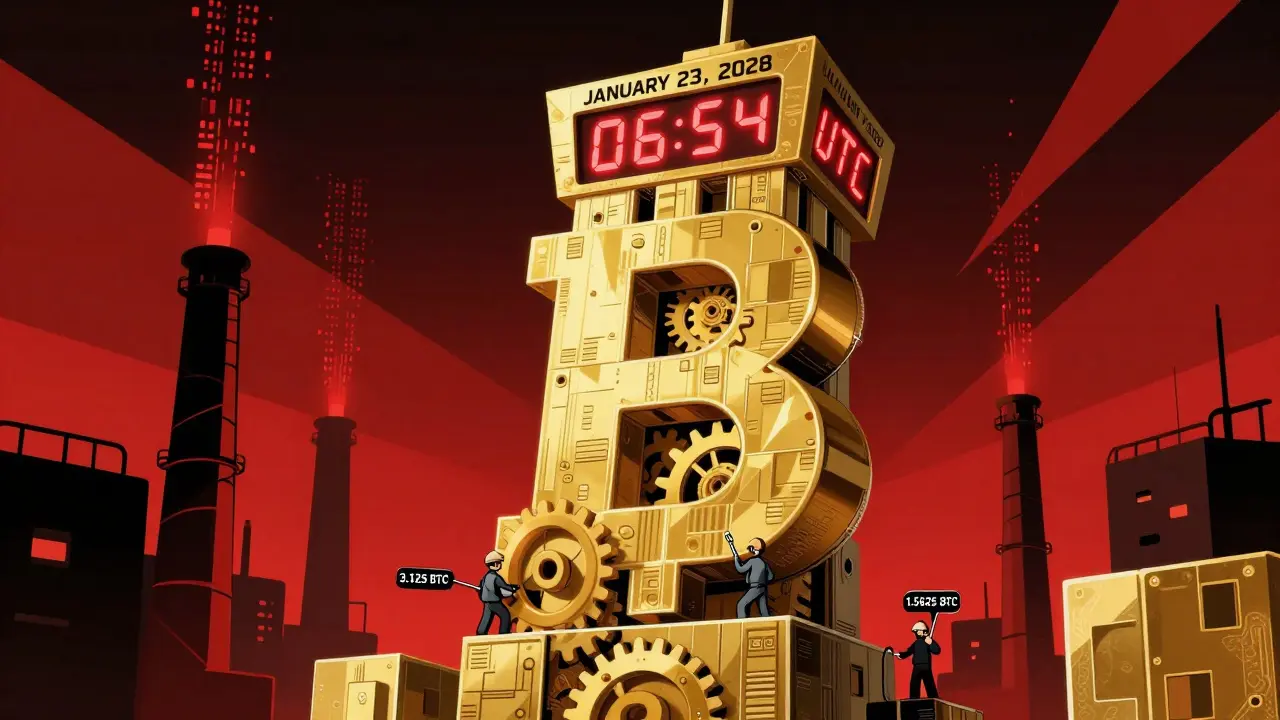
Expected Date: January 23, 2028 (Estimated)
The next Bitcoin halving is projected to occur around January 23, 2028, at approximately 06:54 UTC. This estimate comes from NiceHash’s real-time countdown, which tracks the current block height and average block time. Other platforms like CoinCodex and Binance agree it will happen sometime in the first half of 2028, likely between January and June.
Why not an exact date? Because Bitcoin’s block time isn’t perfectly every 10 minutes. It averages out over time, but daily fluctuations happen. Right now, blocks are coming in every 9 minutes and 52 seconds on average. That’s faster than the target, which means the next halving might arrive slightly sooner than a simple four-year calculation would suggest. If block times slow down, it could push the date into mid-2028. The only way to know the exact moment is within a few weeks of the event.
How the Halving Works
Every time Bitcoin mines 210,000 blocks, the reward for miners is cut in half. This isn’t a guess-it’s hardcoded into Bitcoin’s software. The first halving was in 2012, reducing the reward from 50 BTC to 25 BTC. Then came 12.5 BTC in 2016, 6.25 BTC in 2020, and 3.125 BTC in 2024. The next one will drop it to 1.5625 BTC per block.
This system ensures Bitcoin’s total supply will never exceed 21 million coins. The last coin is expected to be mined around the year 2140. After that, miners won’t get new Bitcoin as a reward. Instead, they’ll rely entirely on transaction fees paid by users to keep the network secure.
There’s no human decision here. No committee votes. No CEO announces it. The network auto-executes the halving. If you’re curious, you can check the current block height on any blockchain explorer like Blockchain.com or Blockstream.info. When it hits 1,050,000, the next halving triggers automatically.
What Happened After Past Halvings
History doesn’t repeat, but it often rhymes. Here’s how Bitcoin performed after each halving:
- 2012 (Block 210,000): Price was around $12. Six months later, it hit $130.
- 2016 (Block 420,000): Price was $650. Six months later, it reached $2,520.
- 2020 (Block 630,000): Price was $8,600. Six months later, it hit $17,900.
- 2024 (Block 840,000): Price was $64,013. Six months later, it reached $90,446-a 41.2% gain.
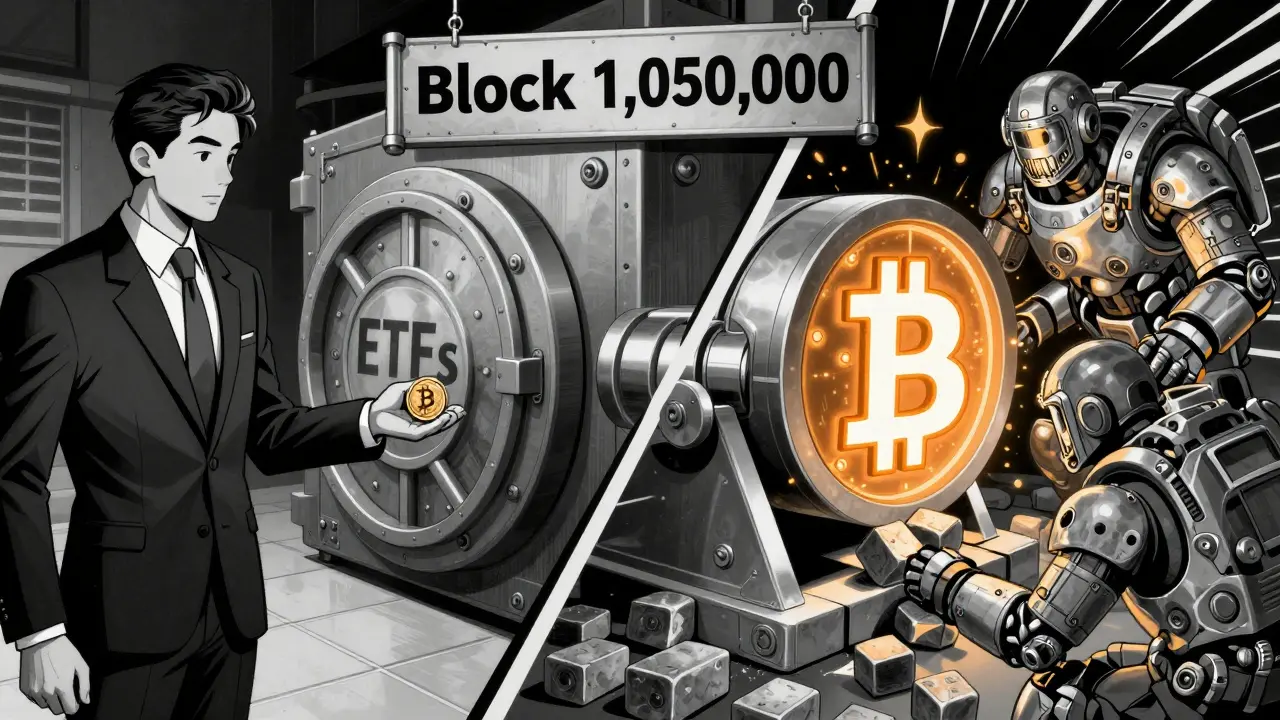
Notice a pattern? Each halving was followed by a significant price rise-usually within 6 to 12 months. But the 2024 cycle was weaker than past ones. Why? Because the market changed. In January 2024, the U.S. approved spot Bitcoin ETFs. BlackRock, Fidelity, and others started buying Bitcoin directly. That meant demand wasn’t just coming from retail traders anymore-it was coming from Wall Street.
Also, governments started releasing seized Bitcoin. Germany and the U.S. sold off hundreds of thousands of BTC in 2024 and early 2025. That added temporary supply pressure. So while the halving reduced new supply, increased selling offset some of the expected scarcity.
Will 2028 Be Different?
Many believe the next halving will be unlike any before it. Why?
- Institutional ownership is higher: By the end of 2024, ETFs held over 950,000 BTC-nearly 5% of all Bitcoin ever mined. That’s more than the entire supply circulating in 2016.
- Miners are big companies now: Back in 2020, most mining was done by individuals or small farms. Today, public companies like Marathon Digital and Riot Platforms control over 35% of the network’s hash rate. They’re more financially stable and less likely to sell Bitcoin immediately after a halving.
- Regulation is clearer: The SEC’s approval of ETFs removed years of legal uncertainty. That attracts more capital.
- Supply shocks are fading: The Mt. Gox repayments-where old Bitcoin was returned to creditors-are ending in early 2025. That means less selling pressure by 2028.
Some analysts think the 2028 halving could trigger a much stronger price surge because demand is now anchored by institutions, not just speculation. Others warn: past performance doesn’t guarantee future results. If global interest rates stay high, or if regulations tighten again, Bitcoin could still struggle to break out.
How to Track the Countdown
You don’t need to be a tech expert to track the next halving. Here are the best tools:
- NiceHash Halving Calculator: Updates in real time based on current network speed. Shows exact projected date and time.
- CoinWarz: Uses the average block time over the last 20,160 blocks (about 140 days) to smooth out short-term noise. More stable than real-time tools.
- Binance Halving Page: Official, clean, and trustworthy. Shows historical data and estimated timeline.
- Blockchain Explorers: Sites like Blockchair or Blockchain.com show the current block height. Subtract 840,000 from 1,050,000 to see how many blocks remain.
Don’t rely on one tool. Compare them. If NiceHash says January 23 and CoinWarz says March 15, the truth is probably somewhere in between. The closer we get to 2028, the more accurate the predictions will become.
What This Means for You
If you hold Bitcoin, the halving doesn’t change your wallet. But it changes the market dynamics. Less new Bitcoin entering circulation means scarcity increases. If demand stays steady or grows, prices tend to rise. That’s the theory.
But remember: the halving isn’t magic. It doesn’t guarantee a price surge. In 2024, Bitcoin didn’t spike immediately after the event. It took months. And even then, the gain was smaller than in 2020. Why? Because the market was already priced in. ETFs had already driven demand upward before the halving.
For miners, the halving is a financial crunch. If Bitcoin’s price doesn’t rise enough to offset the lower reward, smaller miners get squeezed out. That’s actually good for the network long-term-it pushes out inefficient operators and leaves only the most professional ones.
For investors, the key takeaway is patience. The biggest price moves usually happen 6 to 12 months after the halving. If you’re thinking about buying Bitcoin ahead of 2028, don’t chase hype. Look at fundamentals: ETF inflows, miner behavior, macroeconomic trends, and regulatory shifts.
What Comes After 2028?
The halving cycle will keep going. After 2028, the next one will be around 2032, then 2036, and so on. Each time, the reward halves again. By 2040, miners will get just 0.78 BTC per block. By 2060, it’ll be under 0.2 BTC.
Bitcoin’s design is simple: create a digital asset with a fixed supply. The halving is how it achieves that. It’s not a bug-it’s the feature. And as long as the network stays secure and people keep using it, this schedule will keep ticking, no matter what happens in the world.
The 2028 halving won’t be the end of anything. It’ll just be another step in Bitcoin’s slow, steady journey toward becoming digital gold. Whether it soars or stalls depends less on the code and more on how the world chooses to use it.
When is the next Bitcoin halving?
The next Bitcoin halving is expected around January 23, 2028, at 06:54 UTC, though estimates range from early to mid-2028. The exact date depends on Bitcoin’s average block time, which currently averages 9 minutes and 52 seconds. The halving will occur at block height 1,050,000, approximately four years after the April 2024 event.
What happens to Bitcoin’s block reward after the 2028 halving?
After the 2028 halving, the block reward will drop from 3.125 BTC to 1.5625 BTC per block. This continues Bitcoin’s predictable supply schedule, with rewards halving every 210,000 blocks until the final Bitcoin is mined around 2140.
Do Bitcoin prices always go up after a halving?
Historically, Bitcoin prices have risen significantly 6 to 12 months after each halving. But this isn’t guaranteed. The 2024 halving saw a 41.2% price increase over six months-lower than previous cycles. Factors like ETFs, government sales of seized Bitcoin, and macroeconomic conditions now play a bigger role than in the past.
Can I predict the exact date of the next halving?
No, not with perfect accuracy. Block times vary slightly due to network conditions. Tools like NiceHash and CoinWarz give estimates based on current data, but the exact date will only become clear within weeks of the event. A difference of just 8 seconds per block can shift the date by 4 days over 210,000 blocks.
Why does Bitcoin have halvings?
Bitcoin halvings are built into its code to control inflation and limit supply. Satoshi Nakamoto designed Bitcoin to mimic the scarcity of gold. By cutting the mining reward in half every 210,000 blocks, the rate of new Bitcoin issuance slows over time, ensuring only 21 million coins will ever exist.
Jon Martín
January 6, 2026 AT 21:55Miners are corporations now not guys in basements
ETFs are hoarding BTC like it's gold
And the supply shock? It's gonna be a tsunami
2028 isn't just a date it's a turning point
Dennis Mbuthia
January 7, 2026 AT 22:28Tracey Grammer-Porter
January 8, 2026 AT 02:08It makes me feel less lost in all the noise
Just knowing the block height and how it works makes me feel like I'm actually learning something
Thanks for not just saying 'Bitcoin will moon'
Gideon Kavali
January 8, 2026 AT 22:21Allen Dometita
January 9, 2026 AT 05:46Just hold. No cap. No stress. Just vibes.
LeeAnn Herker
January 9, 2026 AT 17:50Andy Schichter
January 9, 2026 AT 21:08Caitlin Colwell
January 10, 2026 AT 09:56Denise Paiva
January 11, 2026 AT 07:37Gold has value because it's useful in industry and jewelry
Bitcoin has value because people believe in it
And belief can vanish overnight
Charlotte Parker
January 12, 2026 AT 04:12Bitcoin halvings are just a marketing gimmick to keep the gullible buying in
Every cycle the same script: 'this time it's different' - until it's not
And then the whales sell into the hype
And the retards buy the dip
Calen Adams
January 12, 2026 AT 14:37ETFs have created a new bid layer that didn't exist before
Miners are now publicly traded entities with balance sheets
This isn't just a supply shock - it's a structural shift in demand dynamics
2028 isn't a halving - it's the inflection point where Bitcoin transitions from speculative asset to institutional reserve asset
Valencia Adell
January 13, 2026 AT 10:31The hype always peaks right before the dump
2024 was a soft landing - 2028 will be the real reckoning
When the ETFs stop inflowing and the miners start selling to cover debt
And the retail crowd realizes they've been holding a digital tulip
Then the real bear market begins
Sarbjit Nahl
January 14, 2026 AT 20:31It is not the code that moves markets but the collective belief of participants
And belief is not static
It is shaped by macroeconomics geopolitics and media narratives
Therefore to predict the outcome of the halving is to predict human behavior - which is impossible
Kelley Ramsey
January 14, 2026 AT 23:32It's so calming to know that somewhere out there, a network is just doing exactly what it was designed to do
Even when everything else feels chaotic
It's like… a quiet revolution
Michael Richardson
January 15, 2026 AT 17:33Sabbra Ziro
January 17, 2026 AT 15:36No CEO
No committee
No press release
Just code doing what it was meant to do
It’s the opposite of everything else in finance
Krista Hoefle
January 17, 2026 AT 17:18the truth is the price was already priced in
and the miners just sell anyway
so like… what’s the point?
Frank Heili
January 18, 2026 AT 19:14Danyelle Ostrye
January 19, 2026 AT 08:15Dave Lite
January 20, 2026 AT 05:10They've got institutional backing
They've got long-term contracts
They're not cashing out after the event anymore
That changes everything
Supply is going to be tighter than ever
And demand? ETFs are just getting started
We're not in a bull run
We're in the early innings of a decade-long accumulation phase
And if you're not holding… you're already behind