Why Banks Freeze Accounts for Crypto Activity and How to Fix It
 Apr, 4 2026
Waking up to a "frozen account" notification is a nightmare for any crypto user. You haven't committed a crime, your taxes are paid, and you're just moving your own money, yet suddenly you can't pay your rent or buy groceries. In 2026, this has become a common occurrence. Banks aren't necessarily accusing you of fraud; they are reacting to a massive shift in how the financial system monitors digital assets. The core problem is that the traditional banking world is still catching up to the transparent, interconnected nature of the blockchain, and they are using a "freeze first, ask questions later" approach to avoid massive regulatory fines.
| Common Trigger | Bank's Perspective | The Reality |
|---|---|---|
| Large transfer from an exchange | Potential money laundering | Legitimate profit taking |
| Indirect link to a mixer/darknet | Interaction with illicit funds | Accidental receipt of "tainted" coins |
| Unusual activity patterns | Account takeover or fraud | Changing trading strategies |
The New Rules: The GENIUS Act and Regulatory Pressure
If you've noticed banks getting more aggressive, it's not your imagination. A huge part of this is due to the GENIUS Act is the Guiding and Establishing National Innovation for U.S. Stablecoins Act, a federal law signed in June 2025 that created a comprehensive regulatory framework for digital assets. This law gave banks a clear legal mechanism to freeze assets through "lawful orders." Essentially, if a regulator flags a transaction, the bank has a direct legal path to lock your funds without needing a full court case first.
At the same time, the FDIC is the Federal Deposit Insurance Corporation, which supervises financial institutions to ensure stability and compliance changed its stance in April 2025. While they now allow banks to engage in crypto-related activities more freely, they've demanded a trade-off: absolute rigor in risk management. This means banks are now terrified of the BSA/AML is the Bank Secrecy Act and Anti-Money Laundering regulations designed to prevent financial institutions from being used to hide illicit gains controls failing. If a bank misses one "dirty" transaction, they face penalties that make your account balance look like pocket change.
How the "Invisible Flag" Works: KYT and Blockchain Analysis
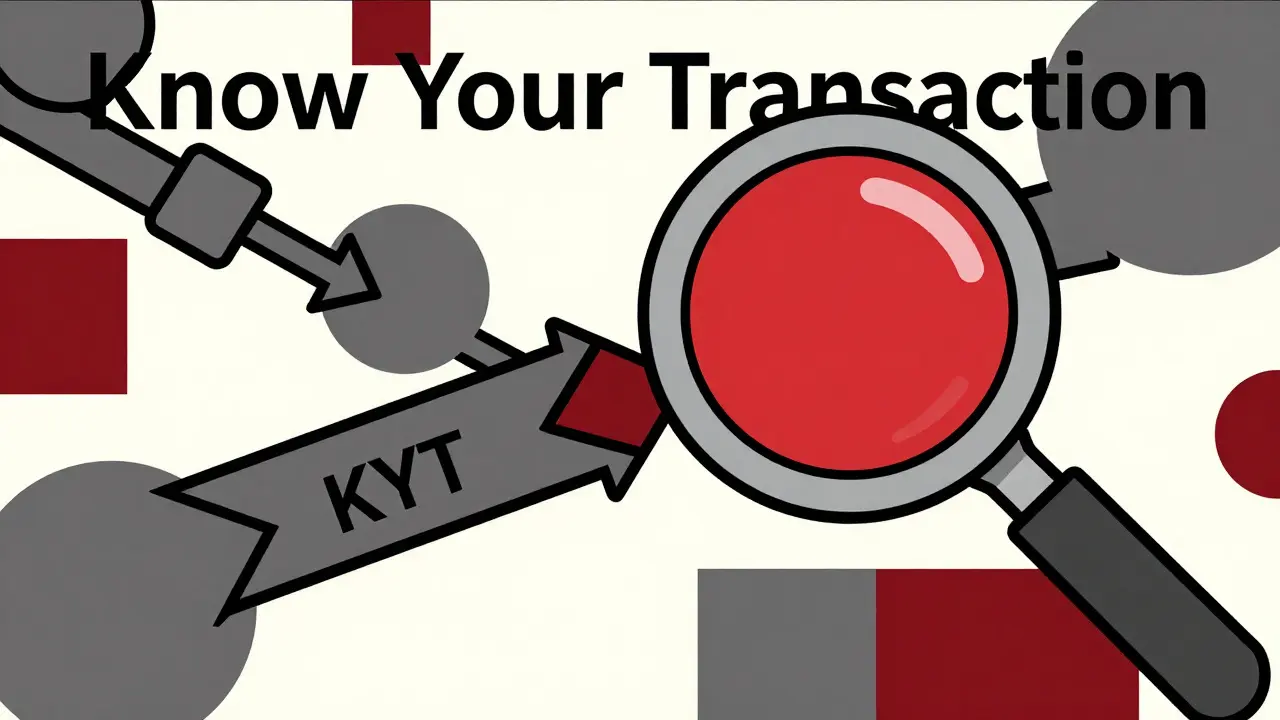
You might wonder how a bank even knows you're using crypto if you're just sending a wire transfer. They use KYT is Know Your Transaction monitoring, a process that analyzes the flow of funds on the blockchain in real-time. Unlike the old KYC (Know Your Customer) which just checked your ID, KYT looks at the history of the money.
Here is the scary part: the blockchain is a public ledger. If you receive Bitcoin from someone who once received it from a sanctioned entity or a darknet market five transfers ago, that "taint" follows the coin. Banks use sophisticated forensics tools to trace these hops. Even if you have no malicious intent, accidentally receiving a coin that was once used in a hack can trigger an automatic freeze. This is what experts call "indirect exposure." You aren't the criminal, but you're holding the criminal's old money.
The Pain of Off-Ramping: Moving Money to Your Bank
The most dangerous moment for a crypto user is the "off-ramp"-when you move funds from a CEX is a Centralized Exchange like Coinbase or Binance that acts as a middleman for trading to a traditional bank account. This is where the friction is highest. In 2026, simply transferring $10,000 from an exchange can lead to an immediate freeze of your entire banking profile.
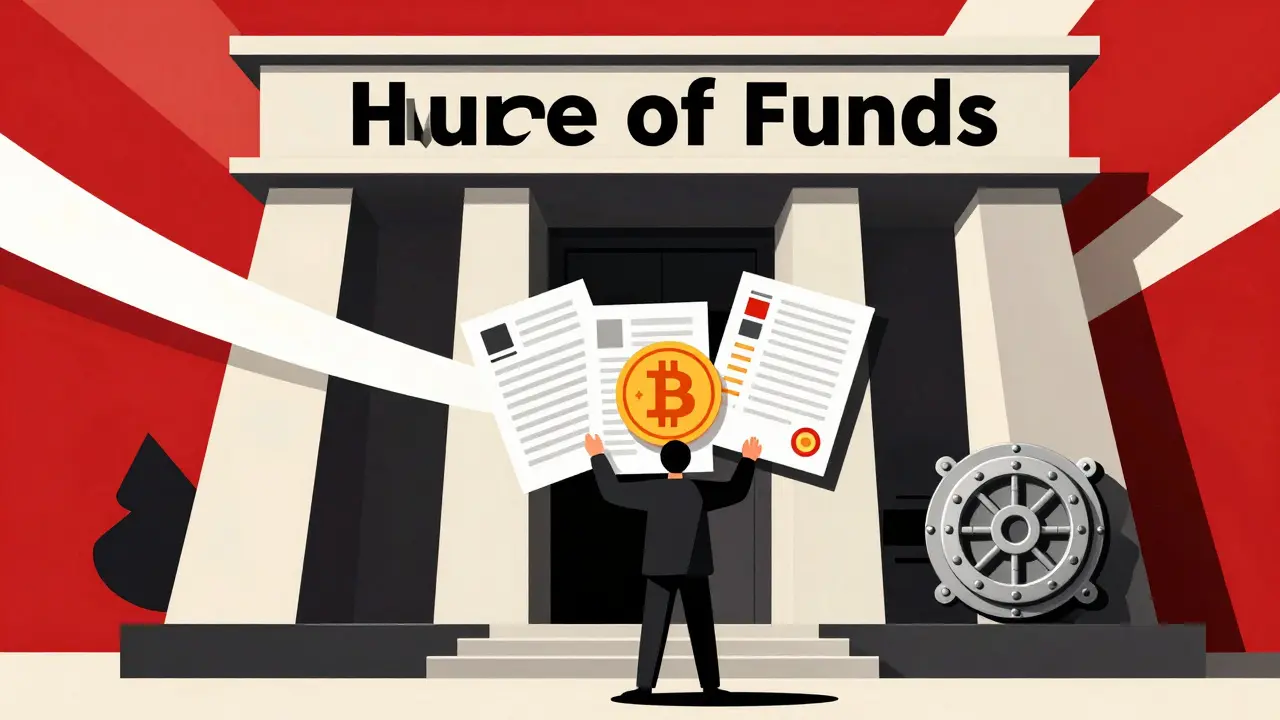
Banks now frequently demand a Source of Funds (SoF) is a formal verification process where a customer proves the origin of their wealth to satisfy AML requirements. This isn't just a request for a screenshot; they want to see the full trail. You may be asked to provide:
- Detailed transaction histories from your exchange.
- Proof of the original investment (e.g., bank statements showing the initial purchase).
- Explanations for any large transfers from private wallets.
- Tax filings that align with the gains you're withdrawing.
If you can't provide this documentation within a few days, the bank may decide the risk is too high and simply terminate your relationship, leaving you to fight for your funds through a lengthy manual review process.
Comparing Regulatory Landscapes: US vs EU
Depending on where you live, your experience with frozen accounts will differ. The US has moved toward a very aggressive, enforcement-heavy model. Meanwhile, the EU uses the MiCA is the Markets in Crypto-Assets regulation, the EU's comprehensive framework for digital asset service providers. While MiCA provides more consistency across borders, the US system under the GENIUS Act is more integrated with the traditional banking core, giving US banks more power to freeze accounts quickly.
| Feature | United States (GENIUS Act/FDIC) | European Union (MiCA) |
|---|---|---|
| Primary Focus | Enforcement and Stablecoin standards | Consumer protection and Market integrity |
| Bank Integration | Deep; direct lawful orders for freezes | Moderate; focused on licensed providers |
| Speed of Freeze | Very Fast (Automatic KYT triggers) | Fast (Based on provider reporting) |
How to Protect Your Account from Being Frozen
You can't stop the banks from monitoring, but you can make yourself a "low-risk" target. The goal is to remove any ambiguity about where your money came from. If a bank sees a clear, documented path from a legal source of income to a reputable exchange and finally to your account, they are less likely to freeze you.
First, avoid "mixing services" or privacy coins if you plan to use traditional banks. While privacy is a core tenet of crypto, banks view privacy tools as a massive red flag for money laundering. Second, keep a meticulous ledger. Every time you move funds between a cold wallet and an exchange, take a screenshot of the transaction and save the TXID. If you're ever challenged, being able to provide a PDF of your transaction history instantly makes you look like a professional, not a money launderer.
Third, use a dedicated "crypto bank account." Don't use your primary checking account for high-frequency off-ramping. By isolating your crypto activity to one specific account, you protect your main livelihood if that specific account gets flagged for a manual review. It's a simple hedge that saves you from the panic of not being able to pay bills while you argue with a compliance officer.
Dealing with a Freeze: The Recovery Process
If your account is already frozen, don't panic, but don't be aggressive. The compliance officers at banks are following a script. If you come across as hostile or evasive, they are more likely to mark your account as "high risk" and close it permanently.
- Request a specific reason: Ask if the freeze is due to a specific transaction or a general KYC update.
- Gather evidence: Before they even ask, prepare your exchange statements and proof of identity.
- Explain the "hops": If you used a bridge or a DeFi protocol, explain it in simple terms. "I used this protocol to earn interest on my assets" is better than using technical jargon they won't understand.
- Be patient but persistent: Manual reviews can take weeks. Follow up every three days to ensure your case hasn't fallen through the cracks.
Can I be charged with a crime if my bank freezes my crypto funds?
A bank freeze is a civil/administrative action, not a criminal charge. However, if the bank discovers evidence of actual money laundering or sanctions evasion, they are required to file a Suspicious Activity Report (SAR) with the government, which could lead to an investigation. For most users, a freeze is simply a compliance hurdle.
Is it safer to use a Neobank for crypto transfers?
Not necessarily. Neobanks often have stricter automated triggers because they lack the massive manual compliance teams of traditional banks. They rely more on AI and KYT tools, meaning a single "tainted" coin is more likely to result in an instant, automated freeze without a human reviewing the context.
Does the GENIUS Act apply to all cryptocurrencies?
The GENIUS Act primarily focuses on stablecoins, creating a specific legal framework for them and exempting them from certain commodity and securities regulations. However, the enforcement mechanisms it establishes (like lawful orders to freeze) are often applied by banks to a wider range of crypto-related assets to maintain overall safety and soundness.
What is the difference between a freeze and a block?
A block usually prevents new funds from entering or leaving the account. A freeze is more restrictive, often locking all existing balances and preventing any movement until a specific condition (like a KYC update) is met. Both are disruptive, but a freeze is typically a sign of a deeper compliance investigation.
How can I prove the source of funds for a private wallet transfer?
The best way is to show the "entry point." Provide the exchange statement showing when you first bought the crypto and the transfer to your private wallet. Then, show the transfer from that same wallet to the exchange for the off-ramp. This creates a closed loop that proves the money didn't appear out of nowhere.
Next Steps and Troubleshooting
If you're moving large sums of money, consider a "pre-clearance" strategy. Call your bank's relationship manager before you make a massive transfer. Tell them: "I am expecting a transfer of $X from [Exchange Name] coming from my own account. I have the full transaction history and proof of source ready for your compliance team." This puts you on their radar as a transparent user rather than a suspicious anomaly.
For those who find traditional banking too restrictive, the trend is shifting toward DeFi is Decentralized Finance, an alternative financial system built on public blockchains that removes intermediaries like banks. While DeFi doesn't solve the problem of eventually needing "real" money, it allows you to manage assets without the constant threat of a centralized entity freezing your access.
JERRY ORTEGA
April 5, 2026 AT 08:48just keep a separate account for the off-ramping like mentioned here... its honestly the only way to sleep at night since banks just trip over themselves these days
shubhu patel
April 7, 2026 AT 04:00I completely agree with the perspective that maintaining a detailed ledger is absolutely essential because when the bank finally decides to flag your account it feels like you are fighting a ghost and having all your screenshots organized in a folder really helps to expedite the process so you aren't left without funds for weeks on end
Arlen Medina
April 8, 2026 AT 13:27GENIUS Act is basically just the government making sure the US stays on top of the game while keeping the riff raff out of our financial system. If you can't prove where your money came from then you probably shouldn't be playing with the big boys anyway lol
Taylor Meadows
April 9, 2026 AT 05:32Most of you are just blindly following the rules while your privacy is being stripped away bit by bit. You think a "crypto bank account" saves you? You're just putting all your eggs in one basket for the bank to watch more closely. It's honestly pathetic how some people just accept this level of intrusion without any real fight.
vijendra pal
April 10, 2026 AT 18:01Exactly!! 🚀 many ppl dont realize that KYT is way more powerfull than KYC. if u ever use a mixer u r basically asking for a freeze 💀 just stay legit and keep records!! 📈
david head
April 12, 2026 AT 02:56totally agree with the pre-clearance tip 😎 keep it simple and the banks stay chill
Patty Levino
April 12, 2026 AT 22:07If anyone is feeling overwhelmed by a current freeze, just remember to breathe and keep your communications with the bank very professional. They really do just follow a checklist, and being the most helpful person in the room usually gets your funds released faster.
Alexandra Lance
April 14, 2026 AT 15:06Oh wow, so we just trust the "lawful orders" now? 🙄 How cute that people think a PDF of a transaction history actually protects them from a system designed to track every cent we move. It's all just a game of control anyway 🤡✨
Lauren Gilbert
April 16, 2026 AT 12:44It is quite fascinating to consider the philosophical shift from the original dream of decentralization to this current reality where we are essentially begging traditional institutions for permission to access our own wealth, and it makes me wonder if the bridge between these two worlds will ever truly be harmonious or if we are just in a long transition period of friction.
Sonya Bowen
April 17, 2026 AT 03:31Focus on the entry point. That's the most critical part of the audit trail.
Carol Prates
April 18, 2026 AT 19:13Omg can you imagine the absolute chaos of waking up to a frozen account and having zero dollars for coffee? Literally my worst nightmare! But seriously, the way banks handle this is just so dramatic and unnecessary lol
Hugo Lopez
April 19, 2026 AT 05:46I've had a great experience with a relationship manager when I was transparent from the start! 😊 It really does make a difference in how they perceive the risk. 🌟
Carmelita Gonzales
April 19, 2026 AT 21:32been through this recently and just being patient really is the only way though it hurts the wallet while waiting
Brooke Herold
April 20, 2026 AT 22:34The difference between the US and EU approach is quite stark when you actually look at the day-to-day impact on users.
sekhar reddy
April 21, 2026 AT 22:21This is totaly ridiculous!! How can a bank freeze money just because of a coin's history?? Its a disaster for every single honest trader!! Absolute madness!! 😱
Trish Swanson
April 23, 2026 AT 14:33MiCA seems way better!!! Why is the US so aggressive???