Crypto Exchange Enforcement Actions and Fines in 2025: What Happened and Who Got Hit
 Feb, 26 2026
By early 2025, the crypto world stopped pretending regulation was optional. The era of "move fast and break things" was over. Exchanges that ignored compliance didn’t just get warnings-they got hit with fines that could wipe out years of profit. And it wasn’t just one player. This wasn’t a glitch. It was a reckoning.
OKX Paid the Biggest Price
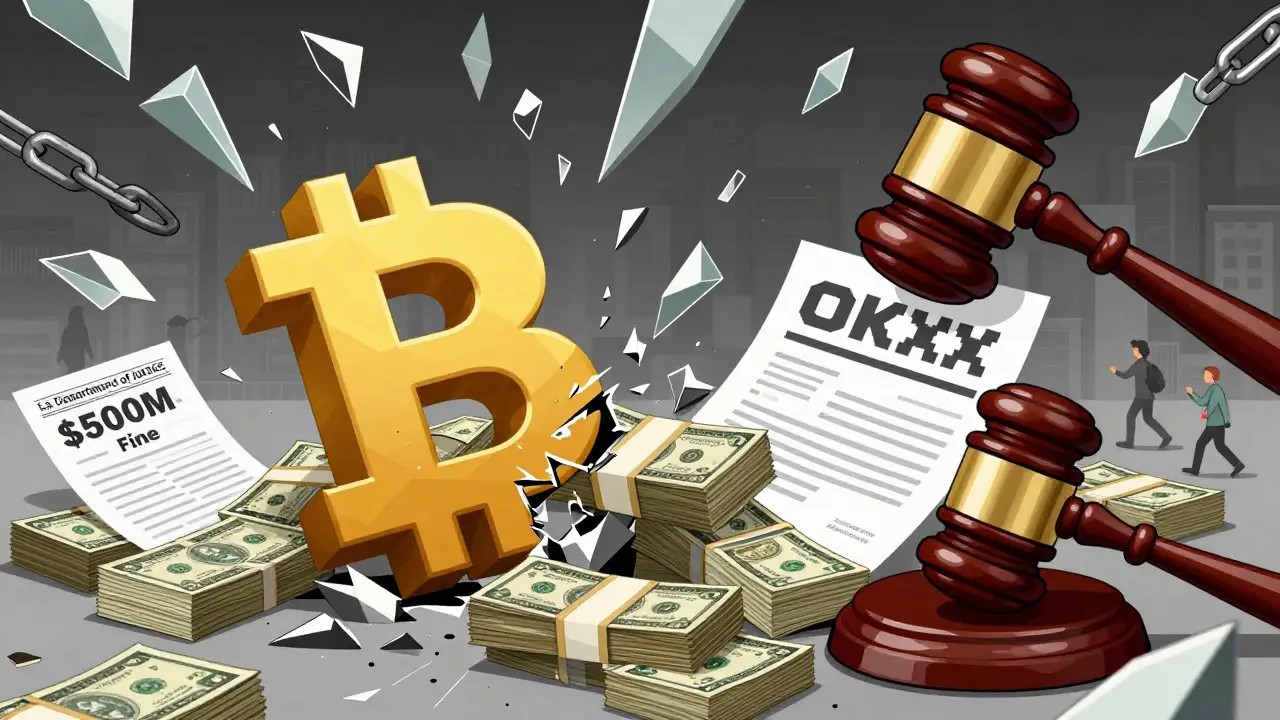
The biggest blow came on February 24, 2025, when the U.S. Department of Justice slapped OKX a cryptocurrency exchange founded in 2017 by Star Xu, headquartered in the Seychelles with a $500 million penalty. That’s not a typo. $500 million. Of that, $420 million was forfeited as illegal proceeds, and $84 million was paid as a civil fine. OKX didn’t just get sloppy-they were caught actively helping U.S. customers lie about their identities. Internal emails showed staff telling American users how to fake documents and bypass geo-blocks. Even worse, they never registered with the U.S. Treasury as a money service business, which is required by law. Their transaction monitoring? Broken. Sanctions screening? Nonexistent. They processed over $5 billion in suspicious transactions. The DOJ didn’t just fine them-they forced OKX to plead guilty. That’s rare. That’s serious.
SEC Targets Fraud, Not Just Exchanges
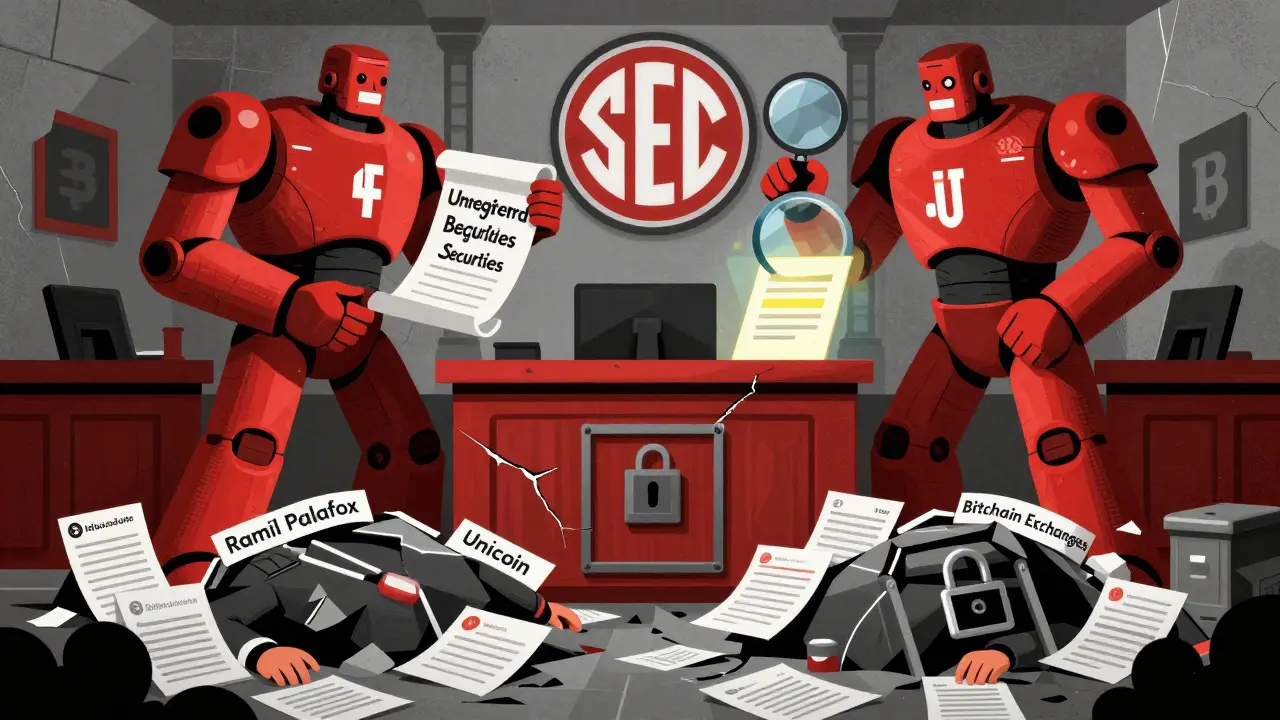
The Securities and Exchange Commission (SEC) the U.S. federal agency responsible for enforcing securities laws and regulating financial markets wasn’t waiting for the DOJ to act. They went after fraudsters who used crypto as a front. In April, they charged Ramil Palafox founder of PGI Global, a crypto and forex trading firm for running a $57 million Ponzi scheme. He promised investors high returns from crypto trading, but instead stole the money and paid early investors with new cash-classic pyramid structure. Then in May, they went after Unicoin a cryptocurrency project accused of selling unregistered securities and its top three executives for the same thing: selling crypto assets as investment contracts without registering them with the SEC. That’s not a gray area. That’s a clear violation of the Securities Act of 1933.
By August, the SEC had secured a $46 million judgment against MCC International Corp. a crypto mining and trading company, CPTLCoin Corp. a company tied to a crypto asset platform, and Bitchain Exchanges a crypto trading platform controlled by the defendants. The scheme? Sell "mining packages" to investors, promise daily profits, then lock them out when they tried to cash out. The defendants owned Bitchain and blocked withdrawals. They didn’t just mislead-they trapped people. The court ordered them to give back nearly $28.5 million and pay $7.8 million in interest.
Fraud Isn’t Just on Exchanges-It’s in Brokers Too
The crackdown wasn’t just aimed at crypto-native platforms. Traditional financial firms playing in crypto got hit too. FINRA the Financial Industry Regulatory Authority, a self-regulatory organization for U.S. broker-dealers settled with two broker-dealers in 2025 for $85,000 each. Why? They sold crypto products to retail investors through unregistered affiliates and didn’t properly explain the risks. One firm even hid the fact that the crypto offerings weren’t their own products-they were third-party, unregulated schemes. FINRA’s message was clear: if you’re a licensed broker, you can’t outsource compliance. You’re still responsible.
Market Manipulation Gets Real
The DOJ didn’t stop at AML failures. They went after the engines of fake volume. In October 2024, prosecutors in Massachusetts charged 17 people with manipulating meme coins and altcoins using automated bots. These weren’t random traders. These were organized teams running wash trades-buying and selling to themselves to make a coin look popular. They inflated trading volumes to lure retail investors, then dumped their holdings. The District of Massachusetts became a hotspot for these cases because prosecutors there built specialized teams to track blockchain activity. They didn’t need to guess what happened. They could trace every transaction on-chain.
Why Are the Fines So High?
In the first half of 2025 alone, global regulators issued over $6 billion in AML fines to crypto firms. That’s more than all previous years combined. Why? Because regulators finally stopped treating crypto like a wild west. They’ve trained investigators, built blockchain analytics teams, and created task forces that work across agencies. The old model-"we didn’t know"-doesn’t fly anymore. Executives are now personally liable. If your compliance team didn’t monitor transactions, or if you ignored red flags, you could be sued, fined, or even jailed.
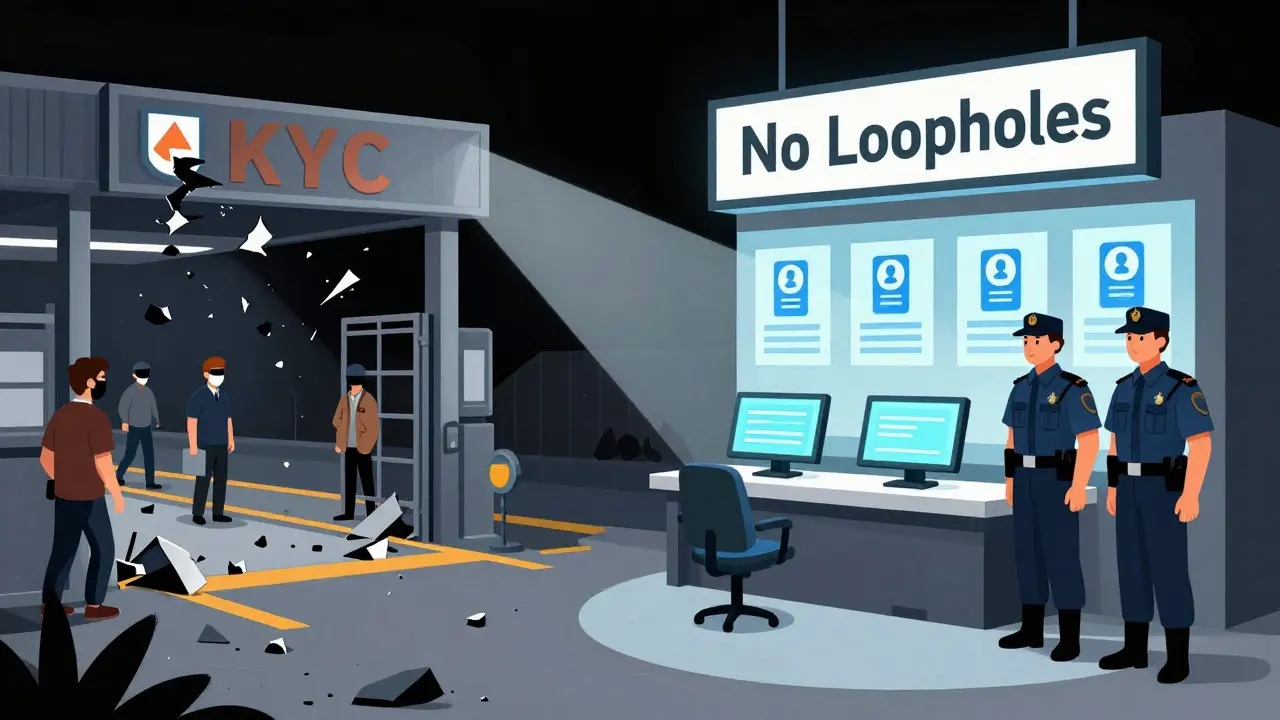
The pattern is clear: exchanges that skipped KYC, ignored sanctions screening, or failed to register as money services businesses are getting crushed. The $500 million OKX fine wasn’t random. It was a warning. It told every exchange: if you’re serving U.S. customers, even indirectly, you’re subject to U.S. law. No loopholes. No exceptions.
What’s Next?
SEC Chairman Paul Atkins announced "Project Crypto"-a full-scale initiative to double down on enforcement. That means more audits, more subpoenas, more charges. Meanwhile, political pressure is building. Some U.S. lawmakers want to cut the SEC’s budget and block new crypto rules. But that’s not stopping enforcement. The DOJ and FINRA are still moving forward. The message is consistent: if you’re in crypto, you’re in the system. And the system now has teeth.
Exchanges that survived 2025 didn’t do it by luck. They did it by hiring compliance officers, installing real-time transaction monitoring, running daily AML checks, and registering properly. The ones that didn’t? They’re gone. Or paying millions.
Why did OKX get fined $500 million?
OKX was fined because it knowingly helped U.S. users bypass restrictions, failed to register as a money services business, and processed over $5 billion in suspicious transactions without proper AML or KYC controls. Internal documents showed staff instructing users to fake IDs. The DOJ proved intentional misconduct, leading to a guilty plea and the largest crypto fine in history.
Can a crypto exchange avoid these fines?
Yes-but only by treating compliance like a core business function, not an afterthought. That means: registering with FinCEN, implementing real-time transaction monitoring, screening all users against global sanctions lists, verifying identities with trusted third-party tools, and training staff regularly. Exchanges that do this have avoided fines. Those that don’t are getting caught.
Are U.S. regulators targeting only U.S.-based exchanges?
No. The DOJ and SEC go after any exchange that serves U.S. customers-even if it’s based overseas. OKX was headquartered in the Seychelles, but because American users were actively helped to access the platform, the U.S. claimed jurisdiction. Location doesn’t matter if your customers are in the U.S.
What’s the difference between SEC and DOJ actions?
The SEC goes after civil violations-like selling unregistered securities or fraud. They can impose fines and injunctions. The DOJ handles criminal cases-like money laundering, conspiracy, or lying to federal agents. They can bring charges that lead to jail time. OKX faced both: criminal charges from DOJ and civil penalties from the SEC.
Do these fines affect Bitcoin and Ethereum?
Not directly. Bitcoin and Ethereum aren’t the targets. The fines hit exchanges and platforms that misused crypto for fraud, money laundering, or market manipulation. The underlying assets themselves aren’t illegal. But if your exchange lists risky tokens or lets users trade unregistered securities, you’re at risk.
What should crypto businesses do now?
Start with three things: hire a compliance officer with crypto experience, audit your KYC and AML systems monthly, and register with FinCEN if you’re dealing with U.S. users. Don’t wait for a subpoena. The cost of compliance is a fraction of the cost of a fine. And if you’re unsure, get legal advice-don’t guess.
Final Thought
The crypto industry didn’t die in 2025. It got cleaned up. The wild west is over. The rules are written. The fines are real. The question isn’t whether you’ll be regulated-it’s whether you’re ready for it.
Alyssa Herndon
February 27, 2026 AT 19:48crypto needed this
not every exchange should be allowed to operate like a lawless casino
if you're serving american users you need to play by american rules
it's not about crushing innovation
it's about protecting people from getting ripped off
Ifeanyi Uche
February 28, 2026 AT 04:32Elana Vorspan
March 1, 2026 AT 21:30so many people lost everything because exchanges were lazy or greedy
finally someone is holding them accountable
not all crypto is bad
but the bad actors had to go
Richard Cooper
March 3, 2026 AT 14:27Dee Resin
March 4, 2026 AT 19:57the same people who said "regulation is the death of crypto" are now crying because their favorite shady exchange got fined $500 million
the irony is thick enough to spread on toast
Tanvi Atal
March 5, 2026 AT 07:17too many scams
too many lazy teams
too much drama
just give up
Sony Sebastian
March 6, 2026 AT 11:19you have the SEC treating tokens as securities
the DOJ treating them as money transmission
and FinCEN treating them as foreign financial entities
no one knows what the hell they're supposed to do
this isn't enforcement
it's regulatory chaos dressed up as justice
Megan Lavery
March 8, 2026 AT 00:31like honestly
if you're building something legit
you want these bad actors gone
they make it harder for everyone else to get taken seriously
Mae Young
March 8, 2026 AT 13:00Trenton White
March 10, 2026 AT 11:00the government flips between banning and allowing crypto
but the truth is
the real innovation is happening outside the system
not because people want to break rules
but because the rules don't fit the tech
Cheryl Fenner Brown
March 10, 2026 AT 21:10but like... honestly? fair
if you're helping people lie to the feds
you deserve to get crushed
also i saw a tweet that said the $500m is like 2% of their monthly volume lol
so... is this even a real penalty??
Michael Teague
March 12, 2026 AT 09:58but what about the small exchanges?
they don't have lawyers on payroll
how are they supposed to keep up?
this just helps the big players crush the little ones
kati simpson
March 13, 2026 AT 08:39they were one of the few exchanges that actually had good customer service
and now they're basically dead
it makes me wonder if the whole system is too rigid
like maybe there should be a way to fix things instead of just destroying them
maybe they could have paid a smaller fine and fixed their systems
instead of just being erased
Kristi Emens
March 14, 2026 AT 21:43it used to be that if you slipped through one agency's net
you were fine
now they're talking to each other
and that means bad actors have nowhere to hide