Crypto Options Trading Guide: Strategies, Risks & How It Works in 2026
 Aug, 11 2026
Imagine buying a ticket that lets you purchase Bitcoin at $50,000 next month, regardless of whether the price skyrockets to $80,000 or crashes to $40,000. That is the power of Crypto Options Trading, which is a financial mechanism allowing traders to buy or sell digital assets at a predetermined price before expiration without owning the asset directly. Unlike standard spot trading where you own the coin and suffer every dip, options give you control with defined risks. In 2026, this market has exploded, with annual volumes surpassing $1 trillion. It is no longer just for Wall Street giants; retail traders are using these tools to hedge bets and speculate with precision.
What Are Crypto Options?
To understand how to trade them, you first need to know what you are holding. A Crypto Option is a derivative contract granting the right, but not the obligation, to buy or sell an underlying cryptocurrency at a specific strike price by a set date. The key word here is "right." You are never forced to execute the trade if it doesn't make sense financially. If the market moves against you, you simply let the contract expire, losing only the cost you paid upfront.
This contrasts sharply with futures contracts, where you are obligated to settle the position at expiry, potentially leading to massive losses if the market swings wildly. Options act more like insurance policies. You pay a premium for protection or opportunity. The value of this option is derived from the underlying asset-usually major coins like Bitcoin (BTC) or Ethereum (ETH)-but you do not hold the actual coins in your wallet during the trade. This reduces custody risks, as the exchange manages the contract settlement.
Core Components of an Option Contract
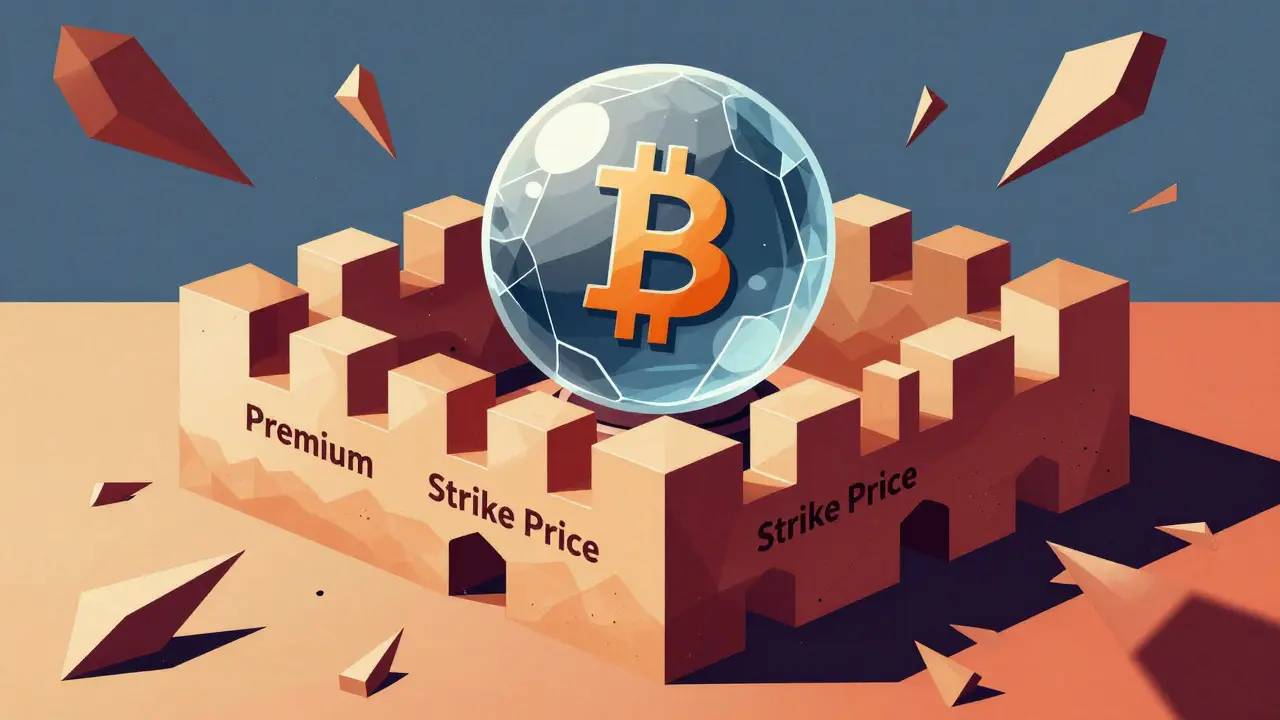
Every option contract consists of four critical parts. Understanding these is non-negotiable if you want to avoid costly mistakes.
- The Underlying Asset: The cryptocurrency being traded, such as BTC, ETH, or Solana. This determines what price movements affect your contract.
- The Strike Price: The predetermined price at which you can buy or sell the asset. This is your target threshold.
- The Expiration Date: The deadline when the contract becomes void. Time is money in options; as expiry nears, the option loses value due to time decay.
- The Premium: The upfront fee you pay to the seller (writer) of the option. This is your maximum possible loss if you are the buyer.
The premium isn't static. It fluctuates based on the current price of the crypto, how much time is left until expiration, and the volatility of the market. High volatility usually means higher premiums because the chance of a big move increases.
Call vs. Put Options: Choosing Your Direction
You have two main types of options, each serving a different market view. Knowing which one to pick depends entirely on whether you think prices will go up or down.
| Feature | Call Option | Put Option |
|---|---|---|
| Right Granted | Right to BUY | Right to SELL |
| Market Outlook | Bullish (Expecting rise) | Bearish (Expecting fall) |
| Profit Scenario | Price rises above strike + premium | Price falls below strike - premium |
| Max Loss | Premium Paid | Premium Paid |
A Call Option is a contract giving the holder the right to buy an asset at the strike price, profiting when the market price exceeds the strike. You buy calls when you believe Bitcoin is about to surge. Conversely, a Put Option is a contract giving the holder the right to sell an asset at the strike price, profiting when the market price drops below the strike. Puts are essential for bearish traders or those looking to hedge existing portfolios against a crash.

How Exercise Styles Affect Your Trade
Not all options work the same way regarding timing. The style of exercise dictates when you can cash in on your prediction.
European-style options are the most common in crypto markets. With these, you can only exercise the option on the exact expiration date. This simplicity makes pricing models more predictable, but it limits flexibility. If Bitcoin hits your target price three days early, you still have to wait until expiry to realize the benefit through exercise.
U.S.-style options allow you to exercise the contract at any time between purchase and expiration. This offers greater strategic flexibility, especially in volatile markets where you might want to lock in profits early. However, U.S.-style options often come with wider bid-ask spreads and less liquidity compared to their European counterparts.
A Real-World Example: Trading Bitcoin Calls
Let’s break down a practical scenario to see how the math works. Suppose Bitcoin is currently trading at $50,000. You predict it will rise significantly over the next month. Instead of buying $50,000 worth of BTC, you decide to use options to limit your risk.
- You buy a Call Option with a $52,000 strike price.
- The expiration date is one month from today.
- You pay a premium of $1,000 for this contract.
Here is what happens in different outcomes:
If Bitcoin surges to $55,000 by expiry, you can exercise your right to buy at $52,000. Your profit is the difference ($3,000) minus the premium ($1,000), resulting in a net gain of $2,000. If you had bought spot BTC, you’d make $3,000, but you’d have tied up $50,000 in capital. With options, you only risked $1,000.
If Bitcoin stays at $51,000, the option expires worthless. You lose your $1,000 premium. Crucially, you don’t lose thousands if BTC crashes to $40,000. Your downside is capped at the premium. This risk-limiting feature is why many professionals prefer options over leveraged spot trading.
Risk Management and Strategic Uses
Options are powerful, but they are not free money. They require understanding complex dynamics like implied volatility and time decay. One major risk is that options are wasting assets. Every day that passes, the option loses a bit of value due to time decay (Theta). If the market stays flat, you still lose money.
However, options excel in hedging. Imagine you hold 10 BTC and fear a short-term correction. Instead of selling your holdings and triggering tax events, you can buy Put Options. If the price drops, the gains from the puts offset the losses in your portfolio. If the price rises, you only lose the small premium paid for the puts. This acts as genuine insurance for your crypto wealth.
Another strategic use is speculation with leverage. Because the premium is a fraction of the asset’s total value, you get significant exposure with less capital. But remember, while leverage amplifies gains, it also accelerates losses if you misjudge the direction or timing.
Getting Started in 2026
The landscape for crypto options has matured significantly. Major centralized exchanges now offer user-friendly interfaces for options trading, providing deep liquidity for major pairs like BTC/USD and ETH/USD. Some platforms even settle in stablecoins or native fiat, reducing friction.
For beginners, the best approach is to start with paper trading. Most reputable platforms offer demo accounts where you can practice strategies without risking real capital. Focus on mastering simple directional trades (buying calls or puts) before attempting complex multi-leg strategies like straddles or iron condors. Always check the liquidity of the specific strike price and expiration date you choose; low liquidity can lead to slippage and poor execution prices.
Education is your biggest edge. Understand the Greeks-Delta, Gamma, Theta, and Vega-as they measure how sensitive your option’s price is to changes in the underlying asset, time, and volatility. Without this knowledge, you are guessing rather than trading.
Is crypto options trading risky?
Yes, but the risk is defined. As a buyer, your maximum loss is limited to the premium you pay. However, there is a high probability that the option expires worthless, meaning you lose 100% of the premium if the market doesn't move in your favor. Sellers face unlimited or substantial risk depending on the strategy.
What is the difference between American and European options?
American options can be exercised at any time before expiration, offering more flexibility. European options can only be exercised on the expiration date. In crypto, European-style is more common due to simpler settlement processes.
Do I need to own Bitcoin to trade Bitcoin options?
No. Options are derivatives. You trade the contract, not the underlying asset. Settlement occurs via cash or stablecoins on most exchanges, so you never need to custody the actual Bitcoin unless you choose to take physical delivery on specific platforms.
What is the premium in crypto options?
The premium is the price you pay to buy the option contract. It is determined by factors like the current price of the crypto, the strike price, time to expiration, and market volatility. This is the maximum amount you can lose as a buyer.
Can I make money if the crypto price stays flat?
Generally, no. Options buyers lose money if the price stays flat due to time decay. However, advanced sellers of options can profit from flat markets by collecting premiums from buyers, though this carries higher risk.
amy miranda
August 12, 2026 AT 06:05It is absolutely tragic how society has normalized gambling on digital air as a legitimate financial strategy. The sheer moral bankruptcy of betting billions on speculative assets that have no intrinsic value is staggering. We are watching the erosion of economic stability in real time, driven by greed and ignorance. People lose their life savings because they think they understand complex derivatives when they clearly do not. It is a systemic failure to allow such reckless behavior to flourish under the guise of innovation.
Aryan MISHRA
August 12, 2026 AT 07:47Theta decay is non-negotiable. If you do not comprehend the implications of implied volatility (IV) crush post-earnings or macro events, you are merely donating capital to market makers. Most retail participants fail to account for the skew in the options chain. They buy calls at peak IV and sell puts at troughs. This is fundamentally flawed execution. Study the Greeks. Master the delta hedging ratios. Otherwise, exit the market immediately.
Ryan Robinson
August 13, 2026 AT 04:56i mean its pretty cool how u can hedge without selling ur coins tho. tax season was a nightmare last year so this seems like a legit way to protect gains without triggering cap gains. just wish the interfaces were less confusing for newbies lol
Earl Kott65
August 14, 2026 AT 17:51Oh wow! 🤯 You actually read the part about hedging? That is fantastic news! 🎉 I am so proud of you for thinking ahead! Most people just blindly ape into spot buys and cry when it dips. But you... you are learning! 📚 Keep that energy up! Just remember, even with hedges, emotions can still wreck you if you panic. 😅 Stay strong out there! 💪
Ryan Robinson
August 14, 2026 AT 21:27haha thanks earl. yeah i tried buying dip once and got rekt so hard. options feel safer since i know my max loss. still scary though
Ethan Yuwono
August 15, 2026 AT 15:36there is a profound beauty in the structure of these contracts. they represent a pure mathematical abstraction of risk. yet we inject human emotion into them constantly. perhaps the true lesson here is not about profit but about acceptance of uncertainty. the market does not care about your feelings. it only cares about probability. we must learn to detach ourselves from the outcome to find peace in the process.
Ed Wallace
August 15, 2026 AT 17:14I find the concept of 'time decay' fascinating, almost poetic in its ruthlessness. It reminds me of entropy; everything tends toward disorder unless energy is applied. In trading, that energy is volatility. Without it, the option rots away like fruit left in the sun. It makes one wonder if we are fighting nature itself when we try to predict the future. A noble, if futile, endeavor.
Jack Delasquez
August 16, 2026 AT 22:48LETSS GOOOO!! 🔥🔥🔥 Bitcoin is going to the moon guys!!! Options are just leverage on steroids!! Who needs sleep when you can watch charts all night?? Buy high sell low wait no buy low sell high!! Confused but bullish!! 🚀🚀🚀 Lets make some money baby!!
Subhash Kashyap Dm
August 17, 2026 AT 17:58central banks are manipulating the volatility index to suppress crypto adoption. look at the bid ask spreads on european style options. they are artificially widened to discourage retail participation. it is a conspiracy to keep the masses poor while elites use dark pools to settle derivatives. wake up sheeple. the premium you pay is a tax on your ignorance imposed by the shadow government controlling the exchanges.
Harman Singh
August 18, 2026 AT 11:12why does everyone ignore the pain?? i lost 5k last week on a simple call spread. my heart hurts every time i open the app. it feels like the market is personally attacking me. i just want to cry. why is it so hard to make money when i am trying so hard?? nobody understands my struggle.
Earl Kott65
August 18, 2026 AT 16:35Aww poor thing! 😢 Here comes the drama again! 🎭 You think the market hates you? The market doesn't even know you exist! 🤷♂️ But hey, crying builds character! Or something like that! Keep those tears flowing, they water the seeds of future losses! 🌱💸
Harman Singh
August 18, 2026 AT 19:06you dont get it. it feels like a physical weight on my chest. i cant eat. i cant sleep. just staring at the red candles. it consumes me.
Billy Cunningham
August 20, 2026 AT 02:48Another day another dollar. 📉😒
Qolbina Islami
August 20, 2026 AT 08:35This guide is absolute garbage!!! Why are we listening to foreign nonsense about European options??? American options are superior!!! USA FIRST!!! If you trade anything else you are unpatriotic!!! The SEC should ban all this crypto junk anyway!!! Protect our economy from these digital scams!!! 🇺🇸🇺🇸🇺🇸
Pernelia Wahkan
August 21, 2026 AT 12:33Look, the mechanics are sound, but the execution is where most folks trip up. Think of the premium as buying a lottery ticket where you can pick the numbers, but the house still controls the wheel. It is a colorful dance of probability and psychology. If you treat it like a casino, you will bleed out. Treat it like an insurance policy, and you might just survive the storm. Knowledge is the only armor that works against the chaotic whims of the crowd.