Evolution of Consensus Algorithms in Blockchain: From PoW to Hybrid Systems
 Jan, 13 2026
When Bitcoin launched in 2009, no one knew it would change how trust works in digital systems. At its core was a simple but radical idea: Proof of Work (PoW). Instead of relying on banks or governments to verify transactions, Bitcoin used math puzzles solved by computers. The first machine to crack the puzzle got paid in new Bitcoin. It was messy, slow, and used a ton of electricity-but it worked. For over a decade, PoW kept Bitcoin secure without a single successful 51% attack. That’s not luck. It’s the result of billions of dollars in hardware and energy stacked against anyone trying to cheat.
Why Proof of Work Wasn’t Built to Last
PoW’s security comes at a cost. Bitcoin’s network consumes about 110 terawatt-hours per year-more than the entire country of Argentina. Mining rigs run nonstop, generating heat and noise, often powered by coal or gas. As Bitcoin grew, so did its energy use. Critics called it unsustainable. Developers started asking: Can we get the same security without burning power?
The answer came in the form of Proof of Stake (PoS). Instead of rewarding the fastest computer, PoS rewards the richest participant. If you own 5% of the network’s tokens, you have a 5% chance of being chosen to validate the next block. If you try to cheat, your stake gets slashed-meaning you lose part or all of your tokens. No mining hardware needed. No massive power plants. Ethereum, the second-largest blockchain, switched to PoS in September 2022. Energy use dropped by 99.9%. That wasn’t just an upgrade. It was a revolution.
The Rise of Faster, Smarter Alternatives
PoS solved the energy problem, but not the speed one. Bitcoin processes about 7 transactions per second. Ethereum before PoS managed 15. For real-world use-like paying for coffee or transferring money across borders-that’s too slow. So new consensus models emerged, built for performance.
Tendermint, created in 2014, brought Practical Byzantine Fault Tolerance (PBFT) to public blockchains. Unlike PoW or PoS, Tendermint doesn’t rely on random selection. It uses a fixed group of validators who take turns proposing blocks. Once two-thirds agree, the block is final-no waiting for confirmations. This gives it consensus in under 3 seconds. Cosmos, a blockchain network built on Tendermint, uses this to connect dozens of other chains. It’s not for everyone, but for projects needing speed and finality, it’s ideal.
Then there’s Delegated Proof of Stake (DPoS). EOS used this model with 21 elected block producers. Token holders vote for who runs the network, like shareholders choosing a board. Block times dropped to half a second. Throughput hit 4,000 transactions per second. Sounds perfect, right? Not quite. Critics say DPoS centralizes power. If a few big holders control most votes, they control the network. Vote buying, collusion, and influence-peddling become real risks.
Meanwhile, Hashgraph took a completely different path. Instead of miners or validators taking turns, nodes gossip information randomly-sharing not just transactions, but who they heard them from. This creates a complete history of communication. Using a clever trick called virtual voting, Hashgraph reaches consensus without direct communication between all nodes. Hedera, the main network using Hashgraph, handles over 10,000 transactions per second with fees under a penny. It’s fast, cheap, and predictable. But it’s also permissioned: a council of 39 companies, including Google and Deutsche Bank, controls the validator set. That’s great for enterprises. Less so for decentralization purists.
Avalanche and the New Wave of Random Sampling
In 2020, a new player arrived: Avalanche. Its consensus mechanism doesn’t pick validators or solve puzzles. It asks random groups of nodes: "Do you think this transaction is valid?" If most say yes, it asks again. And again. Each time, confidence grows like a snowball rolling downhill. Within seconds, the network agrees. Avalanche claims finality in under 2 seconds and handles 4,500 transactions per second. What makes it special is scalability without sacrificing decentralization. Thousands of nodes can participate, even if only a few are sampled each round.
Unlike Tendermint or Hashgraph, Avalanche doesn’t require a fixed set of validators. It’s permissionless, open to anyone. That’s a big deal. It combines the speed of PBFT with the openness of PoS. And unlike Ethereum’s transition, Avalanche was built this way from day one.

Hybrid Systems: The Future Is Not Either/Or
The truth is, no single consensus algorithm is perfect for every use case. That’s why the smartest projects are mixing them.
Ethereum didn’t just switch from PoW to PoS. It used a hybrid called Casper FFG, which layered PoS on top of the old PoW chain. This allowed a smooth, safe transition. No hard fork. No network split. Just a quiet upgrade that kept billions of dollars safe.
Another example is HotStuff, developed in 2018. It’s a streamlined version of PBFT that’s easier to implement and scales better. It’s now used in Facebook’s Diem (formerly Libra) and other enterprise blockchains. It’s not flashy, but it’s reliable.
Even newer ideas are emerging. LazyLedger separates consensus from data availability. Instead of every node storing every transaction, only a few do. Others verify using cryptographic proofs. This lets blockchains scale without bloating storage. It’s the key to making blockchain work for apps that need to handle millions of users.
What’s Next? Quantum, Interoperability, and Green Tech
Consensus isn’t static. It’s evolving because the world around it is changing.
Quantum computers could break today’s cryptography. Researchers are already testing post-quantum signatures for consensus protocols. The goal? Build systems that stay secure even if quantum machines become real.
Interoperability is another frontier. Chains like Cosmos and Polkadot use specialized consensus layers to let tokens and data move between blockchains. No bridges. No wrapped assets. Just native cross-chain communication. That’s the future: not one blockchain, but many working together.
And then there’s sustainability. Some new chains now run entirely on renewable energy. Others offset their carbon footprint through verified programs. In 2026, a blockchain that doesn’t care about its environmental impact isn’t just unethical-it’s commercially dead.
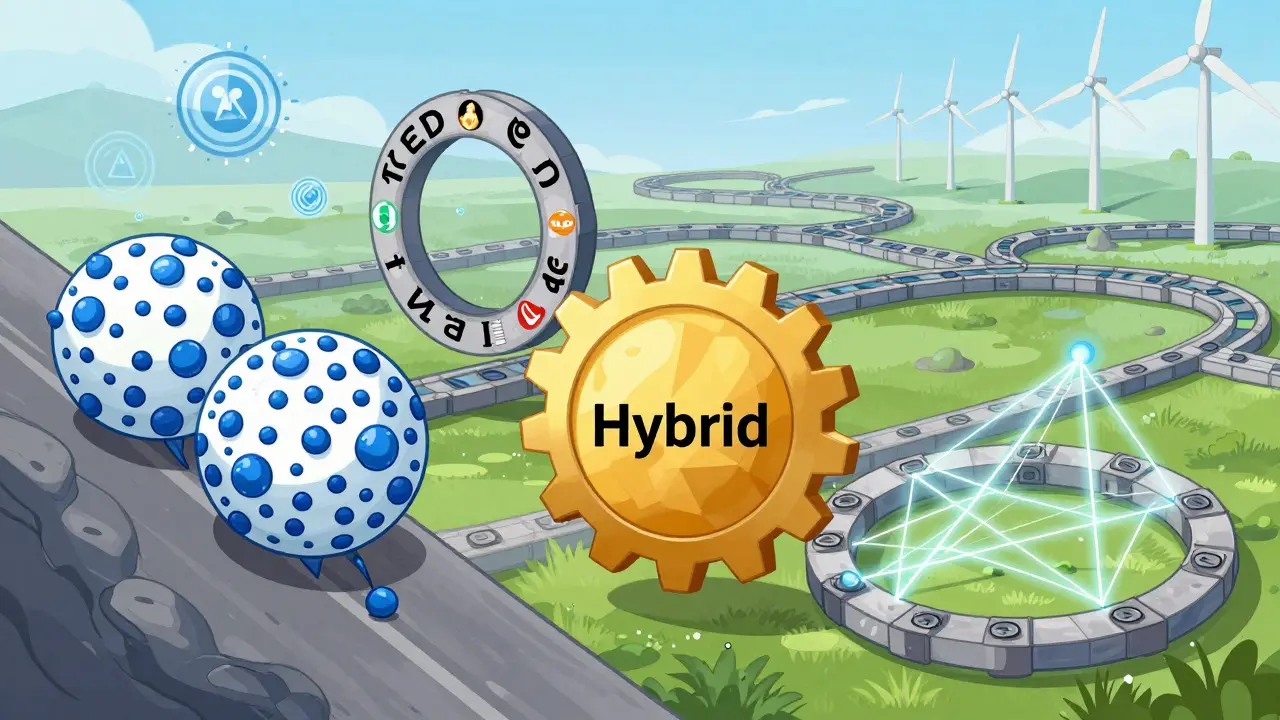
Choosing the Right Consensus for the Job
So which one should you use?
- If you need maximum security and don’t care about speed or energy? Stick with PoW. Bitcoin still holds the crown.
- If you’re building a public blockchain and want to be green and scalable? Go with PoS. Ethereum proved it works at scale.
- If you need instant finality and high throughput? Tendermint or HotStuff are your best bets.
- If you’re building a corporate ledger with known participants? PBFT variants are the industry standard.
- If you want speed, low fees, and don’t mind a council? Hashgraph delivers.
- If you want decentralization, speed, and scalability all at once? Avalanche is the most promising.
There’s no universal winner. The right algorithm depends on your goals: security, speed, cost, decentralization, or compliance. The best projects don’t chase trends. They pick the tool that fits the job.
Final Thoughts: Consensus Is Still Evolving
From Bitcoin’s brute-force puzzles to Avalanche’s random sampling, consensus algorithms have come a long way. What started as a single solution is now a toolbox. And we’re still adding new tools.
The next decade won’t be about one algorithm replacing another. It’ll be about combining them-mixing PoS with PBFT, adding data availability layers, integrating zero-knowledge proofs, and building for quantum resistance. The goal isn’t just to make blockchains faster. It’s to make them trustworthy, efficient, and adaptable enough to run the backbone of digital society.
Consensus isn’t just a technical detail. It’s the foundation of trust in a decentralized world. And that foundation is still being laid-brick by brick, algorithm by algorithm.
What is the most secure consensus algorithm today?
Proof of Work (PoW), as used by Bitcoin, remains the most battle-tested. With over 15 years of operation and billions of dollars in mining hardware securing it, no 51% attack has succeeded. However, Proof of Stake (PoS) systems like Ethereum’s are now considered equally secure, relying on economic penalties instead of computational power. Both are secure, but PoW has a longer track record.
Why did Ethereum switch from Proof of Work to Proof of Stake?
Ethereum switched to reduce energy consumption by 99.9%, lower transaction costs over time, and improve scalability. PoS removed the need for energy-hungry mining rigs and allowed for future upgrades like sharding. The move also aligned Ethereum with global sustainability goals and investor expectations.
Is Proof of Stake more centralized than Proof of Work?
It can be, but it doesn’t have to be. In PoW, mining power is concentrated in large pools, often in regions with cheap electricity. In PoS, wealthier participants can stake more and earn more rewards, creating a similar dynamic. However, PoS allows for more participants to join without expensive hardware. Well-designed PoS systems use random selection and slashing to prevent dominance by a few wallets.
What’s the difference between Tendermint and Avalanche?
Tendermint uses a fixed set of validators who vote in rounds, achieving fast finality (under 3 seconds) but limiting scalability to hundreds of nodes. Avalanche uses random sampling-asking small groups of nodes repeatedly if a transaction is valid-until confidence is high. It supports thousands of nodes, scales better, and is more decentralized, but finality is probabilistic until confirmed.
Are there any blockchains still using Proof of Work today?
Yes. Bitcoin still uses PoW exclusively. Litecoin, Dogecoin, and Bitcoin Cash also rely on it. However, since 2020, fewer than 10% of new blockchain projects choose PoW. Most new chains use PoS, DPoS, or hybrid models due to environmental and scalability concerns.
Can consensus algorithms be hacked?
All consensus mechanisms have theoretical weaknesses. PoW can be attacked with 51% of mining power. PoS can be vulnerable to long-range attacks or nothing-at-stake problems if not designed properly. Tendermint can be stalled if too many validators go offline. But in practice, major networks like Bitcoin and Ethereum have never been successfully compromised at the consensus level. The real risks are in implementation flaws, not the algorithms themselves.
Josh V
January 14, 2026 AT 16:40Finally we can stop pretending mining is 'security' when it's just electricity waste
Shaun Beckford
January 15, 2026 AT 11:12Chris Evans
January 15, 2026 AT 20:21Telleen Anderson-Lozano
January 16, 2026 AT 14:03Sarah Baker
January 17, 2026 AT 07:59Chris O'Carroll
January 17, 2026 AT 15:34Nishakar Rath
January 19, 2026 AT 11:58Dustin Secrest
January 19, 2026 AT 13:14Rod Petrik
January 21, 2026 AT 06:05Anna Gringhuis
January 22, 2026 AT 20:48Lauren Bontje
January 23, 2026 AT 10:06Ashlea Zirk
January 24, 2026 AT 11:35Vinod Dalavai
January 26, 2026 AT 03:27Christina Shrader
January 26, 2026 AT 09:57Katherine Melgarejo
January 28, 2026 AT 03:57Haley Hebert
January 28, 2026 AT 16:17Jill McCollum
January 29, 2026 AT 14:31Jason Zhang
January 30, 2026 AT 21:51Deb Svanefelt
February 1, 2026 AT 09:01Tony Loneman
February 1, 2026 AT 19:19