How DIDs Work on Blockchain: A Simple Guide to Decentralized Identity
 Jun, 13 2026
Think about the last time you had to prove who you are online. Maybe you uploaded a photo of your driver’s license to book a hotel, or filled out a long form for a new bank account. You handed over your name, address, and date of birth, trusting that company to keep it safe. But what if they got hacked? What if they sold your data? This is the broken model we’ve lived with for decades: centralized identity.
Enter Decentralized Identifiers (DIDs), which are a new type of identifier that enables verifiable, digital identities without relying on central authorities. Instead of asking Google or Facebook to verify who you are, you hold the keys to your own identity. It sounds like science fiction, but it’s happening right now on blockchains like Ethereum and XRP Ledger. Here is how it actually works, why it matters, and what you need to know before jumping in.
The Anatomy of a DID: More Than Just a String
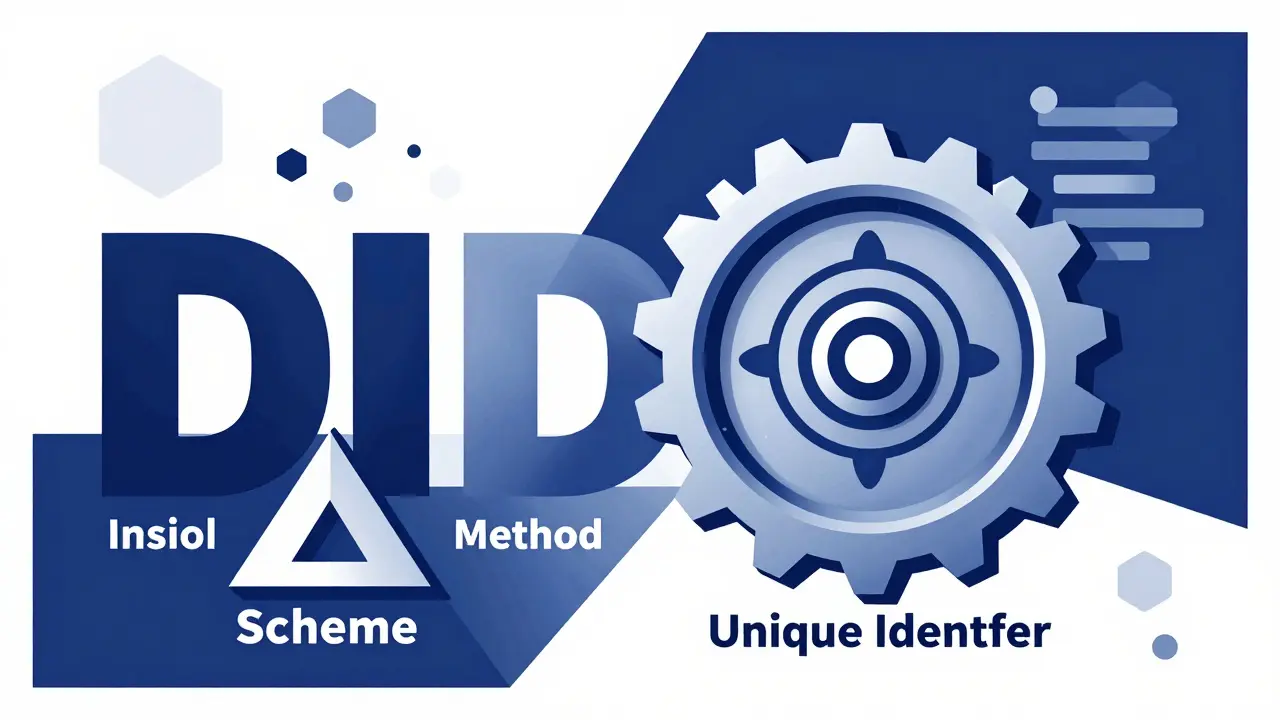
A DID isn’t a username. It’s not an email address. It’s a specific text string that follows a strict standard set by the World Wide Web Consortium (W3C). If you look at one, it looks something like this: did:ethr:0x123456789abcdef....
Let’s break that down because understanding the structure helps you understand the power:
- The Scheme (
did:): This tells any system reading this that it’s a decentralized identifier, not a URL or an email. - The Method (
ethr): This specifies which blockchain or ledger backs the ID.ethrmeans Ethereum.xrplmeans XRP Ledger.webmight mean a simple website server. The method determines the rules for creating and updating the ID. - The Unique Identifier: This is a unique code generated from your cryptographic keys. It’s mathematically linked to you, but it doesn’t contain your name, your face, or your social security number.
When you create a DID, you aren’t just making up a handle. You are generating a pair of cryptographic keys-a private key (which you keep secret) and a public key (which goes on the blockchain). The public key acts as your digital fingerprint. Anyone can see it and use it to verify that you signed a message, but no one can forge your signature without your private key.
The DID Document: Your Digital Passport
So, where does the actual information live? It lives in something called a DID Document, which is a JSON-LD file stored on-chain or referenced by the DID that contains public keys, authentication methods, and service endpoints.
Imagine the DID as the cover of a passport, and the DID Document as the pages inside. When someone wants to verify your identity, they don’t ask a database administrator. They query the blockchain using your DID. The blockchain returns your DID Document. This document tells them:
- Who controls this ID? It lists the public keys associated with the DID.
- How can I interact with this person? It lists service endpoints, like a messaging protocol or a wallet address.
- What are the rules? It defines verification methods, such as which key is used for signing transactions versus which is used for encryption.
This process is called "resolution." It’s fast, transparent, and trustless. You don’t need to trust the person verifying you; you just need to trust the math and the blockchain’s integrity. According to the W3C specification published in August 2022, this resolution process must be deterministic-meaning every time you resolve the same DID, you get the exact same document, ensuring consistency across different systems.
Verifiable Credentials: Proving Facts Without Revealing Secrets
Having a DID is only half the battle. You still need to prove things about yourself, like "I am over 18" or "I have a medical degree." This is where Verifiable Credentials (VCs), which are digital equivalents of physical credentials like diplomas or licenses, issued by trusted entities and cryptographically signed, come into play.
Here is how the flow works in real life:
1. **Issuance:** A university issues you a Verifiable Credential stating you graduated. They sign it with their private key. You store this credential in your digital wallet, linked to your DID.
2. **Presentation:** You apply for a job. The employer asks for proof of education. Instead of uploading a PDF diploma (which could be faked), you present a "Verifiable Presentation" from your wallet.
3. **Verification:** The employer’s system checks three things: - Is the presentation signed by your DID? - Was the original credential signed by the university’s DID? - Has the university’s DID been revoked or compromised?
If all checks pass, you’re verified. Crucially, you can use zero-knowledge proofs to show you meet the criteria (e.g., "graduated after 2020") without revealing the exact date or even the university name, unless you choose to. This is a massive shift from the current model where you hand over everything and hope for the best.
Why Blockchain is the Trust Anchor
You might wonder, "Why do we need a blockchain for this? Why not just a regular server?" The answer lies in censorship resistance and permanence.
In a centralized system, if the server goes down, or if the company decides to ban you, your identity disappears. With a DID anchored on a blockchain like Ethereum or XRP Ledger, the record is immutable. No single entity can delete your DID or change your history. This is critical for financial inclusion, refugee identification, and preserving digital rights.
However, not all blockchains are created equal when it comes to DIDs. Let’s look at the differences:
| DID Method | Underlying Blockchain | Transaction Speed | Cost per Operation | Best For |
|---|---|---|---|---|
did:ethr |
Ethereum | 15-30 seconds | $0.45+ (gas fees vary) | High-value assets, enterprise apps |
did:xrpl |
XRP Ledger | 3-5 seconds | $0.0002 | High-volume, low-cost identity issuance |
did:web |
Any web server | Instant | Free (hosting costs) | Prototyping, non-critical apps |
As you can see, Ethereum offers robust security but higher costs, while XRP Ledger provides speed and near-zero cost. The choice depends on your use case. For a government issuing millions of IDs, XRPL makes sense. For a high-security banking app, Ethereum might be preferred despite the cost.

The Hard Truths: Key Management and Usability
It’s easy to get excited about the technology, but we need to talk about the biggest hurdle: user experience. Currently, managing a DID requires managing private keys. If you lose your private key, you lose your identity. There is no "forgot password" button. Period.
Data from Chainalysis in 2022 showed that 20% of cryptocurrency users have lost access to funds due to key mismanagement. Imagine that happening to your entire digital identity-your bank accounts, your medical records, your professional certifications. That’s a scary prospect.
To solve this, developers are building "social recovery" mechanisms. Services like Argent Wallet allow you to appoint "guardians" (friends, family, or trusted services) who can help you recover access if you lose your key. It’s not perfect, but it’s a step toward making DIDs usable for everyone, not just crypto experts.
Another challenge is fragmentation. Because there are many DID methods (Ethereum, Solana, Polygon, etc.), interoperability can be tricky. A DID created on Ethereum might not be easily resolvable by a system designed for XRP Ledger. The W3C is working on universal resolvers to bridge these gaps, but we’re not there yet.
Where Are We Headed? Adoption and Regulation
DIDs are moving from theory to practice. In 2024, the European Union implemented eIDAS 2.0, which legally recognizes blockchain-based identities. This is a game-changer for adoption in Europe. Meanwhile, projects like Polygon ID are pushing the boundaries of privacy with zero-knowledge proofs, allowing users to verify attributes without revealing underlying data.
Vitalik Buterin, co-founder of Ethereum, has called DIDs the "missing link" between blockchain’s trust layer and practical identity applications. With over 200 blockchain networks supporting DID methods and millions of unique DIDs already created, the infrastructure is being built. The question isn’t whether DIDs will replace centralized identity, but how quickly we can solve the usability hurdles to make them accessible to the average person.
What is the difference between a DID and a traditional username?
A traditional username is controlled by a central authority (like Google or Facebook). They can suspend, delete, or change your account. A DID is self-sovereign; you control the private keys, and no central authority can revoke your identity. Additionally, DIDs are cryptographically verifiable, whereas usernames rely on trust in the platform.
Can someone steal my DID?
They can’t steal the DID itself, as it’s a public string on the blockchain. However, if they gain access to your private key, they can impersonate you. This is why securing your private key (using hardware wallets or secure mobile storage) is critical. Unlike passwords, private keys should never be shared or stored online.
Do I need to pay to create a DID?
It depends on the blockchain. On Ethereum, you pay gas fees, which can range from $0.50 to several dollars depending on network congestion. On XRP Ledger, the cost is fractions of a cent. Some methods like did:web are free but require you to host the DID Document yourself.
Are DIDs anonymous?
Not necessarily. DIDs provide pseudonymity by default. Your DID doesn’t reveal your real-world identity unless you choose to link it via Verifiable Credentials. However, since transactions are recorded on a public ledger, sophisticated analysis could potentially de-anonymize users if they make mistakes in linking their off-chain and on-chain activities.
What happens if I lose my private key?
Without your private key, you cannot sign transactions or update your DID Document. In most pure blockchain implementations, this means permanent loss of access. To mitigate this, many modern DID wallets offer social recovery features, allowing trusted contacts to help you restore access to a new key pair.
Suman Patil
June 13, 2026 AT 11:58Look, I get the hype around DIDs and self-sovereign identity, but let's be real about the tech stack here. The interoperability issue is a massive bottleneck that nobody wants to talk about seriously. You have Ethereum doing its thing with high gas fees, then you have XRPL trying to be the cheap alternative, and now Polygon ID is throwing zero-knowledge proofs into the mix like it's a magic wand. It’s a fragmented mess right now.
The W3C specs are great on paper, deterministic resolution and all that jazz, but in practice? If I create a DID on one chain, can I actually use it seamlessly on another without jumping through hoops? Not really. We need universal resolvers that actually work across different ledger architectures, not just theoretical frameworks. Until then, we’re just building silos with better cryptography.
Kumaran sowkarpet
June 14, 2026 AT 21:34hiii everyone! :D i think this is super cool stuff for the future of privacy. in india we are dealing with so much data leakage from centralized servers, so having control over our own keys sounds amazing. but the part about losing your private key scares me lol. no forgot password button? that is terrifying for normal people who already struggle with remembering wifi passwords. social recovery sounds like a good idea though, maybe friends can help us out if we mess up. keep writing such informative posts! :)
Mauricio Contreras Loredo
June 15, 2026 AT 22:02Oh joy, another article pretending blockchain solves human stupidity. Let me guess, you lose your key, you lose your life, and the developers shrug because 'math doesn't care about your feelings.' Brilliant. Truly inspiring. I’m sure the average person is thrilled to manage cryptographic keys instead of just resetting their password via email. What a dream come true for UX designers everywhere.
sreeja boora
June 17, 2026 AT 05:07The implementation of decentralized identifiers must be viewed through the lens of national security and regulatory compliance. While the technology offers certain efficiencies, the lack of central oversight poses significant risks to state sovereignty. In India, we have Aadhaar, which is a centralized system that works effectively for billions. Why would we replace a functioning, government-vetted system with a chaotic, unregulated blockchain experiment? The eIDAS 2.0 regulation in Europe is a step towards standardization, but it still relies on legal frameworks that these decentralized systems often ignore. We cannot allow pseudonymous identities to undermine the integrity of our digital infrastructure. The state must remain the ultimate arbiter of identity verification to prevent fraud and ensure accountability.
Grace Newman
June 17, 2026 AT 06:19I find it deeply unsettling how casually this article dismisses the implications of immutable records. Once a DID is anchored on a blockchain, it is there forever. Do you truly believe that 'trustless' systems are free from manipulation? The entities controlling the nodes, the miners, the validators-they hold immense power. Who audits the auditors? The claim that 'no single entity can delete your DID' is a double-edged sword; it also means no entity can correct errors or protect you from malicious actors who might exploit your public key information. This is not freedom; it is exposure. The surveillance capitalism model is being replaced by a surveillance anarchism model, and I am not convinced the latter is safer. We are handing over our digital souls to algorithms written by anonymous coders.
Annemarie Fitzgerald
June 18, 2026 AT 19:39its like we are all just puppets dancing on strings made of code. the idea that a string of characters can define who you are is laughable yet tragically accurate. we trade our privacy for convenience and now they tell us we can keep our privacy but only if we memorize a 24 word phrase. ironic isnt it. the world is burning and we are arguing about json-ld files. anyway did someone mention xrpl? sounds like a cult name to me. typical.
Abby Sivertsen
June 20, 2026 AT 09:15I’ve been following the space for a while, and honestly, the cost difference between ETH and XRPL is night and day. For mass adoption, especially in developing countries, $0.0002 per transaction is the only way this scales. Ethereum is fine for high-value assets, but asking a refugee or a low-income worker to pay $0.45+ just to register an identity is absurd. It excludes the very people who need self-sovereign identity the most. The table in the post highlights this perfectly, but I wish more people realized that 'best for enterprise' often means 'best for excluding the masses.'
Benjamin Eisen
June 22, 2026 AT 04:38Great breakdown of the anatomy of a DID. One thing that really resonates with me is the concept of verifiable credentials. Being able to prove I graduated without showing my entire diploma is huge. But im worried about the fragmentation issue mentioned earlier. If i build my identity on ethereum, will a company using solana based tools even be able to verify me? Seems like we need better bridges between these ecosystems before this becomes mainstream. Also, social recovery wallets seem like the missing link for usability. Hope devs focus more on that side of things.
Kenneth Riley
June 23, 2026 AT 04:44you guys are sleeping on the fact that this whole paradigm is fundamentally flawed because it assumes users are rational actors who will safeguard their keys. they wont. they never do. look at the history of crypto losses. billions gone. now apply that to identity. you lose your key you lose your existence. simple as that. the 'social recovery' nonsense is just a bandaid on a gunshot wound. eventually someone will hack the guardians or the guardians will collude. its inevitable. stop pretending this is secure for the average joe. its a toy for geeks.
ravi mahla
June 24, 2026 AT 13:41Haha, @Kenneth Riley always the optimist! But seriously, the sarcasm is justified when you think about the UX nightmare. However, I think we're underestimating the progress in wallet interfaces. Apps like Argent are making it surprisingly easy for non-techies to set up guardians. It's not perfect, but it's light years ahead of managing raw hex strings. Plus, the zero-knowledge proof aspect is genuinely exciting for privacy. Imagine proving you're over 18 without revealing your birthdate or nationality. That's the killer app right there. Let's not throw the baby out with the bathwater just because key management is hard today.
Mark Brunschwiler
June 25, 2026 AT 12:38I feel like this topic is really important for my mental health too. Knowing that I own my data makes me feel safe. But reading about all the technical details makes my head spin. Can someone explain why we need a blockchain at all? Why can't a regular server just store the keys securely? I trust companies more than math sometimes. Or maybe I'm just tired. Either way, thanks for explaining it simply. It helps me feel less confused about the internet.
Sonya O'Brien
June 26, 2026 AT 14:22I completely agree with the points raised regarding the importance of interoperability and the challenges associated with user experience, which are indeed critical factors that will determine the widespread adoption of decentralized identifiers in the near future. Furthermore, the distinction between the various blockchain methods, such as Ethereum and XRP Ledger, provides valuable insight into the trade-offs between security, cost, and speed, thereby allowing organizations to make informed decisions based on their specific requirements and constraints. It is also worth noting that the role of verifiable credentials in enabling privacy-preserving verification mechanisms represents a significant advancement over traditional methods of identity proofing, as it allows individuals to share only the necessary information without exposing sensitive personal data. Consequently, as the ecosystem matures and standards become more unified, we can expect to see a gradual shift towards greater integration of these technologies into everyday applications, ultimately leading to a more secure and user-centric digital landscape.
Filbert Reeves
June 28, 2026 AT 09:34don't believe the hype. this is just a new way for big tech to track you even harder. they say 'decentralized' but really it's just distributed surveillance. the governments love this stuff because they can monitor transactions on the public ledger. zero knowledge proofs are a myth designed to sell coins. i've seen too many projects fail and leave users with nothing. stick to cash and paper. everything digital is a trap. also the spelling in this post is terrible. 'sequestial'? really? amateur hour.
Nick Rice
June 30, 2026 AT 07:36Let's cut through the noise. The real value proposition here is censorship resistance. If you live in a country where your bank account can be frozen overnight or your social media accounts banned for speaking out, a DID on a robust blockchain like Ethereum or Solana is your lifeline. It's not about convenience; it's about survival. Yes, key management is hard. Yes, UX is clunky. But compared to having your digital life erased by a corporate executive or a government decree, learning to back up a seed phrase is a small price to pay for freedom. Stop whining about gas fees and start appreciating the sovereignty.
Amit Thakur
July 2, 2026 AT 01:32The integration of zk-SNARKs and zk-STARKs within the DID framework is what truly separates this from legacy systems. By leveraging zero-knowledge proofs, we can achieve selective disclosure without compromising the underlying data integrity. This is crucial for enterprise-grade applications where GDPR compliance is mandatory. The ability to verify attributes like age or accreditation without exposing PII (Personally Identifiable Information) is a game-changer. However, the computational overhead of generating these proofs on-device remains a challenge for low-end mobile devices. We need optimized circuits and possibly off-chain computation with on-chain verification to scale this effectively. The potential is immense, but the engineering hurdles are significant.
Eric Scheinberg
July 2, 2026 AT 12:12The architectural distinction between the DID method and the DID document is fundamental to understanding the modularity of the system. The method defines the operational rules for creation and update while the document contains the actual cryptographic material. This separation allows for flexibility in deployment strategies. For instance, one might utilize a high-security ledger for the DID anchor while hosting the DID document on a decentralized storage solution like IPFS. This hybrid approach mitigates the cost issues associated with storing large documents on-chain while maintaining the immutability of the identifier itself. Such nuances are often overlooked in introductory guides but are essential for robust implementation.