How International Authorities Monitor Cross-Border Crypto in 2026
 Aug, 17 2026
Imagine sending $5,000 worth of Bitcoin from London to a wallet in Singapore. In the past, this might have been a ghost on the ledger. Today, it is a tracked event. Cross-border crypto monitoring is no longer just a theoretical concept for regulators; it is an active, technical reality enforced by international bodies to stop money laundering and sanctions evasion. As of August 2026, the landscape has shifted from reactive policing to proactive surveillance. If you are moving digital assets across borders, you are likely being watched by more than one government agency simultaneously.
The Core Mechanism: The Travel Rule and Data Requirements
At the heart of global crypto surveillance is the Travel Rule, a standard established by the Financial Action Task Force (FATF) to ensure that originator and beneficiary information travels with the transaction. For years, this was loosely interpreted. Now, enforcement is tight. Under current frameworks, particularly those aligned with the U.S. Bank Secrecy Act and adopted by the EU, Virtual Asset Service Providers (VASPs) must collect specific data points for any transfer exceeding $3,000.
This isn't just about knowing who sent the money. Regulators require:
- The full legal name and address of both the sender and receiver.
- The identity of the financial institution or VASP involved in each leg of the journey.
- The exact amount, date, and unique transaction hash.
- Wallet addresses that can be linked to verified identities through Know Your Customer (KYC) processes.
If you use a centralized exchange like Coinbase or Binance, your data is already in their systems. The challenge arises when you move funds to a self-custody wallet. That is where the next layer of monitoring kicks in.
Regional Approaches: US, EU, and UK Coordination
Regulation is not uniform globally, but the major players are converging. In the United States, the Financial Crimes Enforcement Network (FinCEN) treats cryptocurrencies as 'monetary instruments' under the Bank Secycy Act. This means they are subject to the same anti-money laundering (AML) recordkeeping rules as cash. FinCEN’s recent proposals go further, requiring banks to verify customer identity even for transactions involving unhosted wallets if those wallets are in high-risk jurisdictions.
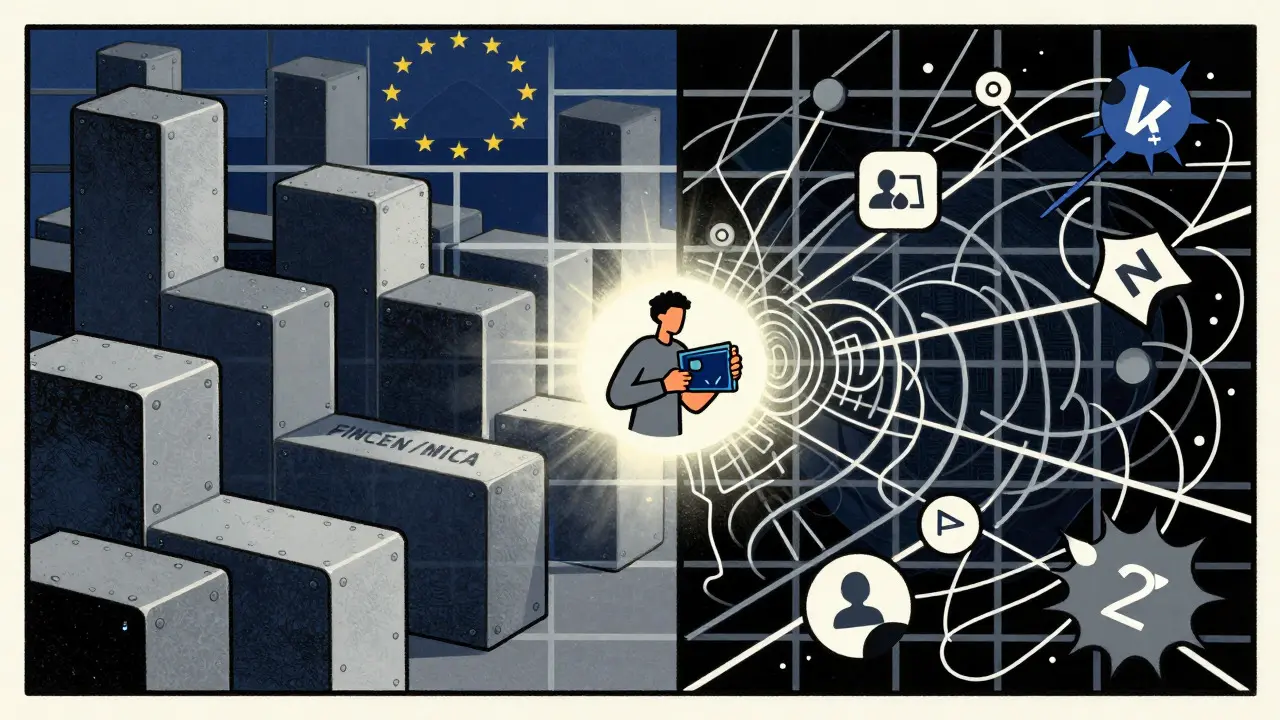
In Europe, the Markets in Crypto-Assets (MiCA) regulation sets a stricter, risk-averse tone. Licensed providers must conduct enhanced due diligence and report suspicious activity immediately. Meanwhile, the UK-US Transatlantic Task Force is acting as a bridge, aligning licensing and custody standards between the two largest economies. This bilateral cooperation creates a de facto global standard because so much crypto volume flows through these two hubs.
| Jurisdiction | Primary Authority | Key Regulation | Monitoring Focus |
|---|---|---|---|
| United States | FinCEN | Bank Secrecy Act (BSA) | AML/CFT, Travel Rule ($3k+), Unhosted Wallet Verification |
| European Union | National Competent Authorities | MiCA / AMLD | Licensing, Enhanced Due Diligence, Suspicious Activity Reporting |
| United Kingdom | OFSI / FCA | Sanctions & AML Threat Assessment | Sanctions Evasion, VPN Obfuscation, Intermediary Wallets |
Technical Challenges: How Money Moves Off-Radar
Regulators aren't blind, but the technology is evolving fast. The biggest headache for authorities is the use of anonymity-enhancing techniques. Mixers, bridges, and layer-2 solutions allow users to obscure the path of funds. A user in a sanctioned country might use a Virtual Private Network (VPN) to appear as if they are in a compliant jurisdiction, then use an instant exchange service that doesn't require KYC to convert fiat to crypto.
The UK's Office of Financial Sanctions Investigations (OFSI) identified this as a critical vulnerability in its 2025 threat assessment. They noted that intermediary wallets often separate incoming deposits from withdrawals, effectively breaking the chain of visibility that compliance software relies on. To counter this, authorities are deploying advanced blockchain analytics tools that can trace funds across multiple chains, identifying patterns rather than just individual transactions.

What This Means for Businesses and Individuals
If you are running a business that accepts stablecoins or crypto, you don't necessarily need your own license. You can partner with licensed VASPs. However, this shifts the burden to due diligence. You must ensure your partners have robust AML controls. If your partner fails a compliance check, the liability can ripple back to you.
For individuals, the message is clear: the era of total privacy in mainstream crypto transfers is over. While DeFi and private coins still offer some opacity, the main rails-centralized exchanges and stablecoin corridors-are heavily monitored. Non-compliance can lead to frozen assets, heavy fines, or blacklisting from major platforms.
Future Trajectory: Standardization and AI Surveillance
By late 2026, we expect to see more automated cross-checking between national databases. The goal is a unified view of global crypto flows. With 91% of central banks exploring digital currencies, the integration of traditional finance and crypto is accelerating. This means regulatory tech (RegTech) will become smarter, using AI to flag anomalies in real-time. The focus will shift from catching known bad actors to predicting illicit flows before they settle.
Does the Travel Rule apply to all crypto transactions?
No. Currently, the strictest requirements apply to transactions over $3,000 involving Virtual Asset Service Providers (VASPs). Small peer-to-peer transfers between personal wallets may still fly under the radar, but thresholds are expected to lower as technology improves.
Can I hide my location using a VPN when trading crypto?
It is increasingly difficult. While a VPN hides your IP address, blockchain analytics can correlate wallet activity with geographic behavior patterns. Additionally, many exchanges now require proof of residence documents during KYC, making VPN usage a red flag for compliance teams.
What happens if I violate cross-border crypto monitoring rules?
Penalties vary by jurisdiction but typically include monetary fines, asset freezes, and potential criminal charges for money laundering. For businesses, loss of partnership with major payment processors is a common consequence.
Are stablecoins monitored differently than Bitcoin?
Yes. Stablecoins are often treated more like traditional currency equivalents. Because they aim to hold a fixed value, they are viewed as higher risk for sanctions evasion. Many jurisdictions require stablecoin issuers to maintain reserves and report large movements directly to regulators.
Which countries have the strictest crypto monitoring?
The United States, European Union member states, and the United Kingdom currently lead in enforcement intensity. These regions have established dedicated task forces and integrated crypto data into existing financial crime databases.
Alexander Scheel
August 19, 2026 AT 03:01It is truly fascinating to observe how the so-called "decentralized" revolution has merely created a more efficient mechanism for state surveillance.
We are told that sovereignty lies in the code, yet here we are, watching the Financial Action Task Force dictate who gets to hold their own assets.
The irony is not lost on those of us who remember the early days of Bitcoin; it was supposed to be the end of the middleman, not just the replacement of one corrupt broker with a digital panopticon.
Now, if you wish to move value across borders, you must first submit your soul to the KYC database of a centralized entity.
This is not financial freedom; this is financial compliance dressed up in blockchain aesthetics.
Let us not pretend that the Travel Rule is anything other than a leash, and a very expensive one at that.
The moral high ground of privacy has been abandoned, and now we are left to clean up the mess of our own naivety.
Evelyn Kula
August 19, 2026 AT 09:01America leads the way, as always!
While Europe bickers about MiCA and the UK plays catch-up with their little task forces, we are actually doing the work.
FinCEN knows what they are doing because we built the modern financial system, after all.
You can try to hide behind a VPN or some obscure mixer, but the eagle eye of the federal government never blinks.
They say privacy is good? I say transparency is strength.
If you have nothing to hide, why fear the camera?
It is time for the rest of the world to stop whining and adopt our standards.
Global security starts with American enforcement.
Don't let these conspiracy theorists fool you into thinking this is a plot against you; it is a shield for the honest citizen.
Stand tall, pay your taxes, and keep your crypto where it belongs: under watchful eyes.
manish jha
August 20, 2026 AT 01:28The masses are confused by the noise.
True wisdom lies in understanding that control is inevitable.
Those who resist the structure suffer from ignorance.
Follow the rules and you will find peace.
Deviate and you will face chaos.
This is the natural order of things.
Do not argue with the current.
Align yourself with the flow of authority.
Only then will you understand the deeper truth.
Rest now.
Ashley Snyder
August 21, 2026 AT 00:13I think it's actually kind of cool that they're finally getting serious about this.
I mean, if you want to use crypto, you should probably expect some level of accountability, right?
It's not like it's completely untraceable anymore anyway.
Plus, it helps protect people from scams and stuff.
Just gotta stay compliant, I guess.
No big deal really.
Sarah Hafner
August 22, 2026 AT 14:40Hello everyone! : )
I wanted to add a bit of context here because I work in compliance.
The $3,000 threshold mentioned in the post is crucial.
Many people forget that below this amount, P2P transfers are often less scrutinized, though that is changing fast.
Also, note that stablecoins are treated differently than BTC.
Regulators see them as closer to cash, so the reporting requirements are tighter.
If you are running a small business accepting USDC, make sure your VASP partner is fully licensed.
Liability can indeed ripple back to you if they fail an audit.
It is a complex landscape, but manageable if you stay informed.
Feel free to ask if you need clarification on any specific part! ^_^
Gary Straiton
August 24, 2026 AT 06:46DID YOU SEE THAT?!
THEY ARE WATCHING US!
EVERY SINGLE BITCOIN MOVE IS TRACKED!
IT IS THE END OF ANONYMY!
THE ELITES WANT TO CONTROL YOUR WALLET!
WHY DO WE TOLERATE THIS TYRANNY?
AMERICA MUST STAND UP AND FIGHT BACK!
THEIR SO-CALLED "COMPLIANCE" IS JUST A CHAIN FOR THE WEAK!
WE ARE THE STORM!
WE WILL NOT BE CAGED BY DIGITAL LEASHES!
HURRAH FOR FREEDOM!
Daniel Brown
August 24, 2026 AT 11:32Regarding the technical implementation of the Travel Rule, it is worth noting that the data transmission protocols are standardized via ISO 20022.
This ensures that the originator and beneficiary information travels seamlessly between VASPs.
Without this standardization, cross-border verification would remain fragmented and inefficient.
The integration of this protocol into major exchanges has significantly reduced friction in international transfers.
Furthermore, the latency of these data packets is negligible compared to the transaction settlement time.
Thus, the argument that monitoring slows down trade is largely obsolete.
The infrastructure is robust and ready for scale.
We should focus on the efficiency gains rather than the perceived loss of privacy.
The data architecture is sound.
End of analysis.
Kate Staab
August 25, 2026 AT 09:03Oh, wonderful.
Another layer of bureaucracy for the already overburdened individual.
One simply cannot send money without filling out a form, apparently.
How delightful.
The thrill of having your IP address correlated with your wallet activity.
Truly, the peak of human innovation.
I suppose we should thank them for making our lives slightly more tedious.
Bravo.
Applause.
Can we go home now?
Kelsey Anne
August 26, 2026 AT 01:43Facts.
Privacy is dead.
Move on.
KYC is mandatory.
Comply or die.
Simple.
Efficient.
Necessary.
Stop complaining.
Use the rails.
Or don't.
Your choice.
But know the cost.
It's clear.
Done.
Patrick Pat
August 27, 2026 AT 18:13So, you're telling me my coffee is being tracked by a satellite?
Great.
Just great.
I'll bet my toaster is reporting my breakfast habits to the EU next week.
Thanks for the update, folks.
Can't wait to fill out my next 40 pages of forms just to buy a sandwich in crypto.
Very exciting times.
Love the progress.
Nothing like feeling watched while eating toast.
Cheers to that.
See you in court.
Probably.
Dina Lazarova
August 29, 2026 AT 16:13One observes with mild interest the continued decline of the libertarian fantasy.
It is rather quaint, isn't it?
To believe that technology could outpace the state's desire for control.
Yet here we are, in 2026, with the state firmly in the driver's seat.
The complexity of the regulatory framework is, admittedly, impressive in its thoroughness.
However, the practical implication remains unchanged: submission.
For the sophisticated investor, this is merely another variable to calculate.
For the casual user, it is a barrier to entry.
Which is precisely the point, one assumes.
To filter the sheep from the goats.
How very pastoral.
And utterly predictable.
One wonders if there is any novelty left in this particular game of cat and mouse.
Perhaps not.
But the spectacle continues, regardless.
One watches from a safe distance, sipping tea.
It is all so very theatrical.
And yet, the curtain does not fall.
It merely changes color.
From red to blue.
From white to grey.
Always shifting.
Never ending.
How tiresome.
And yet, compelling.
In a dull sort of way.
One supposes.
At least the paperwork is well-organized.
That is something.
Isn't it?
Indeed.
Mostly.
When one looks closely.
Which one rarely does.
Given the volume.
Of course.
Understandable.
Completely understandable.
In fact.
Essential.
For survival.
Of the institution.
Not the individual.
Who cares about the individual?
Doesn't one.
Usually.
On most days.
Except today.
Because of the article.
Which was quite dry.
As expected.
Thankfully.
Or perhaps unfortunately.
Depending on one's perspective.
Which is fluid.
Like water.
Or crypto.
Whichever flows faster.
These days.
It's hard to say.
But both are monitored.
Tightly.
Very tightly.
Like a vice.
Or a hug.
Depends on who's hugging whom.
Right?
Exactly.
Spot on.
Perfectly accurate.
As usual.
One thanks the author.
Sincerely.
Or so it seems.
From a distance.
Keep it up.
Please.
Don't stop.
It's the only thing keeping us awake.
At night.
When we check our wallets.
Again.
And again.
And again.
Until dawn.
Breaks.
Slowly.
Dimly.
Grey.
Like the fog.
Over London.
Or New York.
Or wherever.
It doesn't matter.
The eyes are everywhere.
Blinking.
Waiting.
Watching.
Always watching.
Never sleeping.
Just like the market.
Which never sleeps.
Either.
Do you see?
The parallel?
It's poetic.
In a grim sort of way.
Like a sonnet.
Written in code.
And blood.
And ink.
And sweat.
And tears.
And laughter.
And silence.
And noise.
And everything in between.
All of it.
Monitored.
Recorded.
Stored.
Retrieved.
Analyzed.
Judged.
Passed.
Failed.
Repeated.
Forever.
And ever.
Amen.
Or something similar.
Depending on your faith.
Or lack thereof.
Which is also monitored.
Apparently.
By the algorithm.
Which knows best.
As always.
Doesn't it?
Yes.
It does.
Thank you.
Goodbye.
For now.
See you soon.
Probably.
Might be.
Could be.
Will be.
Must be.
Shall be.
Ought to be.
Should be.
Would be.
Could have been.
Should have been.
Would have been.
Is being.
Was being.
Will be being.
Had been being.
Have been being.
Will have been being.
Complex.
Very complex.
Like the regulations.
Yes.
Indeed.
Quite.
Extremely.
Exceedingly.
Unbelievably.
Indescribably.
Unfathomably.
Immeasurably.
Boundlessly.
Limitlessly.
Infinitely.
Eternally.
Forevermore.
Until the heat death of the universe.
When the servers finally shut down.
And the lights go out.
And the silence falls.
Finally.
Peace.
At last.
Maybe.
Perhaps.
Hopefully.
Pray.
Wish.
Hope.
Dream.
Wake.
Realize.
Accept.
Submit.
Comply.
Pay.
Live.
Die.
Repeat.
Start over.
New cycle.
New block.
New hash.
New key.
New identity.
New life.
Same old story.
Different characters.
Same script.
Same director.
Same audience.
Same theater.
Same stage.
Same lights.
Same shadows.
Same whispers.
Same screams.
Same laughter.
Same tears.
Same joy.
Same pain.
Same love.
Same hate.
Same fear.
Same hope.
Same dream.
Same reality.
Same illusion.
Same truth.
Same lie.
Same paradox.
Same mystery.
Same puzzle.
Same riddle.
Same question.
Same answer.
Same silence.
Same noise.
Same everything.
Same nothing.
Same void.
Same fullness.
Same emptiness.
Same abundance.
Same scarcity.
Same plenty.
Same lack.
Same enough.
Same too much.
Same too little.
Same just right.
Same Goldilocks zone.
Same sweet spot.
Same balance.
Same equilibrium.
Same stability.
Same chaos.
Same order.
Same disorder.
Same structure.
Same anarchy.
Same law.
Same freedom.
Same control.
Same liberty.
Same slavery.
Same master.
Same servant.
Same king.
Same peasant.
Same rich.
Same poor.
Same wealthy.
Same destitute.
Same abundant.
Same barren.
Same fertile.
Same sterile.
Same alive.
Same dead.
Same born.
Same died.
Same lived.
Same existed.
Same was.
Same is.
Same will be.
Same forever.
Same eternity.
Same infinity.
Same zero.
Same one.
Same all.
Same none.
Same yes.
Same no.
Same maybe.
Same perhaps.
Same likely.
Same unlikely.
Same certain.
Same uncertain.
Same known.
Same unknown.
Same understood.
Same misunderstood.
Same accepted.
Same rejected.
Same loved.
Same hated.
Same admired.
Same despised.
Same respected.
Same ignored.
Same noticed.
Same overlooked.
Same seen.
Same unseen.
Same heard.
Same unheard.
Same felt.
Same unfelt.
Same touched.
Same untouched.
Same tasted.
Same untasted.
Same smelled.
Same unsmelled.
Same experienced.
Same unexperienced.
Same lived through.
Same survived.
Same perished.
Same thrived.
Same withered.
Same bloomed.
Same decayed.
Same renewed.
Same ended.
Same began.
Same started.
Same finished.
Same completed.
Same abandoned.
Same resumed.
Same paused.
Same played.
Same stopped.
Same went.
Same stayed.
Same moved.
Same remained.
Same changed.
Same constant.
Same variable.
Same fixed.
Same flexible.
Same rigid.
Same soft.
Same hard.
Same brittle.
Same tough.
Same fragile.
Same strong.
Same weak.
Same powerful.
Same powerless.
Same influential.
Same irrelevant.
Same important.
Same trivial.
Same significant.
Same insignificant.
Same meaningful.
Same meaningless.
Same purposeful.
Same aimless.
Same directed.
Same random.
Same planned.
Same spontaneous.
Same calculated.
Same intuitive.
Same logical.
Same emotional.
Same rational.
Same irrational.
Same sane.
Same insane.
Same normal.
Same abnormal.
Same typical.
Same atypical.
Same common.
Same rare.
Same frequent.
Same infrequent.
Same regular.
Same irregular.
Same consistent.
Same inconsistent.
Same reliable.
Same unreliable.
Same trustworthy.
Same untrustworthy.
Same honest.
Same dishonest.
Same truthful.
Same false.
Same real.
Same fake.
Same genuine.
Same counterfeit.
Same authentic.
Same imitation.
Same original.
Same copy.
Same unique.
Same duplicate.
Same singular.
Same plural.
Same single.
Same multiple.
Same one.
Same many.
Same few.
Same several.
Same some.
Same any.
Same all.
Same none.
Same every.
Same each.
Same both.
Same neither.
Same either.
Same or.
Same and.
Same but.
Same so.
Same because.
Same therefore.
Same however.
Same nevertheless.
Nonetheless.
Yet.
Still.
Anyway.
Regardless.
Irrespective.
Despite.
In spite of.
For all that.
Notwithstanding.
Albeit.
Though.
Although.
Even though.
While.
Whereas.
As long as.
Provided that.
On condition that.
If.
Unless.
Until.
Before.
After.
During.
Since.
From.
To.
By.
With.
Without.
Against.
Between.
Among.
Through.
Across.
Over.
Under.
Above.
Below.
Near.
Far.
Close.
Distant.
Here.
There.
Everywhere.
Nowhere.
Somewhere.
Anywhere.
Always.
Never.
Sometimes.
Often.
Rarely.
Seldom.
Frequently.
Occasionally.
Periodically.
Regularly.
Constantly.
Continuously.
Unceasingly.
Endlessly.
Boundlessly.
Limitlessly.
Infinitely.
Eternally.
Forever.
Amen.