Salavi Exchange Review: Is It Safe or a Scam? (2026 Analysis)
 Aug, 2 2026
You’ve probably seen the ads. They promise zero slippage, no downtime, and a "premium experience" that makes your wallet grow while you sleep. Salavi Exchange is a digital asset trading platform claiming to offer spot, futures, and portfolio diversification services with high security and regulatory compliance. It sounds too good to be true, doesn’t it? In the world of cryptocurrency, where trust is everything and scams are everywhere, that feeling isn’t paranoia-it’s survival instinct.
I’ve spent years analyzing crypto platforms, from the giants like Binance to the obscure newcomers popping up overnight. When I looked into Salavi Exchange in mid-2026, I expected to find detailed fee structures, user testimonials, and clear regulatory licenses. Instead, I found silence. A lot of it. This review cuts through the marketing fluff to answer one critical question: Is Salavi Exchange a legitimate place for your money, or should you steer clear?
The Silence Speaks Volumes: User Feedback and Reputation
In the crypto industry, reputation is built on transparency. Established exchanges thrive on community engagement. You can find thousands of threads on Reddit about Binance, debates about Bybit's features, and honest reviews on Trustpilot for almost every major player. These platforms have active communities because they have active users.
Now, look at Salavi. According to independent monitoring sites like CashbackForex.com, Salavi Exchange holds a rating of 0 out of 5 stars based on 0 user reviews. Zero. Not five negative ones, not ten mixed ones-zero. For a platform claiming to be a "prominent" gateway to the crypto universe, this absence is deafening.
- No Community Presence: There are virtually no discussions about Salavi on major crypto forums like Bitcointalk or specialized subreddits.
- No Social Proof: Unlike competitors who showcase real-time trade alerts and user success stories, Salavi lacks verifiable social media engagement from actual traders.
- Hand-Moderated Reviews: Even when review sites allow submissions, the lack of volume suggests either extreme newness or restricted access to the general public.
Why does this matter? Because in crypto, if you can’t find anyone talking about an exchange, it’s usually a red flag. It suggests the platform might not have a significant user base, or worse, that existing users are hesitant to share their experiences due to poor service or withdrawal issues.
Security Claims vs. Industry Standards
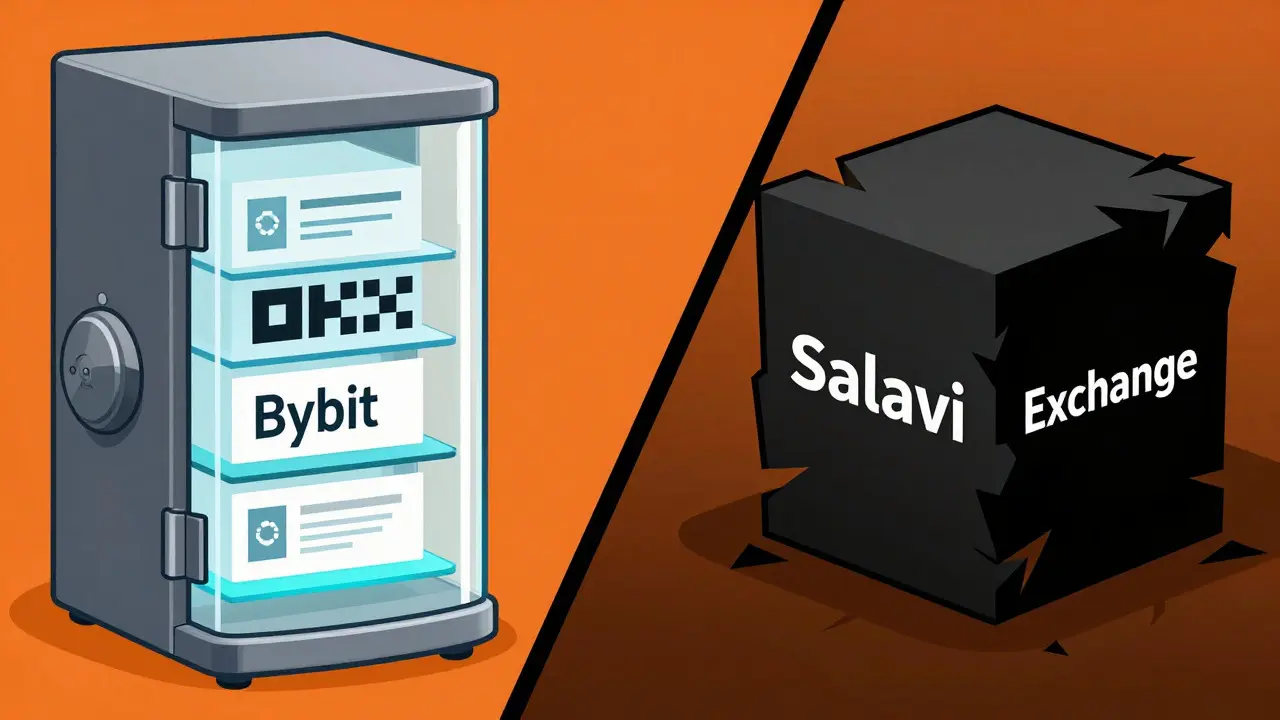
Salavi’s marketing materials emphasize "safety" and "regulatory compliance." But in 2026, vague promises aren’t enough. Users demand proof. Let’s compare what Salavi says against what established leaders do.
| Feature | Salavi Exchange | OKX | Bybit |
|---|---|---|---|
| Cold Storage Percentage | Not Disclosed | 95% in multi-signature cold wallets | Multi-layered security architecture |
| Proof of Reserves | None Available | Regularly Published | Regularly Published |
| Audit Reports | None Public | Available from third-party firms | Available from third-party firms |
| Hack History | Unknown | No major exploits reported | No major exploits reported |
| Insurance Fund | Not Specified | Yes (for specific assets) | Yes (Protection Fund) |
OKX, for instance, stores 95% of user funds in multi-signature cold wallets and uses RAM storage for private keys to prevent permanent memory theft. They publish regular proof-of-reserves audits so users can verify that the exchange actually holds the assets it claims to. Bybit has similar transparency measures and maintains regulatory licenses in multiple jurisdictions, including Canada and Cyprus.
Salavi offers none of this. There are no public audit reports, no proof-of-reserves snapshots, and no details on how much of your capital is kept offline in cold storage. Without these metrics, you’re essentially trusting them with your life savings based on a slogan. That’s a gamble, not an investment strategy.
Regulatory Gray Areas
Compliance is the backbone of a trustworthy exchange. As governments worldwide tighten regulations in 2025 and 2026, operating without clear licensing is becoming increasingly risky for both the exchange and its users.
Salavi claims to adhere to legal requirements but fails to specify which laws or which jurisdictions. Compare this to Bybit, which holds specific licenses for dealing in virtual currencies in Canada, innovative technologies in Kazakhstan, and crypto custody in Cyprus. These licenses mean something: they require regular reporting, capital reserves, and adherence to anti-money laundering (AML) protocols.
When an exchange hides its regulatory status, it often means one of two things:
- They are operating from a jurisdiction with lax laws (a "crypto haven") to avoid scrutiny.
- They are not yet licensed and hope to fly under the radar until they scale up-or until problems arise.
For UK-based traders (like myself in Edinburgh), this is particularly concerning. The Financial Conduct Authority (FCA) requires crypto firms to register and comply with strict consumer protection rules. If Salavi isn’t FCA-registered, your funds may have little to no recourse if the platform collapses or freezes withdrawals.
Trading Features: What You Actually Get
Let’s look at the product itself. Salavi offers spot trading, futures, and portfolio diversification tools. On paper, this sounds comprehensive. However, the devil is in the details-and those details are missing.
Liquidity and Slippage: Salavi promises "zero slippage." In reality, zero slippage is nearly impossible unless you’re trading tiny amounts or the exchange is manipulating order books. High liquidity is required to execute large trades without moving the price significantly. With no public trading volume data, we have no way to verify if Salavi has the depth to support serious trading. Binance processes billions in daily volume; Bybit handles over $28 billion. Salavi’s volume is unknown, suggesting it may be low, leading to higher slippage despite their claims.
Fees: Transparency is key here. Major exchanges clearly list their maker/taker fees, withdrawal costs, and deposit charges. Salavi claims "transparent fee structures" but doesn’t publish specific percentages. Are they charging 0.1% per trade? 1%? Is there a hidden spread? Without this information, calculating your break-even point is guesswork.
Mobile Experience: They offer iOS and Android apps. This is standard in 2026. However, app quality varies wildly. Without user reviews, we don’t know if the app crashes during market volatility, lags behind real-time prices, or has buggy withdrawal interfaces. Established exchanges invest heavily in UX/UI testing because they know that a bad mobile experience drives users away.
Onboarding and Accessibility
Getting started on a new exchange should be straightforward. Yet, Salavi’s onboarding process is shrouded in ambiguity. How much is the minimum deposit? Which fiat currencies are supported? Do they accept SEPA transfers, Apple Pay, or credit cards?
By comparison, Bybit allows deposits as low as $2 and supports 15 different fiat currencies via various methods including Wise, Alipay, and Google Pay. This clarity helps users plan their entry. Salavi’s lack of clear onboarding documentation creates friction. It raises questions about whether the platform is fully operational or still in a beta phase with limited access.
If you’re trying to convert GBP to USDT quickly, you need to know exactly how long the transfer takes and what fees apply. Guessing games are expensive in crypto.
Risk Assessment: Should You Use Salavi?
So, where does this leave us? Salavi Exchange presents a classic case of "high promise, low proof." Here is my risk assessment based on the available data:
- High Risk: The complete lack of user reviews and community presence is the biggest warning sign. In a digital-first industry, invisibility is suspicious.
- Moderate Risk: Vague security claims without technical backing (cold storage %, audits) put your funds at potential risk compared to verified competitors.
- Low Utility: Without clear fee schedules and liquidity data, the platform offers no competitive advantage over established players.
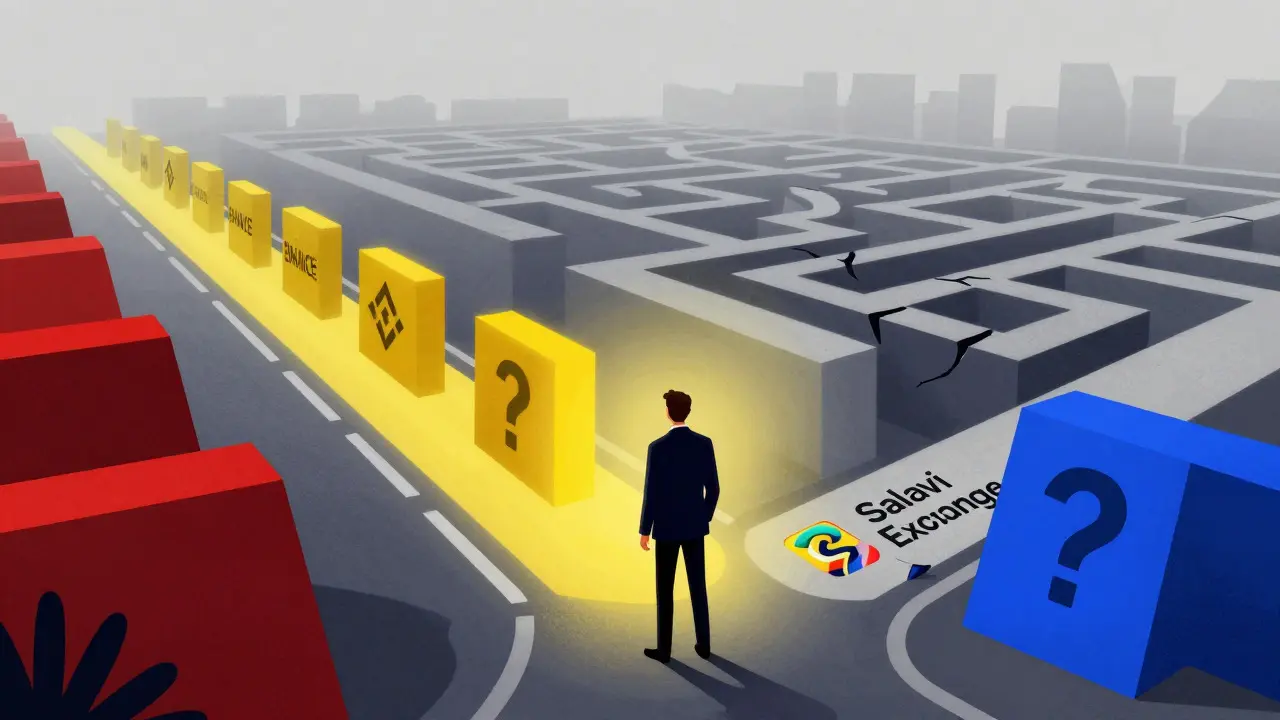
Unless you have a specific reason to use Salavi (such as exclusive access to a unique token listing that isn’t available elsewhere), the risks outweigh the benefits. The crypto market is crowded with excellent, transparent alternatives. Why choose the dark alley when the main street is well-lit?
Better Alternatives for 2026
If you’re looking for a reliable exchange, consider these proven options instead:
- For Beginners: Coinbase or Kraken. Both are highly regulated, have excellent customer support, and offer simple interfaces for buying Bitcoin and Ethereum.
- For Traders: Bybit or OKX. They offer deep liquidity, advanced charting tools, futures trading, and robust security features with regular audits.
- For Low Fees: Binance remains the leader in volume and fee discounts, especially if you hold BNB. Despite regulatory hurdles in some regions, its infrastructure is unmatched.
These platforms have survived market crashes, regulatory crackdowns, and security threats. They have earned their place through transparency and performance. Salavi hasn’t even begun that journey.
Is Salavi Exchange a scam?
While there is no definitive proof that Salavi Exchange is a scam, it exhibits several red flags common to fraudulent or unreliable platforms. These include zero user reviews, lack of public security audits, undisclosed fee structures, and vague regulatory compliance statements. Until these issues are resolved with verifiable data, it is safer to treat it with extreme caution.
Does Salavi Exchange have an app?
Yes, Salavi Exchange claims to offer mobile applications for both iOS and Android devices. However, without user feedback, the reliability, speed, and security of these apps remain unverified. Users should check official app stores for recent updates and ratings before downloading.
What cryptocurrencies can I trade on Salavi?
Salavi states it offers diverse trading pairs, including spot and futures markets. However, the exact list of supported cryptocurrencies is not clearly published in accessible sources. Major exchanges typically list hundreds of coins; Salavi’s limited transparency makes it difficult to confirm its full offering.
Is Salavi Exchange regulated?
Salavi claims to prioritize regulatory compliance but does not specify which jurisdictions it is licensed in. This contrasts with competitors like Bybit, which holds licenses in Canada, Kazakhstan, and Cyprus. The lack of specific regulatory disclosure raises concerns about its legal standing and user protections.
How do Salavi's fees compare to other exchanges?
Salavi claims to have transparent fees but does not publish specific rates for trading, deposits, or withdrawals. In contrast, exchanges like Binance and Bybit clearly display their fee tiers. Without this information, it is impossible to determine if Salavi offers competitive pricing or if hidden costs exist.