What is Plutonians (PLD) Crypto Coin? GameFi Token Explained
 Jun, 27 2026
You’ve probably seen the ticker PLD pop up on a crypto exchange or heard whispers about a "VR space game" on Solana. But what exactly is it? Is it the next big play-to-earn hit, or just another forgotten project from the 2022 metaverse boom?
Let’s cut through the noise. Plutonians (PLD) is the governance and ecosystem token for Plutonians, a virtual-reality space RPG massively multiplayer online role-playing game (MMORPG) built on the Solana blockchain. Developed by U.A. Fabrica Game Studios, it aims to merge classic space-shooter gameplay with Web3 ownership mechanics.
Here is the reality check: as of mid-2026, PLD is a low-cap, low-liquidity asset trading at sub-cent prices. It is not a household name like Bitcoin or even major GameFi tokens like Axie Infinity’s AXS. However, its architecture-combining Unreal Engine 5 graphics with a dual-token economy-is technically ambitious. If you are looking into PLD, you need to understand not just the token, but the game behind it, the risks involved, and whether there is any real utility left in this ecosystem.
The Core Concept: A VR Space MMO on Solana
To understand PLD, you have to understand the product it powers. Plutonians is described as a hybrid of classic titles like Homeworld and Escape Velocity, but with a modern twist: it runs on the Solana blockchain using high-speed, low-cost transactions.
The developers, led by CTO Tillmann Meyer of U.A. Fabrica, built the game using Unreal Engine 5. This matters because UE5 allows for high-fidelity graphics that can run on everything from web browsers via WebXR to dedicated VR headsets. The goal was to create a "persistent-state" universe where players don’t just rent their experience-they own assets like spaceships, land plots, and upgrades as NFTs.
Unlike many early GameFi projects that forced users to buy expensive NFTs to start playing, Plutonians launched with a free-to-play entry point. You could jump into the browser-based alpha version without spending a dime. However, to truly participate in the economy-trading ships, earning rewards, or governing the project-you needed tokens. That is where PLD comes in.
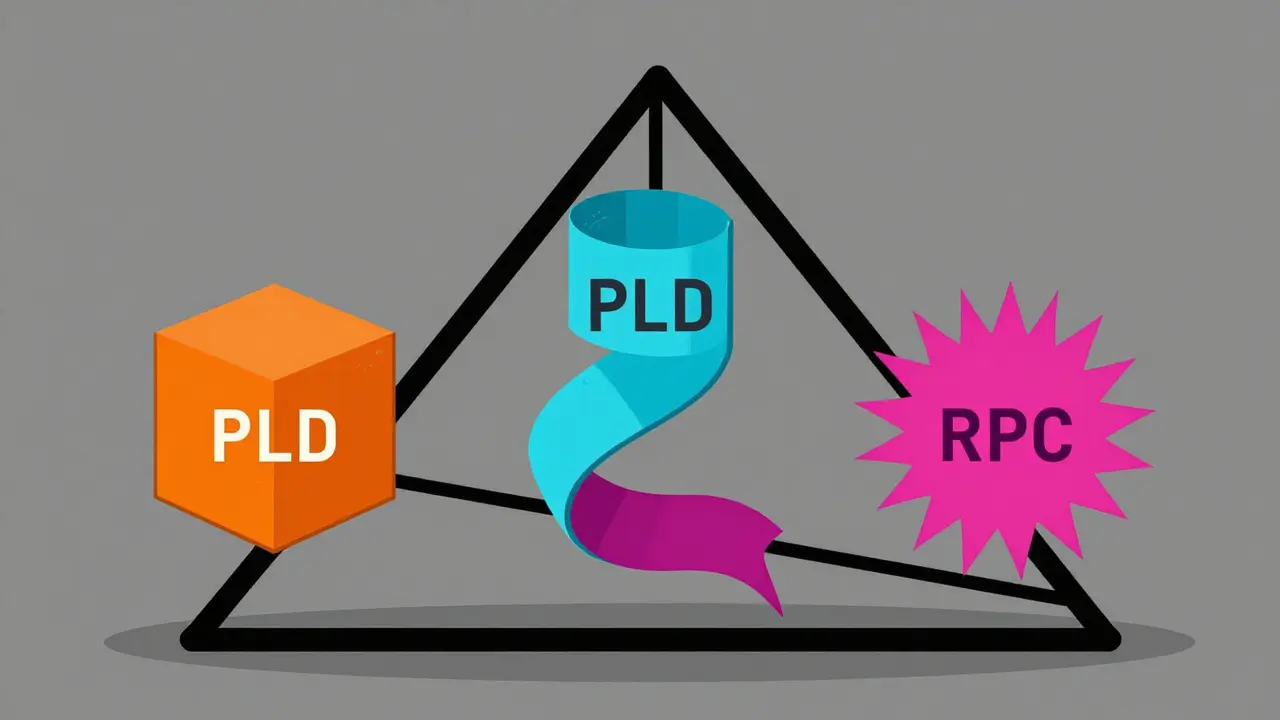
Tokenomics: PLD vs. RPC vs. PU238
Plutonians uses a three-part economic model. This is crucial because confusing these tokens is the most common mistake new investors make. They serve very different purposes.
| Token | Ticker | Primary Function | Supply Cap |
|---|---|---|---|
| Governance & Staking | PLD | Voting rights, treasury management, high-level coordination | 350,000,000 (Fixed) |
| Utility & Transactions | RPC | In-game purchases, marketplace fees, buying upgrades | 35,000,000,000 (Fixed) |
| Fuel | PU238 | Required for space travel missions; earned by staking RPC | Dynamic (Earned via staking) |
PLD (Plutonian DAO) is the "stock" of the company. It has a hard cap of 350 million tokens. No more will ever be minted. Holders use it to vote on how the project’s treasury is spent and to influence game development mandates. It also plays a role in advanced financial features, like borrowing or lending NFT spaceships.
RPC (Republic Credits) is the "cash" inside the game. With a much larger supply of 35 billion, it handles daily transactions. You use RPC to buy ship parts, accessories, or other NFTs from other players. To keep the economy stable, RPC must be staked to earn PU238, which acts as fuel for your spaceship. This creates a demand sink: if you want to fly around the metaverse, you need fuel, so you stake RPC, reducing the circulating supply of the utility token.
Price History and Market Reality
If you look at the charts, the story of PLD is one of extreme volatility followed by stagnation. Launched in April 2022 during the peak of the metaverse hype cycle, PLD saw significant initial interest. It listed on exchanges like KuCoin, triggering intraday jumps of over 30%.
However, the broader GameFi sector crashed hard in 2023 and 2024. By mid-2026, PLD is trading at fractions of a cent. Data from trackers like CoinGecko shows prices hovering around $0.0007-$0.0018 USD. More concerning than the price itself is the volume. Daily trading volumes are often reported in single digits (e.g., under $20 USD). This indicates severe liquidity risk. You might find it difficult to sell a large position without crashing the price further.
There is also confusion regarding circulating supply. Some platforms report zero circulating supply due to data errors, while others suggest nearly the entire 350 million max supply is in circulation. This discrepancy makes calculating market capitalization unreliable. Always check multiple sources and be aware that the "Fully Diluted Valuation" (FDV) looks deceptively small because the total supply is fixed, but the actual float may be large and illiquid.
Risks and Red Flags
Before you buy any PLD, you need to weigh the risks. This is not a blue-chip investment.
- Liquidity Risk: With daily volumes often below $20, exiting a position can be slow and costly. Slippage will eat into your profits.
- Security Ratings: As of May 2026, security auditors like CertiK have given the project relatively low scores (around 2.9/10). While this doesn’t mean a hack is imminent, it suggests vulnerabilities or lack of rigorous auditing compared to top-tier DeFi protocols.
- Execution Uncertainty: The game reached an Alpha stage in March 2023, but public updates on major content expansions or player milestones have been scarce since then. In GameFi, token value is directly tied to active user engagement. Without a growing player base, the tokens lose their utility.
- Data Opacity: Conflicting data across exchanges makes it hard to know the true state of the market. Always verify on-chain data via Solana explorers if possible.

How to Buy and Use PLD
If you decide to proceed, here is the practical path. Since PLD is an SPL token on Solana, you cannot hold it in a standard Ethereum wallet like MetaMask without bridging. You need a Solana-compatible wallet like Phantom or Solflare.
- Acquire SOL: Buy Solana (SOL) on a major centralized exchange like Binance or Coinbase.
- Transfer to Wallet: Send SOL to your self-custody Solana wallet address.
- Swap for PLD: Use a decentralized exchange (DEX) like Raydium or Orca. Search for the PLD/USDC pair. Be careful to verify the contract address to avoid scams.
- Alternative: Check if PLD is still listed on smaller centralized exchanges like KuCoin, though liquidity there may also be thin.
Once you have PLD, you can theoretically participate in the Plutonian DAO governance votes. However, remember that without an active game client drawing in thousands of daily users, the voting power holds little real-world weight right now.
Is Plutonians Worth Your Attention?
Plutonians represents a specific era of crypto gaming: the hope that VR + Blockchain = Mass Adoption. Technically, the stack (Unreal Engine 5 + Solana) is solid. The dual-token model is well-designed on paper. But execution is everything.
As of 2026, the project lacks the visibility and liquidity of its competitors. It serves as a cautionary tale for many GameFi investors: a good idea does not guarantee survival. If you are a die-hard fan of space simulators and believe in the long-term vision of U.A. Fabrica, PLD might be a speculative bet. For most investors, the low liquidity and uncertain development status make it a high-risk asset best avoided unless you fully understand the downsides.
What is the maximum supply of PLD?
The maximum supply of Plutonians (PLD) is fixed at 350,000,000 tokens. No additional tokens can be minted after this cap is reached.
Which blockchain does PLD run on?
PLD is an SPL token built on the Solana blockchain. This allows for fast transaction speeds and low fees, which are essential for in-game microtransactions.
What is the difference between PLD and RPC?
PLD is the governance token used for voting and high-level ecosystem decisions. RPC (Republic Credits) is the utility token used for in-game purchases, marketplace trades, and staking to earn fuel (PU238).
Is Plutonians game available to play?
An Alpha version launched in March 2023. The game is designed to be accessible via web browsers using WebXR technology, as well as VR headsets. However, current player activity levels are low.
Where can I buy PLD tokens?
PLD can typically be found on Solana-based decentralized exchanges like Raydium or Orca. It has also been listed on centralized exchanges such as KuCoin, though availability and liquidity may vary.