What Happens During a Blockchain Fork: Technical Mechanics and Community Impact
 Aug, 25 2026
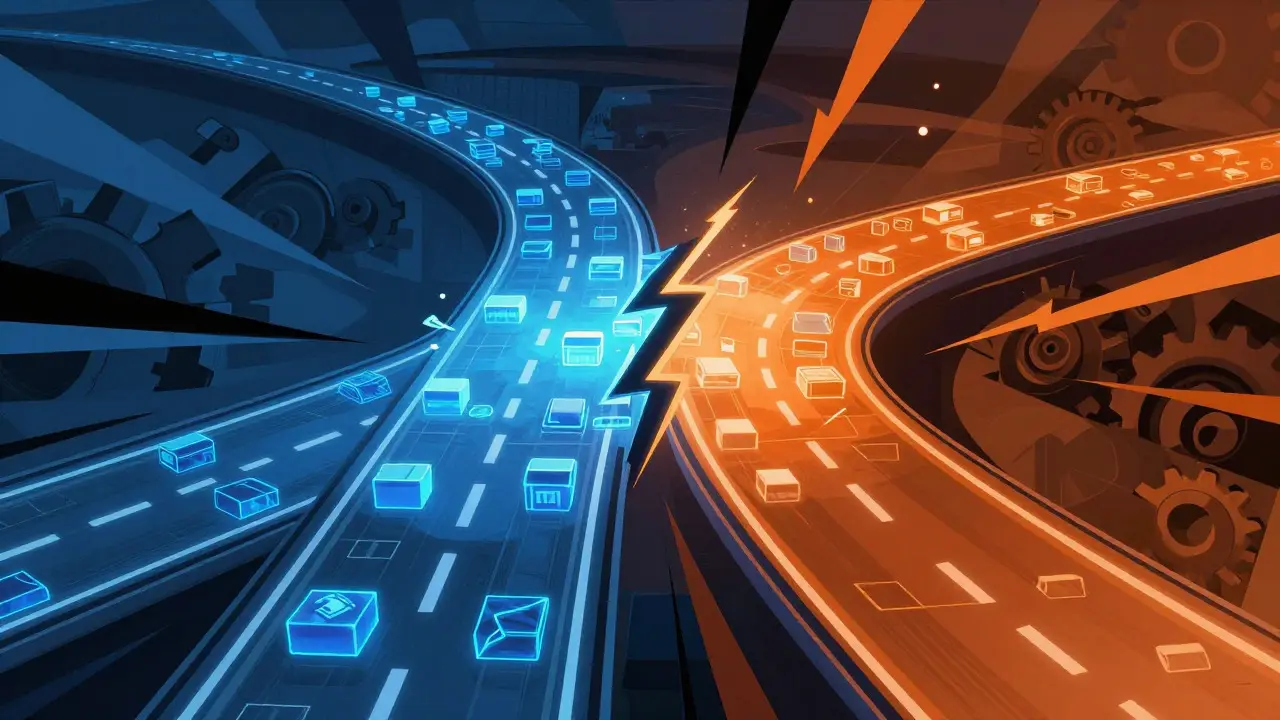
Imagine you are driving down a highway and suddenly the road splits into two separate lanes. One lane keeps going straight, while the other veers off to a new destination. That is essentially what happens during a blockchain fork is a divergence in a blockchain's transaction history or protocol rules that creates distinct developmental paths for the network. It is not just a technical glitch; it is a fundamental shift in how the network operates. For many users, this event can feel confusing. Do they keep their coins? Does the price crash? Which chain is the "real" one? Understanding the mechanics behind these splits is crucial for anyone holding digital assets or interested in decentralized technology.
Forks are the primary way decentralized networks evolve. Unlike traditional software where a company pushes an update to every user at once, blockchains require consensus from thousands of independent nodes. When the community disagrees on the direction of the protocol, or when significant changes are needed, the chain splits. This article breaks down exactly what happens technically, socially, and economically when a fork occurs, helping you navigate these events with confidence.
The Two Main Types of Forks
Not all forks are created equal. The most critical distinction lies between soft forks and hard forks. Understanding the difference helps predict the impact on your wallet and the network's stability.
- Soft Forks: These are backward-compatible updates. Think of it like changing the rules of a game slightly so that old players can still play with new ones. If a node doesn't upgrade its software, it can still validate blocks under the new rules. Soft forks usually don't create a new cryptocurrency. They are often used for minor bug fixes or efficiency improvements. Because they are compatible, the network remains unified, though some older nodes might see the new blocks as invalid if they are too outdated.
- Hard Forks: These are irreversible changes. A hard fork creates two separate chains that are incompatible with each other. If a node runs the old software, it will reject the new blocks, and vice versa. This typically results in the creation of a new coin (like Bitcoin Cash splitting from Bitcoin) or a major protocol overhaul (like Ethereum moving to Proof-of-Stake). Hard forks are high-stakes events because they permanently divide the network's history from that point forward.
There is also a concept called a codebase fork, which is different from a live network split. This happens when developers copy the entire code of an existing blockchain (like Bitcoin) and modify it to create a brand-new project. Many altcoins started this way. However, when we talk about a "fork event" affecting current holders, we are usually discussing live network forks.
Step-by-Step: How a Fork Actually Happens
A fork doesn't happen overnight. It follows a structured process that involves developers, miners, validators, and the broader community. Here is the typical lifecycle of a significant fork:
- Proposal and Debate: Developers identify a need-perhaps the network is too slow, fees are too high, or there is a security risk. They propose a change through formal documents like Bitcoin Improvement Proposals (BIPs) or Ethereum Improvement Proposals (EIPs). The community debates these ideas. This phase can last months or even years.
- Consensus Building: The network must agree on the change. In Proof-of-Work systems, mining pools signal their support. In Proof-of-Stake systems, validators vote. If enough power agrees, the fork is scheduled.
- Scheduling: The fork is set for a specific block height or timestamp. This gives everyone time to prepare. Exchanges, wallets, and node operators update their software to handle the new rules.
- Activation: At the designated moment, the new rules go live. The first block mined or validated under the new rules marks the official split. From this point, the blockchain has two possible futures.
- Post-Fork Stabilization: The network settles into its new reality. If it was a hard fork creating a new coin, both chains continue independently. If it was a protocol upgrade, the single chain continues with the new features.
What Happens to Your Coins?
This is the question every holder asks. The answer depends entirely on the type of fork.
If it is a soft fork, nothing changes for you. You keep your same coins, and the network looks the same. You might not even notice it happened unless you check the developer forums.
If it is a hard fork that creates a new token, you usually get both. For example, when Bitcoin split into Bitcoin and Bitcoin Cash, holders of BTC automatically received BCH based on the ratio defined by the fork. Your old wallet now holds two types of assets. However, this isn't always automatic. Some exchanges hold funds in cold storage and may take days to distribute the new tokens. Always check with your exchange or wallet provider before a known fork date to ensure you aren't locked out of the new asset.
It is worth noting that not all hard forks result in a new coin. Sometimes, a hard fork is just a major upgrade to the existing chain. In this case, you still only have one coin, but the underlying technology has changed significantly. The key indicator is whether the community decides to assign a new ticker symbol to the divergent path.
Community and Market Impact
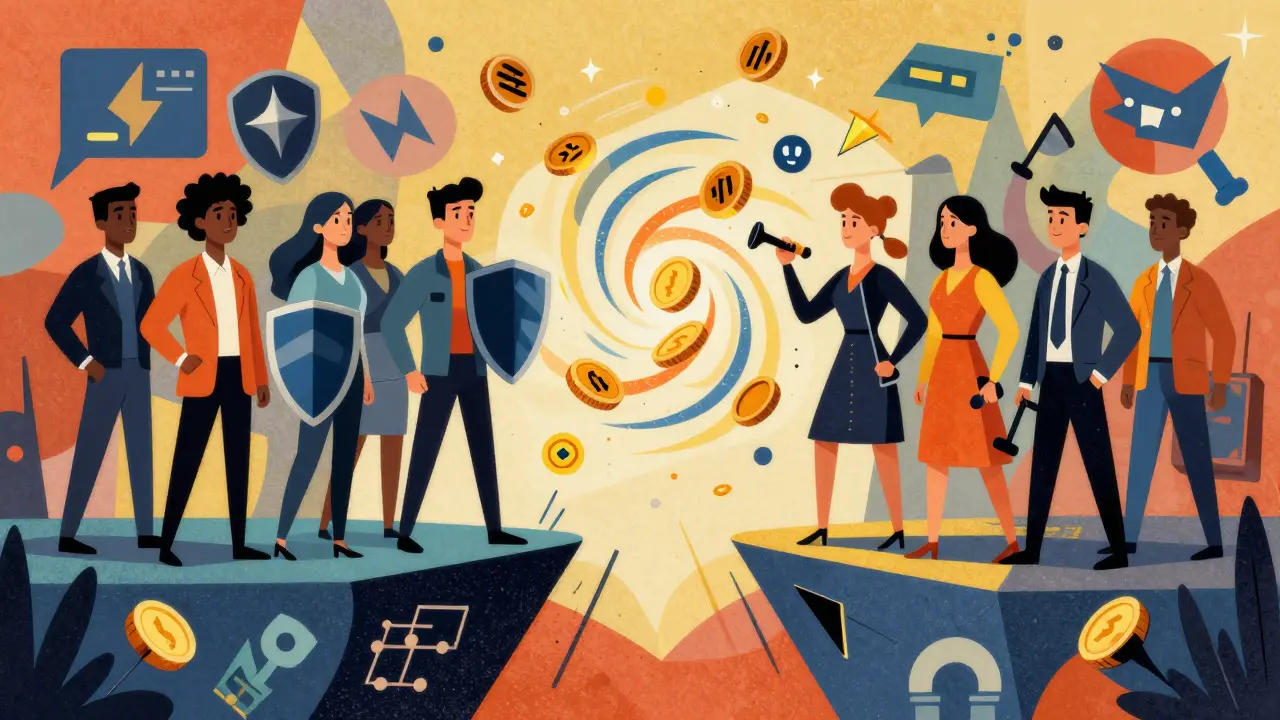
Forks are as much social events as they are technical ones. When a chain splits, the community often splits too. This fragmentation can lead to intense debate, differing visions for the future, and sometimes permanent division.
| Feature | Soft Fork | Hard Fork |
|---|---|---|
| Backward Compatibility | Yes | No |
| New Token Created? | Rarely | Possible | Network Split? | No | Yes (if incompatible) | User Action Required | Minimal | Update software/wallet | Market Volatility | Low | High |
Markets react strongly to forks. Uncertainty drives volatility. Before a fork, prices might drop due to fear of a bad outcome. After the fork, the original coin might lose value as liquidity spreads across two assets, or it might gain if the upgrade solves a major problem. For instance, Ethereum's transition to Proof-of-Stake involved several hard forks over multiple years. Each step required careful coordination, but the final result reduced energy consumption by 99%, a massive improvement that stabilized long-term confidence in the network.
Community dynamics also shift. Developers who disagree with the majority might leave to work on the alternative chain. Miners or validators choose which chain to support based on economic incentives. This can lead to a period of instability where neither chain has clear dominance, making it risky for businesses to integrate either version.
Why Do Forks Happen?
Forks are necessary because blockchains are immutable. Once a rule is written into the code, it cannot be silently changed. To fix a bug or add a feature, you must create a new version of the rules. Since there is no central boss to force the update, the network uses forks as a democratic mechanism for evolution.
Common reasons include:
- Scalability: The network is too slow or expensive. A fork might increase block size or change the consensus algorithm to process more transactions.
- Security: A vulnerability is discovered. A quick fork might be needed to patch it before hackers exploit it.
- Ideology: The community disagrees on the purpose of the coin. Is it a store of value or a payment system? This philosophical split often leads to hard forks.
- Governance: New voting mechanisms or reward structures are introduced to better manage the network.
Navigating Future Forks
As blockchain technology matures, forks are becoming more sophisticated. Many projects now use formal governance tokens to vote on changes, reducing the likelihood of contentious splits. Layer 2 solutions also help by allowing innovation to happen on secondary layers without touching the main chain, reducing the pressure for frequent base-layer forks.
For users, the best strategy is preparation. Keep your wallet software updated. Understand the difference between custodial (exchange-held) and self-custody wallets. Follow reliable news sources for announcements about upcoming forks. And remember, a fork is not a failure-it is a sign that the network is alive and evolving. Whether it results in a smooth upgrade or a dramatic split, it represents the decentralized nature of blockchain doing exactly what it was designed to do: adapting without a central authority calling the shots.
Do I need to do anything during a soft fork?
Usually, no. Soft forks are backward-compatible, meaning your current wallet and software should continue to work. However, it is always good practice to keep your software updated to ensure you can validate the latest blocks efficiently.
Will I get a new coin after a hard fork?
Only if the fork creates a new token. Check the official announcement for the specific project. If it does, you will typically receive the new token in the same wallet, subject to any distribution ratios defined by the developers.
Which chain becomes the 'real' one after a split?
Technically, both are real. However, the chain with more miner/validator support, higher market cap, and stronger community backing usually becomes the dominant one. The other may fade away or remain as a niche project.
Are forks dangerous for my funds?
Forks themselves are rarely dangerous, but the surrounding activity can be. Scammers often use fork events to launch fake tokens. Always verify contract addresses and stick to reputable exchanges or wallets to avoid losing funds to phishing scams.
How long does a fork process take?
Minor soft forks can happen within weeks. Major hard forks involving significant protocol changes can take years of development and testing, as seen with Ethereum's transition to Proof-of-Stake.
Rajni Mathur
August 26, 2026 AT 18:07Finally, someone writes a post that doesn't treat us like we're too stupid to understand the mechanics of a split. 📊 The highway analogy is actually quite apt for those who haven't read the whitepapers. Most people just see 'fork' and panic sell because they think it's a bug, not a feature. The distinction between soft and hard forks is the single most important concept here, yet 90% of retail investors still confuse them. You need to understand that backward compatibility is what keeps the network stable during minor updates. Without it, every small change would require a total migration of the ledger. The article correctly identifies that social consensus is just as critical as code changes. A technical fork without community buy-in is just dead weight on the blockchain. I appreciate the mention of the BIP/EIP process; it highlights the democratic nature of these networks. It is a slow process, yes, but necessary to prevent centralization of power. The table comparing impacts is useful for quick reference during volatile periods. Just remember that liquidity fragmentation is a real economic force to consider. If you are holding long-term, the noise of a fork should be irrelevant to your thesis. But for traders, it is pure chaos and opportunity. Keep your eyes on the hash rate distribution post-fork. That is where the true dominance lies, not in the marketing hype. Excellent breakdown for the technically inclined. 👍
Bill Patterson
August 27, 2026 AT 08:41this is all very complicated for no reason
why cant we just update the software like normal apps do
the whole decentralization thing is just an excuse for inefficiency
i bet the developers are making a fortune off this confusion
soft forks are basically useless if nobody notices them
hard forks are just a way to create more scams
we had enough with bitcoin cash already
ethereum took years to switch to proof of stake which was ridiculous
just pick one path and stick with it
the market volatility mentioned is really just fear mongering
people get rich when prices crash so why complain
keep it simple folks
stop overthinking the technology
Matt Reckdenwald
August 27, 2026 AT 23:41Oh, the sheer audacity of trying to explain immutable ledgers with highway metaphors! It’s almost poetic in its simplicity, isn’t it?
Think about it: we are witnessing the birth of a new digital organism right before our eyes. The split isn't just a line in the code; it's a schism in the collective consciousness of thousands of nodes. When Bill says it's inefficient, he misses the profound beauty of distributed trust. There is something incredibly dramatic about knowing that at block height X, reality itself will bifurcate into two parallel timelines of transaction history. One path might lead to utopia, the other to oblivion, and we are all just passengers watching the windshield crack. The tension in the air before activation is palpable, thick with the scent of potential and risk. It reminds me of those old sci-fi novels where humanity splits into factions based on ideology rather than geography. Here, the geography is purely digital, yet the emotions are undeniably human. We argue, we fear, we hope, and we trade. The energy consumption drop from Ethereum's upgrade wasn't just a stat; it was a breath of fresh air for the planet. Let us not forget the philosophical weight of choosing which chain to support. Are we voting for efficiency or for purity? For speed or for security? Every click on 'upgrade' is a moral choice disguised as a technical one. And isn't that the most thrilling part of it all?
Melanie Armijo
August 29, 2026 AT 12:14You know, I've been thinking about this. Is a fork really a failure of consensus, or is it the ultimate success of democracy? If everyone agreed, there would be no need for a fork. So maybe the split is proof that the system is working exactly as intended. It allows for diversity of thought to manifest in tangible form. Two chains, two truths, two futures. Which one is 'real' is a question that haunts me. Maybe both are real, just in different dimensions of value. The idea that we can hold two assets from the same origin point is fascinating. It challenges our notion of singular identity in finance. Perhaps we are becoming multi-dimensional beings through these technologies. Don't you feel a sense of wonder when you realize how complex this is? It's not just code; it's philosophy in action.
Laine Van Sickle
August 31, 2026 AT 04:41honestly i dont get why people make such a big deal out of this
its just computer stuff
my mom doesnt even know what a blockchain is and shes fine
you guys worry too much
just keep your coins in a cold wallet and stop panicking
the price will go up eventually anyway
or down who cares
life is short
focus on something else
like cooking or gardening
crypto is a distraction
but whatever good luck to you all
Ashwin Bhandurge
September 1, 2026 AT 18:29Let's look at the bigger picture here! This isn't just about coins; it's about the evolution of decentralized governance. Every fork is a lesson in resilience. When the community disagrees, the network adapts. That is the strength of open-source systems. We must stay optimistic and engaged. The debate phase is crucial because it forces transparency. Developers have to justify their proposals publicly. This builds trust over time. Even if the outcome is a split, the process strengthens the remaining participants. Think of it as a stress test for the entire ecosystem. Those who survive the volatility become stronger. We need to encourage more participation in the proposal stages. Don't just wait for the announcement; get involved in the forums. Your voice matters in shaping the next version of the protocol. Let's build a future where forks are seen as opportunities for innovation, not threats. Stay motivated, everyone!
Teresa Watson
September 2, 2026 AT 10:12oh great another fork
why does everything have to be so complicated
i just want to buy coffee with my crypto
who decided that splitting the chain was a good idea
probably some developer who thinks they're smarter than the rest of us
the market always crashes after these things
it's basically a tax on holders
and don't get me started on the scams that pop up afterwards
fake tokens everywhere
you have to be careful
but mostly it's just annoying
let's just go back to central banks
they at least tell you what's happening
Nadia Christian
September 2, 2026 AT 13:52It is interesting to note that while the technology is global, the impact is often felt differently depending on where you live. In the US, we have strong regulatory frameworks that sometimes try to stifle these innovations. However, the resilience of the American tech sector ensures that we remain at the forefront of blockchain development. The fact that we can coordinate such a massive update across thousands of nodes is a testament to our engineering prowess. Other countries may struggle with infrastructure issues, but we have the bandwidth and the talent to handle it. This is why Bitcoin remains the king; it was born here and thrives here. The hard fork mechanism is a uniquely American invention in spirit, even if the code is open to all. We should take pride in this technological leadership. It shows that free-market principles work best when applied to digital currency. Let us continue to support these developments and ensure that our nation stays ahead of the curve. The future belongs to those who innovate, and that is us.
jeffry jones
September 3, 2026 AT 03:21Nice breakdown. Key takeaway: check your custodial status. If you're on an exchange, you're at their mercy for token distribution. Self-custody gives you control but adds complexity. Hard forks are irreversible; soft forks are optional upgrades. Watch the hashrate shift post-activation. That's the real signal of network health. Don't FOMO on the new ticker immediately. Wait for liquidity to stabilize. The governance aspect is evolving. Layer 2 solutions are reducing base-layer pressure. Good info for newbies too.
Aaliyah Simpson
September 4, 2026 AT 05:25Of course, the article conveniently leaves out the part about how the whales are rigging the vote. They buy up the mining pools before the fork so they can decide which chain wins. It's all a setup. The 'community' debate is just theater for the masses. Real power lies with the few who control the hardware. Once the fork happens, they dump the original coin and pump the new one. Or vice versa. It's a game of chicken. And we're all just pawns. The volatility isn't random; it's engineered. Wake up people. The decentralization myth is crumbling. Look at the concentration of hash power. It's getting worse, not better. Trust the conspiracy, not the whitepaper.
Paul Needham
September 4, 2026 AT 07:03Sure, let's pretend this isn't just a glorified database error that got out of hand.
Who actually reads these BIPs? Probably just the devs and a handful of lawyers.
The rest of us are just gambling on which side of the road we end up on.
And don't get me started on the 'democratic' process. It's mob rule with extra steps.
If you wanted efficiency, just use a regular database. At least that one has a boss.
This whole thing is a mess wrapped in jargon.
But hey, if you like playing roulette with your life savings, go for it.
Just don't come crying when the house wins again.
Martha Packard
September 4, 2026 AT 13:59Let's dissect this 'democracy' angle for a moment. Is it truly democratic when the loudest voices dominate the forum? Or is it a plutocracy of hash power? The article paints a rosy picture of consensus, but in practice, it's often a battle of resources. The 'minority' chain usually dies not because it's wrong, but because it's poor. That's not freedom; that's survival of the fittest. And what about the users who don't care about ideology? They just want their money to work. Forks disrupt that simplicity. It adds friction. It adds risk. It adds confusion. Maybe we should ask if we need this many choices. Maybe less is more. The complexity is growing faster than our ability to understand it. We are drowning in options. And that is a problem. The solution isn't more forks; it's better coordination. But who coordinates in a decentralized world? No one. That's the flaw.
Jarnail Singh
September 5, 2026 AT 04:33One must appreciate the intricate dance of consensus mechanisms, wouldn't you agree? 😊 It is, after all, a testament to the enduring legacy of decentralized governance structures that have evolved significantly since the inception of the first proof-of-work protocols, showcasing a remarkable trajectory of technological refinement and community-driven adaptation that continues to challenge traditional financial paradigms and redefine the boundaries of digital asset management in an increasingly interconnected global economy, where the nuances of protocol upgrades and network splits play a pivotal role in shaping the future landscape of cryptographic currencies and their underlying infrastructures. 🚀
Alan Hawkins
September 5, 2026 AT 23:41Good points raised here. The distinction between soft and hard forks is crucial for any serious investor. I agree with the sentiment that preparation is key. Keeping wallets updated is non-negotiable. Also, the market impact section is spot on. Volatility is inevitable during these events. We should all stay informed and calm. The future of blockchain depends on smooth transitions like these. Great discussion overall.