What is Hive Dollar (HBD)? A Complete Guide to the Hive Blockchain Stablecoin
 Jun, 29 2026
Imagine a digital dollar that pays you interest just for holding it. That is the promise of Hive Dollar, widely known by its ticker symbol HBD. Unlike traditional stablecoins like USDT or USDC, which are backed by bank reserves and controlled by centralized companies, HBD is an algorithmic stablecoin native to the Hive blockchaina decentralized social media platform forked from Steem in 2020. It aims to maintain a value of approximately one United States dollar while offering users high yields through on-chain savings accounts.
If you have stumbled upon HBD in your crypto journey, you might be wondering how it works, why its price sometimes wobbles, and whether it is safe to use. This guide breaks down exactly what Hive Dollar is, how its unique peg mechanism functions, and what risks you need to watch out for in 2026.
Key Takeaways
- HBD is a crypto-collateralized stablecoin: It is backed by the market value of the HIVE token, not by fiat currency held in a bank account.
- High yield potential: Users can earn variable interest rates on their HBD balances, which have historically reached around 15% APR.
- Algorithmic peg with volatility: While targeting $1.00, HBD often trades at a discount (e.g., $0.94-$0.96) due to lower liquidity compared to major stablecoins.
- Censorship-resistant: Transactions settle in seconds without KYC requirements, making it useful for peer-to-peer payments within the Hive ecosystem.
- Niche adoption: HBD is primarily used for content rewards and savings within the Hive community, with limited presence on major global exchanges.
What Is Hive Dollar (HBD)?
Hive Dollar (HBD) is a protocol-native asset designed to function as a stable store of value within the Hive network. Launched in March 2020 alongside the Hive blockchain itself, HBD emerged when the Hive community forked away from the Steem blockchain following governance disputes. The goal was to create a truly decentralized ecosystem where users could earn cryptocurrency for creating content, and HBD served as the stable counterpart to the volatile HIVE tokenthe native utility and governance coin of the Hive blockchain.
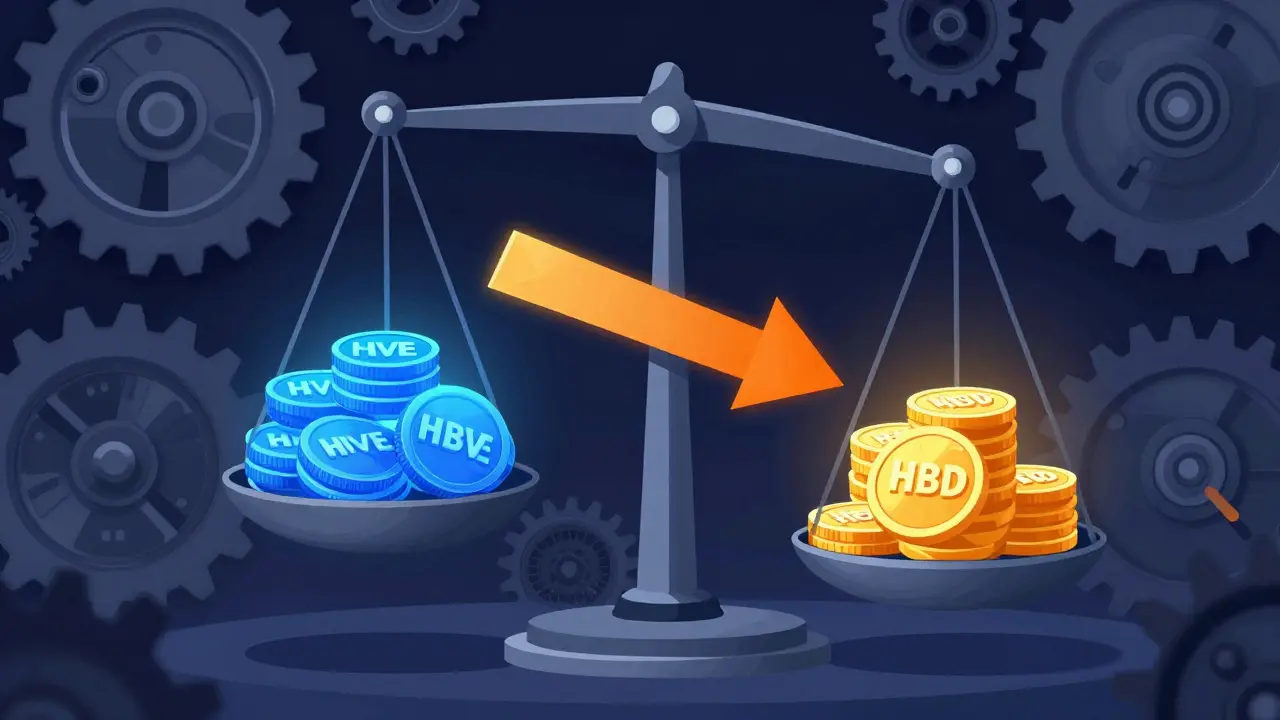
Unlike Tether (USDT) or Circle’s USDC, which rely on centralized issuers holding dollars in reserve, HBD is trustless. Its value is derived from an on-chain conversion mechanism. Essentially, every HBD represents a claim against the underlying value of HIVE. If you hold 10 HBD, you have the right to convert them into roughly $10 worth of HIVE tokens directly on the blockchain. This process is governed by smart contracts and witness nodes, removing the need for a central authority to manage the supply.
The core appeal of HBD lies in its dual nature: it offers the stability of a dollar-denominated asset combined with the high yields typical of decentralized finance (DeFi). For users in countries with unstable local currencies, HBD provides a way to preserve purchasing power while earning interest, all without needing permission from a bank.
How Does the HBD Peg Work?
The most critical question for any stablecoin user is: "How does it stay at $1.00?" HBD uses an algorithmic peg mechanism driven by supply and demand incentives rather than direct fiat redemption.
Here is the simplified logic behind the system:
- Minting HBD: When users want to create new HBD, they must lock up HIVE tokens as collateral. This increases the supply of HBD and burns the locked HIVE, reducing the circulating supply of HIVE.
- Burning HBD: When users want to redeem HBD back into HIVE, they initiate a conversion request. The protocol mints new HIVE from the burned supply and gives it to the user after a delay.
- Interest Rates as Levers: The Hive network’s witnesses (block producers) vote on the interest rate paid to HBD savers. If HBD trades above $1.00, the system incentivizes people to mint more HBD (increasing supply to push the price down). If HBD trades below $1.00, higher interest rates encourage people to save HBD rather than sell it, reducing selling pressure.
This system relies heavily on the health of the HIVE token’s market capitalization. As long as the total value of HIVE in circulation is significantly higher than the outstanding debt of HBD, the system remains solvent. However, because this is an algorithmic model, it is susceptible to market stress. If HIVE’s price crashes rapidly, the collateral backing HBD may shrink, potentially leading to a de-pegging event where HBD trades well below $1.00.
HBD vs. Major Stablecoins: A Comparison
To understand where HBD fits in the broader crypto landscape, it helps to compare it with established players like USDT, USDC, and DAI.
| Feature | Hive Dollar (HBD) | Tether (USDT) | Dai (DAI) |
|---|---|---|---|
| Backing Type | Crypto-collateralized (HIVE) | Fiat reserves (USD) | Crypto-collateralized (Multi-asset) |
| Governance | Decentralized (Witnesses) | Centralized (Tether Ltd.) | Decentralized (MakerDAO) |
| Yield/Savings | ~10-15% APR (Variable) | 0% (unless lent out) | Variable (Savings Rate) |
| Transaction Speed | ~3 seconds | Depends on chain (Ethereum: mins) | Depends on chain (Ethereum: mins) |
| KYC Required | No | Yes (for large amounts/exchanges) | No |
| Market Cap (Approx.) | $32 Million | $100+ Billion | $5+ Billion |
As the table shows, HBD is a niche player. Its market cap is tiny compared to USDT or even DAI. This lack of scale means there is less liquidity, which can lead to wider price swings. However, its integration into the Hive social ecosystem gives it a specific use case that general-purpose stablecoins do not offer: seamless, fee-less tipping and content rewards.
Earning Interest with HBD Savings
One of the main reasons people hold HBD is the interest rate. In the Hive ecosystem, you can deposit your HBD into a "Savings" account directly within your wallet. This action locks your HBD for a short period (usually 3 days) but activates interest accrual.
The interest rate is not fixed. It is determined by the median vote of the active witnesses (block producers) on the Hive network. Throughout 2025 and into 2026, this rate has frequently hovered around 15% APR. To put that in perspective, if you hold 1,000 HBD in savings, you could earn approximately 150 HBD in a year, assuming the rate stays constant and simple interest applies.
Why is the rate so high? In DeFi, higher risk usually commands higher reward. The Hive network subsidizes these rates to encourage people to hold HBD rather than converting it back to volatile HIVE immediately. By keeping HBD in circulation and in savings, the network stabilizes the peg and reduces sell pressure on the HIVE token. However, keep in mind that these rates can change. If the system becomes over-leveraged, witnesses may vote to lower the rate to protect the peg.

Risks and Volatility: The Reality of the Peg
While HBD targets $1.00, it is not perfectly stable. Data from mid-2026 shows HBD trading between $0.89 and $1.01 depending on market conditions. On November 20, 2024, for example, HBD dropped to $0.89, representing an 11% discount to the dollar. More recently, in June 2026, it traded around $0.95.
Several factors contribute to this volatility:
- Low Liquidity: With daily trading volumes often under $1,000 on external exchanges, large buy or sell orders can move the price significantly.
- Conversion Delays: Converting HBD back to HIVE via the protocol takes about 3.5 days. During this time, if the HIVE price drops, you receive less value than expected. This delay discourages instant arbitrage, allowing the price to drift from $1.00.
- System Debt Ratio: If too much HBD is created relative to the value of HIVE, the system enters a "haircut" mode. In extreme stress scenarios, conversions may be reduced to prevent insolvency, meaning you might get back less than $1.00 worth of HIVE per HBD.
Experts note that HBD is safer than purely algorithmic coins with no collateral (like the failed UST/Terra), but riskier than fully reserved coins like USDC. It sits in a middle ground: crypto-backed but dependent on complex economic incentives.
How to Buy and Use HBD
Getting started with HBD is straightforward if you are already in the Hive ecosystem. Here are the common paths:
- Earn it: Create content on Hive-based platforms (like Ecency or Hive.blog). You can choose to receive your curation and author rewards in HBD instead of HIVE.
- Convert HIVE: If you already own HIVE, you can use the internal decentralized exchange (DEX) on Hive front-ends to swap HIVE for HBD. Alternatively, you can use the protocol conversion feature, though remember the 3.5-day delay.
- Buy on Exchanges: Some centralized exchanges like Upbit list HBD pairs (e.g., HBD/BTC). However, major US exchanges like Coinbase do not support spot trading for HBD, limiting accessibility for some users.
For storage, you don’t need a specialized hardware wallet. Standard Hive wallets like AtomicWalleta multi-cryptocurrency wallet supporting desktop and mobile devices or web-based interfaces like Ecencya popular front-end interface for the Hive blockchain allow you to manage HBD balances, send transactions, and access savings features easily. Always ensure you secure your private keys, as HBD transactions are irreversible and require no identity verification.
Is HBD Right for You?
Hive Dollar serves a specific audience. It is ideal for:
- Hive Content Creators: Who want to stabilize their earnings against HIVE’s volatility.
- Yield Seekers: Looking for high APRs in a decentralized environment without complex DeFi protocols.
- Privacy Advocates: Who prefer censorship-resistant transfers without KYC hurdles.
However, if you need a stablecoin for frequent, large-scale trading on major exchanges, or if you cannot tolerate any deviation from the $1.00 peg, HBD may not be the best fit. Its niche status means lower liquidity and higher susceptibility to market sentiment shifts within the Hive community.
In summary, HBD is a fascinating experiment in decentralized monetary policy. It proves that a community can sustain a dollar-pegged asset through code and consensus alone. But like all crypto assets, it requires active understanding of its mechanics and risks. Do your own research, start small, and always monitor the health of the underlying HIVE token before committing significant funds.
Is Hive Dollar (HBD) safe to invest in?
HBD carries moderate risk. It is not backed by fiat currency in a bank, but by the HIVE token. While it has maintained its peg reasonably well since 2020, it has experienced discounts of up to 10% during periods of low liquidity or market stress. It is safer than uncollateralized algorithmic stablecoins but riskier than USDC or USDT. Always consider the volatility of the underlying HIVE asset.
How do I earn interest on HBD?
You can earn interest by depositing your HBD into the Hive savings account. This is done directly through Hive-compatible wallets or front-ends like Ecency. The interest rate is variable, set by witness votes, and has historically been around 15% APR. Note that withdrawing from savings typically requires a 3-day waiting period.
Can I buy HBD on Coinbase or Binance?
As of 2026, HBD is not listed for spot trading on major US exchanges like Coinbase or Binance. It is available on some international exchanges such as Upbit, and can be acquired by swapping HIVE on the Hive decentralized exchange (DEX). Most users obtain HBD by earning it through content creation on the Hive network.
What happens if the HIVE price crashes?
If the HIVE price crashes significantly, the collateral backing HBD decreases. This can cause HBD to trade below $1.00 (de-peg). In extreme cases, if the system debt ratio becomes too high, the protocol may enforce "haircuts," meaning users converting HBD back to HIVE receive less than the full dollar value to preserve system solvency.
How long does it take to convert HBD to HIVE?
Using the official protocol conversion mechanism, it takes approximately 3.5 days (84 hours) for the converted HIVE to become available in your account. This delay is built into the system to prevent panic dumping and stabilize the peg. Trading on the internal DEX is instant but depends on market liquidity.
Is HBD anonymous?
Yes, HBD transactions on the Hive blockchain are pseudonymous and do not require KYC (Know Your Customer) verification. Transfers are recorded on the public ledger, so they are transparent but not linked to your real-world identity unless you voluntarily disclose it. However, buying HBD via centralized exchanges may require KYC.