What is Kangal (KANGAL) Crypto Coin? Tokenomics, Risks & Status in 2026
 Jul, 1 2026
You might have stumbled upon the name Kangal (KANGAL) while scrolling through a list of low-priced cryptocurrencies or digging into old DeFi trends. It’s easy to get curious when you see a token with a price that looks like it has more zeros than digits. But before you connect your wallet, you need to know exactly what this asset is, where it stands in mid-2026, and whether it’s worth your time.
Kangal is not just another random meme coin that popped up overnight. It launched in February 2021 as part of a specific experiment: building a decentralized application (dApp) ecosystem governed by a community-run organization known as a Decentralized Autonomous Organization (DAO). The token itself, KANGAL, was designed to be the governance backbone for this system, paired with a second utility token called TEAK. While the initial hype from early 2021 has long since faded, the project still exists on multiple blockchains. Here is the reality of holding or trading KANGAL today.
The Origin Story: From Meme Hype to Governance Experiment
To understand where Kangal is now, you have to look at how it started. The project was born during the peak of the 2021 crypto bull market, a period famous for speculative frenzies around dog-themed tokens. The name comes from the Turkish Kangal, an Anatolian Shepherd dog breed historically used to protect livestock. The creators leaned into this "guardian" theme, positioning the token as a protector of value within its ecosystem.
Launched on February 14, 2021, Kangal followed a "fair launch" model. This means there was no private presale for venture capitalists and no special allocation for the development team. Instead, 100% of the total supply-exactly 100 billion tokens-was dumped directly into a liquidity pool on Uniswap, a decentralized exchange on Ethereum. This approach was meant to build trust. By locking the liquidity for ten years via Unicrypt, the team signaled they couldn’t pull the rug out from under investors, a common scam in the DeFi space.
However, the execution didn't match the vision for most traders. In March 2021, the token saw a massive pump, rising over 1,000% in a single day. Reddit threads from that era reveal a divided community: some celebrated the gains, while others pointed out that despite the grand roadmap, the token felt like "just a meme coin" with no immediate utility. That disconnect between high price action and low actual usage set the stage for its current status.
How the Two-Token System Works
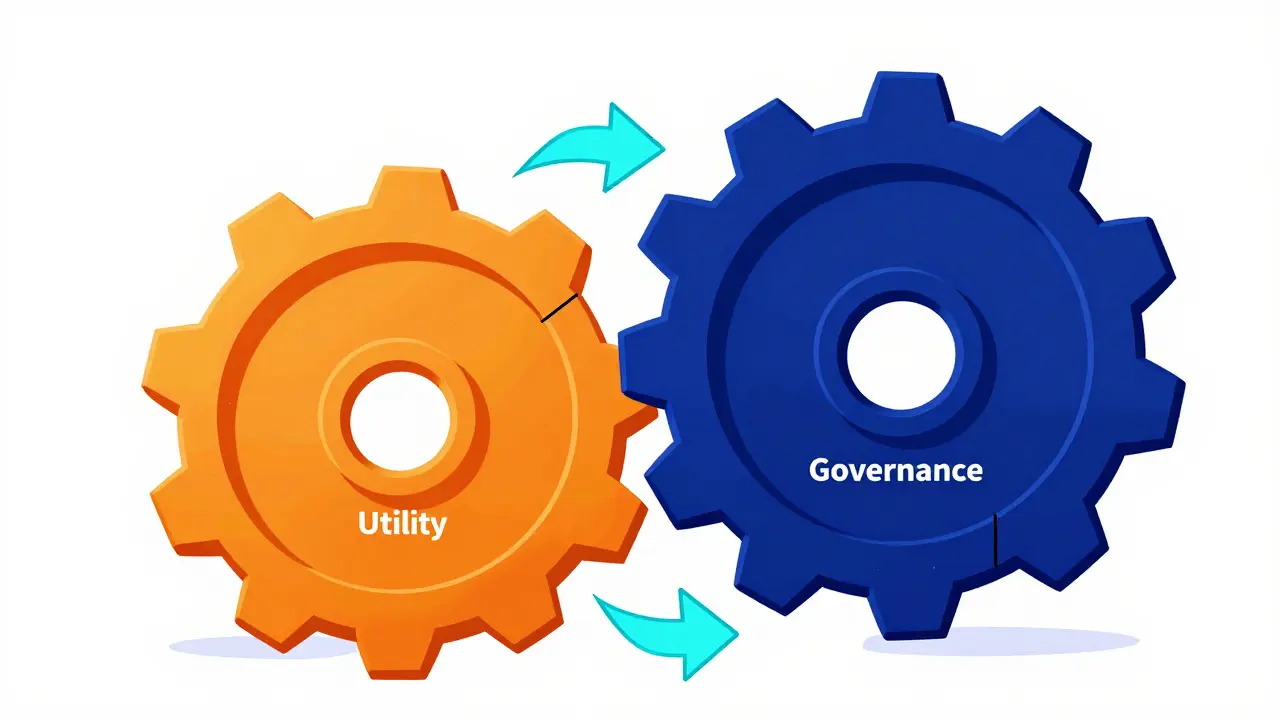
Unlike many simple meme coins that rely solely on social media buzz, Kangal introduced a dual-token structure intended to create a circular economy. Understanding this distinction is crucial if you are evaluating its potential.
| Feature | KANGAL (Governance) | TEAK (Utility) |
|---|---|---|
| Primary Role | Voting rights in the DAO; store of value | Fuel for dApps; rewards for staking |
| Supply Model | Fixed at 100 billion units | Minted dynamically via staking KANGAL |
| Inflation | None (deflationary pressure possible) | High (depends on staking activity) |
| Use Case | Govern proposals, treasury decisions | Paid for by dApps, burned or generated by apps |
Here is how the logic flows: You hold KANGAL to vote on the future of the platform. If you want to participate actively or earn rewards, you stake your KANGAL tokens. This staking process mints TEAK tokens. The idea was that developers would build applications (like NFT marketplaces or games) that require users to spend TEAK. Some apps would burn TEAK, reducing supply, while others would generate profits in TEAK, which could then be redistributed. This creates a theoretical balance where KANGAL holders benefit from the growth of the TEAK economy.
In practice, however, the adoption of these dApps has been minimal. Without active developers building on the platform, the demand for TEAK remains low, which in turn reduces the incentive to stake KANGAL. This lack of network effect is the primary reason the token’s value has stagnated.
Market Reality in 2026: Liquidity and Price Action
If you check the charts for KANGAL today, July 2026, the picture is starkly different from the spring of 2021. The token hit an all-time high of approximately $0.0002421 in April 2021. Since then, it has suffered a drawdown of over 99%. As of late June 2026, the price hovers around $0.0000005446 per token.
The most critical metric to watch here isn't the price-it’s the volume. Daily trading volume for KANGAL is often less than $10 USD. To put that in perspective, if you tried to sell even a modest amount of tokens, you would likely crash the price due to slippage. The market capitalization sits between $50,000 and $95,000, ranking it outside the top 6,000 cryptocurrencies on major trackers like CoinGecko.
This extreme illiquidity makes KANGAL a dangerous asset for anyone looking for short-term gains. There are no major centralized exchanges (CEXs) like Binance or Coinbase listing it for direct fiat trading. Instead, it trades almost exclusively on decentralized exchanges (DEXs) like PancakeSwap on the BNB Smart Chain. This means you need a Web3 wallet, such as MetaMask, and native chain tokens (like BNB or ETH) to pay for gas fees, adding complexity and cost to any transaction.
Technical Infrastructure: Multi-Chain Presence
Despite its small size, Kangal is technically present on three major blockchain networks:
- Ethereum: The original home of the ERC-20 token contract. Most historical data and the core DAO governance logic reside here.
- BNB Smart Chain (BSC): Hosts the BEP-20 version of the token. This is currently the most active venue for trading due to lower transaction fees compared to Ethereum.
- Polygon: A Layer-2 scaling solution for Ethereum, offering fast and cheap transactions for holders who want to move assets without high gas costs.
This multi-chain strategy allows users flexibility, but it also fragments liquidity. Your tokens on Ethereum cannot be easily swapped on PancakeSwap without bridging them first. For a micro-cap project, managing three separate contracts and liquidity pools dilutes attention and resources. Furthermore, while the official site confirms presence on these chains, you may encounter derivative tokens or wrappers (such as a "KNGL" variant on Uniswap). Always verify the contract address against the official Kangal website to avoid scams.
Risks and Future Outlook
Let’s be direct about the risks. Quantitative prediction models from platforms like Bitget and CoinCodex classify KANGAL as bearish for 2026 and beyond. Some algorithms even project the price toward zero by 2027. Why? Because micro-cap tokens without sustained developer activity or institutional backing tend to fade away. The "meme" label sticks because, without a thriving dApp store, the token lacks fundamental utility.
However, the project hasn't disappeared. The official website was updated recently, reaffirming the roadmap for the dApp store and the role of TEAK. The DAO structure remains intact, meaning holders theoretically still have voting power. If the community can attract developers to build compelling applications that utilize TEAK, the ecosystem could revive. But this requires significant effort and marketing in a crowded market dominated by larger DeFi protocols.
For the average investor, KANGAL represents a high-risk speculative asset. It is not suitable for those seeking stability or steady returns. It is best viewed as a niche collectible for those deeply interested in the history of 2021 DeFi experiments or willing to bet on a long-shot community revival.
Is Kangal (KANGAL) a good investment in 2026?
For most investors, KANGAL carries extremely high risk. With daily trading volumes often under $10 and a market cap below $100,000, liquidity is dangerously low. Selling large amounts could drastically drop the price. Prediction models suggest a continued downward trend. Only consider it if you fully understand the risks of micro-cap, illiquid assets and are prepared to lose the entire investment.
What is the difference between KANGAL and TEAK?
KANGAL is the fixed-supply governance token used for voting in the DAO and storing value. TEAK is a utility token minted when you stake KANGAL. TEAK is intended to be used within the ecosystem's dApps (like games or NFT markets), creating a circular economy where TEAK is spent, burned, or earned.
Where can I buy KANGAL token?
KANGAL is primarily traded on decentralized exchanges (DEXs). The most active pair is on PancakeSwap (on BNB Smart Chain) and Uniswap (on Ethereum). You will need a Web3 wallet like MetaMask, along with BNB or ETH to pay for transaction fees. It is not listed on major centralized exchanges like Binance or Coinbase.
Is Kangal a scam?
Kangal launched with a fair-launch model and locked its liquidity for 10 years, which reduces the risk of a traditional "rug pull." However, the project has failed to achieve significant adoption or utility since its 2021 peak. While not necessarily a scam in the malicious sense, it is a high-risk asset with very low liquidity and limited real-world use case, making it prone to value erosion.
What is the total supply of KANGAL?
The total, maximum, and circulating supply of KANGAL is fixed at 100,000,000,000 (100 billion) tokens. No new KANGAL tokens can be mined or created, distinguishing it from inflationary tokens.
nancy jarecki
July 2, 2026 AT 07:04The sheer intellectual laziness displayed by the retail herd flocking to these micro-cap garbage tokens is truly disheartening. We are witnessing a classic case of liquidity fragmentation and tokenomic failure, where the dual-token structure serves only to obfuscate the lack of fundamental utility. The TEAK/KANGAL model is a textbook example of pseudo-decentralized governance that fails to create any actual network effects, resulting in a death spiral of value erosion. It is pathetic that people still believe in 'fair launches' when the market clearly dictates that venture-backed projects with institutional oversight are the only viable path forward in this ecosystem.
Sajjad Ghorbani Moghaddam
July 2, 2026 AT 18:32I get why people look at it, but you gotta be careful with the liquidity situation. If you're thinking about dipping your toes in, just remember that selling even a small amount could crash the price because there's barely anyone trading. It's more of a history lesson now than an investment opportunity for most folks.
Robert Hundley
July 3, 2026 AT 19:37lol imagine holding this in 2026 :D
the charts are literally flatlining! who has time for this stuff when real gems are pumping? stay woke fam!! (y)
Melissa L
July 4, 2026 AT 13:16i dont get why ppl still care about this dog coin lol its been dead for years
Rob Morton
July 5, 2026 AT 12:59There is something deeply philosophical about the lifecycle of a meme coin. It begins with hope, driven by the collective imagination of a community, and ends in silence, governed only by the cold mathematics of supply and demand. Kangal represents a frozen moment in time, a relic of 2021 optimism that never quite evolved into tangible utility. Perhaps we should view it not as a failed investment, but as a monument to the transient nature of digital hype.
Carl Belgrave
July 5, 2026 AT 23:25This is exactly what happens when you let unregulated crypto scams run wild instead of sticking to proven American financial institutions. These foreign-coded tokens are a drain on our economy and a playground for fraudsters. Real wealth is built on hard work and stable assets, not gambling on dog-themed coins from overseas. Wake up and support legitimate markets!
Carl Hanzel
July 6, 2026 AT 16:01You all are missing the point entirely. Kangal isn't failing; it's succeeding in exposing the incompetence of every other project out there. While everyone chases the next shiny object, Kangal sits there, immutable and stoic, mocking your desperate need for gains. It is the ultimate contrarian play. Buy the dip? No, buy the despair. That is where the true alpha lies for those brave enough to hold against the tide of mediocrity.
Daniel J. Cox
July 6, 2026 AT 21:49It's funny how the name comes from the Turkish Kangal dog, right? Those dogs are super protective and loyal. In a way, the token kind of stuck around like a good guard dog, even if there's nothing left to protect anymore. I respect the cultural nod, even if the tech didn't follow through. 🐕
Emma Rémond
July 7, 2026 AT 20:52The asymmetry of risk here is absolutely abysmal. To engage with such a low-liquidity asset is to demonstrate a profound misunderstanding of basic market microstructure theory. The slippage alone would render any arbitrage strategy futile, and the gas costs on Ethereum merely exacerbate the inefficiency. One must question the cognitive framework of individuals who allocate capital to assets with sub-$10 daily volume. It is not investing; it is donation.
ELNORA JEFFERSON
July 9, 2026 AT 08:00ugh another article about dead coins. i am so tired of reading about projects that peaked in 2021. can we please focus on things that actually matter? this is just noise and clutter. boring.
Carol @minaszilda
July 9, 2026 AT 15:11Let's take a breath and remember that not every experiment needs to succeed to be valuable. Kangal taught us about fair launches and DAOs, even if it didn't last. Be kind to yourself if you held some. Learn, grow, and move forward with hope.
John Curry
July 9, 2026 AT 22:22Oh, the tragedy of it all! A once-promising guardian reduced to a ghost in the machine. It is a dramatic fall from grace, really. The silence of the charts speaks volumes about the fleeting nature of digital dreams. What a spectacle of decay.
Trent Erman1
July 10, 2026 AT 09:52Hey everyone! Just wanted to drop some knowledge bombs here 💥
So, if you're curious about the TEAK token, remember it's minted when you stake KANGAL. But since no one is using the dApps, TEAK isn't doing much. It's a cool concept in theory, but execution is key! Don't let this discourage you from learning about DeFi though. Keep exploring and stay awesome! 🚀🔥
Routh Middaugh
July 11, 2026 AT 22:03I think we should all try to find peace in this chaos, don't you agree? The market goes up, the market goes down, but life continues, doesn't it? Maybe Kangal is just resting, waiting for the right moment to shine again, or maybe it's gone forever, who knows? Let's just be open-minded and supportive of each other, regardless of our portfolio performance, yes?