What is teleBTC (TELEBTC)? A Warning About This Wrapped Bitcoin Token
 Jun, 1 2026
Imagine finding a coin that claims to be backed by Bitcoin but trades at twice the price. It sounds like a golden ticket, right? Or maybe it sounds like a trap. That is exactly the situation with teleBTC (TELEBTC), a cryptocurrency that has raised more red flags than green lights since its inception.
You might have seen TELEBTC listed on tracking sites or heard whispers about "trustless wrapped Bitcoin." The promise is appealing: take your Bitcoin and use it on other blockchains like Polygon without trusting a central company. But when you look under the hood, things get messy. As of late 2025, this token ranks outside the top 9,000 projects by market cap, with data so contradictory it defies basic math. Before you think about buying even a fraction of a cent worth, let’s break down what teleBTC actually is, why the numbers don’t add up, and whether it’s safe for your wallet.
The Promise vs. The Reality of teleBTC
To understand teleBTC, you first need to know what "wrapped Bitcoin" means. Normally, Bitcoin lives only on the Bitcoin network. If you want to use it in decentralized finance (DeFi) apps on Ethereum or Polygon, you need a wrapper. Think of it like putting cash into a secure box that prints a receipt. You trade the receipt, not the cash. When you’re done, you burn the receipt to get your cash back.
teleBTC was introduced as a fully decentralized protocol designed to wrap Bitcoin on programmable blockchains using over-collateralized security mechanisms. The concept came from an academic paper published on arXiv in July 2023 titled "TeleBTC: Trustless Wrapped Bitcoin." The authors aimed to solve a big problem in crypto: trust. Most wrapped Bitcoin tokens, like WBTC, rely on custodians-companies that hold the real Bitcoin. If those companies go bankrupt or act shady, you lose your money. TeleBTC promised to remove that middleman entirely.
However, there is a massive gap between an academic paper and a working product. While the theory sounds solid, the execution appears lacking. Unlike established players such as Wrapped Bitcoin (WBTC), which processes billions in daily volume and maintains strict 1:1 parity with Bitcoin’s price, teleBTC shows signs of being non-functional or severely illiquid.
| Feature | teleBTC (TELEBTC) | WBTC (Wrapped Bitcoin) | sBTC (StakeStone BTC) |
|---|---|---|---|
| Launch Date | 2023 (Paper) / 2024+ (Token) | 2019 | 2021 |
| Market Cap Rank | #9,549+ | Top 25 | Top 200 |
| Price Parity | ~$120,000 (Anomalous) | 1:1 with BTC | 1:1 with BTC |
| Daily Volume | $26 - $800k (Inconsistent) | $1.2 Billion+ | $50 Million+ |
| Audits | None Publicly Verified | 7+ Audits | Multiple Audits |
The Math Doesn't Add Up: Pricing Anomalies
Here is where you should stop and pay attention. In a healthy wrapped asset market, the price of the wrapped token must match the underlying asset. If Bitcoin is trading at $60,000, one unit of WBTC should also be worth roughly $60,000. If it’s worth $60,001, arbitrageurs will buy the cheap one and sell the expensive one until prices equalize.
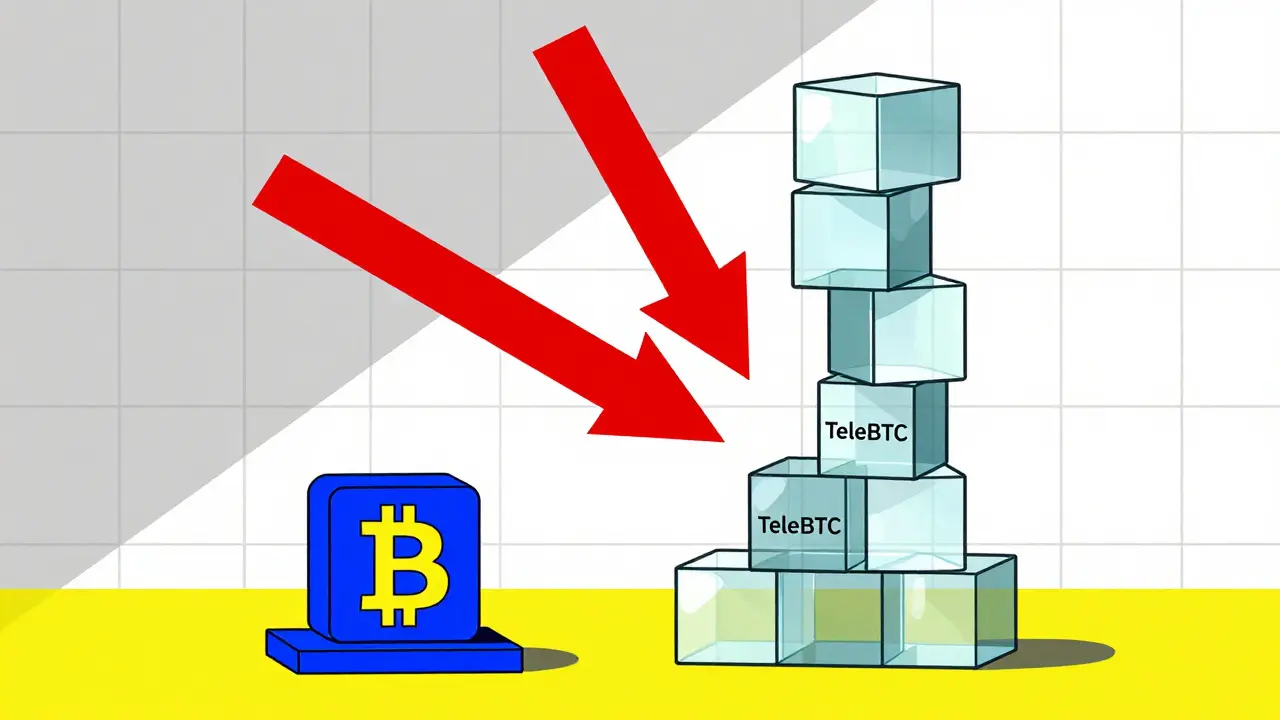
TeleBTC breaks this rule completely. Data from October 2025 showed teleBTC trading between $115,000 and $122,000 per token. At the same time, Bitcoin was hovering around $60,000. Why would anyone pay double for a "wrapped" version of Bitcoin? They wouldn’t. This suggests one of three things:
- Extreme Illiquidity: There are almost no buyers or sellers. A single small trade could swing the price wildly.
- Data Errors: Tracking platforms might be misreading the token’s decimals or supply.
- Manipulation: The price is artificially inflated to make the project look valuable.
Adding to the confusion, some trackers reported a market capitalization of $0.00 for teleBTC despite listing a high per-token price. Market cap equals price times circulating supply. If the market cap is zero but the price is $120,000, the circulating supply must be effectively zero. You can’t really buy or sell anything if there’s nothing out there to trade.
Technical Red Flags and Security Concerns
Let’s talk about where the code lives. According to blockchain explorers, the teleBTC contract operates on the Binance Smart Chain (BSC) at address 0xC58C1117DA964aEbe91fEF88f6f5703e79bdA574. However, the original whitepaper mentioned integration with Polygon. This discrepancy alone is worrying. Is it on BSC? Polygon? Both? Neither?
More importantly, look at the development activity. The GitHub repository associated with the project hasn’t seen a commit since August 2023. In the fast-moving world of crypto, silence for two years usually means abandonment. Legitimate projects update their code constantly to fix bugs, improve security, and adapt to new standards.
Security audits are another missing piece. Reputable wrapped assets undergo rigorous testing by firms like CertiK or OpenZeppelin. These audits check for vulnerabilities that hackers could exploit to steal funds. TeleBTC has no public record of such audits. Without them, you are trusting unknown developers with your assets-a dangerous game.
"Tokens showing price/BTC parity deviations exceeding 5% with less than $100k daily volume typically indicate either honeypot contracts or abandoned projects," noted Wendy O'Connell of Arcane Research in her September 2025 report.
This quote sums up the risk perfectly. TeleBTC fits this description exactly. High price deviation, low volume, and no active development.
User Experience: What Happens When You Try to Use It?
If you ignore the warnings and try to interact with teleBTC, what happens? User reports from CoinGecko and Reddit tell a grim story. One user, "DeFiNewbie," reported trying to swap a tiny amount of BNB for teleBTC and failing repeatedly. Another user, "CryptoWatcher42," commented that the price chart looked manipulated.
There is no official documentation, no active Discord server, and no Telegram channel where you can ask questions. If you get stuck, you’re on your own. Compare this to WBTC, which has extensive guides, customer support, and integration with major exchanges like Coinbase and Binance. TeleBTC exists in a vacuum.
Furthermore, the token isn’t listed on any major centralized exchange. You can’t just log in to Kraken and buy it. You’d have to navigate decentralized exchanges (DEXs) with thin liquidity pools. This increases the chance of slippage-where you end up paying much more than expected-or getting scammed by fake tokens with similar names.

Regulatory Risks and Future Outlook
The regulatory landscape for crypto is tightening. In July 2025, the SEC issued guidance stating that any token claiming Bitcoin backing must maintain transparent reserves and 1:1 redeemability. TeleBTC fails both tests. Its opaque reserve structure and bizarre pricing model put it squarely in the crosshairs of regulators.
Institutional investors avoid tokens like teleBTC because they lack custody solutions. Firms like Fidelity Digital Assets and Coinbase Custody won’t touch unverified, illiquid assets. Without institutional support, the token remains isolated from the broader financial ecosystem.
Looking ahead, the wrapped Bitcoin sector is consolidating around proven standards. Projects using Inter-Blockchain Communication (IBC) protocols are gaining traction. TeleBTC shows no sign of adopting these modern standards. Its roadmap, outlined in the 2023 paper, mentions multi-chain expansion and governance features, none of which have been implemented.
Is teleBTC Worth Your Time?
Let’s be direct. Based on available data as of late 2025, teleBTC does not appear to be a functional or safe investment. It violates basic economic principles of wrapped assets, lacks security audits, has no active development, and offers no user support. The extreme price anomalies suggest it may be a honeypot-a contract designed to let you buy in but not sell out-or simply an abandoned experiment mistakenly listed on tracking sites.
If you are looking to use Bitcoin in DeFi, stick to established options like WBTC, renBTC, or native solutions on Layer 2 networks. They offer liquidity, security, and transparency. Chasing obscure tokens with mysterious pricing models is a quick way to lose money.
Why is teleBTC priced higher than actual Bitcoin?
The price discrepancy is likely due to extreme illiquidity, data reporting errors, or market manipulation. In a healthy market, wrapped assets trade at parity with the underlying asset. TeleBTC’s lack of trading volume allows small trades to skew prices drastically, creating artificial highs that do not reflect true value.
Can I trust teleBTC with my funds?
No. TeleBTC lacks third-party security audits, has inactive development repositories, and shows no evidence of transparent reserves. These factors classify it as extremely high-risk. Users have reported failed transactions and inability to sell tokens, suggesting potential honeypot mechanics.
Where can I buy teleBTC?
TeleBTC is not listed on major centralized exchanges like Binance or Coinbase. It may appear on some decentralized exchanges (DEXs) on the Binance Smart Chain, but liquidity is negligible. Attempting to trade it carries significant risk of loss due to slippage and potential contract issues.
How does teleBTC compare to WBTC?
WBTC is a mature, widely adopted wrapped Bitcoin token with billions in daily volume, multiple security audits, and institutional custody support. TeleBTC is an obscure, illiquid token with no audits, inactive development, and anomalous pricing. WBTC is suitable for serious DeFi use; teleBTC is not.
Is teleBTC a scam?
While we cannot definitively label it a scam without legal proof, teleBTC exhibits many characteristics of fraudulent or abandoned projects. These include impossible pricing, lack of transparency, no community support, and failure to deliver on its technical promises. Treat it with extreme caution.